Biomass and coal boilers are often discussed as if the only difference were the fuel price. In practice the decisive differences are physical: ash content and ash melting behaviour, fuel moisture, volatile matter, particle size, and the conveying and metering behaviour of the fuel. These properties determine grate design, furnace volume, air distribution, ash removal equipment and the practical turn-down range. This article compares the two fuel families on those engineering terms and explains what drives capital and operating cost, without quoting prices, since those depend on capacity, pressure, site conditions and local supply chains.
Ash content and ash chemistry
Typical bituminous steam coal contains roughly 8–15% ash by mass (as received), while woody biomass pellets usually contain 0.5–3% and agricultural residues such as straw, husk or bagasse can contain 3–12%. Lower ash mass sounds easier, but ash chemistry matters more than ash quantity. Coal ash is dominated by silica, alumina and iron oxides with relatively high ash fusion temperatures. Many biomass ashes are rich in potassium, sodium, calcium and chlorine, which lowers the softening temperature of the ash.
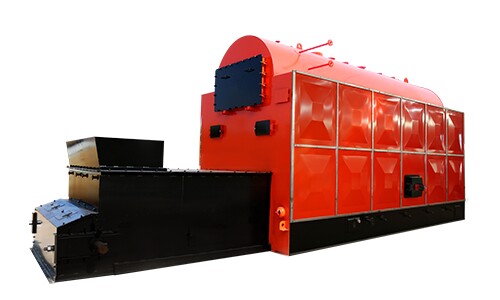
For a grate-fired unit, the practical consequence is that a biomass fuel with a low ash softening temperature can slag on the grate even at moderate furnace temperatures. Designers respond with lower grate heat release rates, staged air, water-cooled or air-cooled grate bars, and sometimes fuel blending or additives. A coal boiler sized for 1.2–1.5 MW/m² of grate area may need a larger grate for a high-potassium biomass fuel to keep the ash below its softening range. Ash quantity also sets the ash removal system: a coal unit at 12% ash and 5 t/h fuel input produces about 600 kg/h of ash, whereas a wood pellet unit at 1% ash on the same fuel input produces about 50 kg/h.
Moisture and its effect on furnace and efficiency
Moisture is the single largest driver of biomass boiler sizing. Coal is normally fired at 8–12% moisture (as received). Wood chips are commonly delivered at 30–50% moisture, and bark or wet sawdust can exceed 55%. Every kilogram of water in the fuel consumes heat to evaporate and superheat the vapour, so the useful heat release per kilogram of fuel falls sharply.
As a rule of thumb, raising fuel moisture by 10 percentage points reduces the net calorific value by roughly 0.8–1.0 MJ/kg and increases flue gas volume and stack loss. A biomass boiler designed for 35% moisture fuel will not reach its rated output on 50% moisture fuel without derating, and a coal boiler cannot simply be switched to wet biomass without losing capacity and risking incomplete combustion. Flue gas dew point also rises with moisture and chlorine content, so the minimum metal temperature at the cold end of the boiler must be set accordingly to avoid condensation and corrosion.
Grate design and combustion air
Coal firing on a travelling grate relies on a relatively stable fuel bed with limited volatiles release in the first zone. Biomass has high volatile matter, often 70–80% on a dry ash-free basis, which releases rapidly and needs a large furnace volume and well-staged overfire air to complete combustion. Under-grate air must be controlled zone by zone, and grate speed must match the fuel’s burning profile.
Common grate choices for biomass are inclined reciprocating grates, vibrating grates and, for pellets and dry fuels, travelling grates. For high-moisture fuels, a water-cooled grate protects the bars and reduces slag adhesion. Fluidised bed designs tolerate wider fuel variation and lower-grade fuels but have higher auxiliary power demand and more complex ash handling. The table below summarises typical design values; these are indicative ranges for grate-fired industrial boilers and must be confirmed by fuel testing.
| Parameter | Bituminous coal | Wood pellets | Wood chips (35–45% M) | Agri residue (indicative) |
|---|---|---|---|---|
| Moisture, as received (% mass) | 8–12 | 6–10 | 35–45 | 10–20 |
| Ash, as received (% mass) | 8–15 | 0.5–2 | 1–3 | 3–12 |
| Net calorific value (MJ/kg, ar) | 22–27 | 16–18 | 9–12 | 12–15 |
| Volatile matter (% daf) | 20–35 | 75–82 | 75–80 | 65–75 |
| Grate heat release (MW/m²) | 1.2–1.6 | 1.0–1.4 | 0.8–1.2 | 0.7–1.1 |
| Furnace volume release (kW/m³) | 150–250 | 120–200 | 100–180 | 90–160 |
| Excess air (typical, %) | 20–30 | 25–40 | 30–45 | 30–45 |
Assumptions: values are typical ranges for industrial grate-fired boilers in the 5–50 t/h range, referenced to fuel as received; actual design must use a laboratory fuel analysis and site altitude and ambient conditions.
Fuel handling and storage
Coal is dense, free-flowing and can be stored in silos or open stockpiles with simple belt or screw conveying. Biomass is bulky, fibrous and prone to bridging, rat-holing and dust explosion in the case of dry pellets. Wood chips require walking-floor silos, push-rod or hydraulic dischargers, and conveying equipment sized for a low bulk density of roughly 200–350 kg/m³ for chips versus 800–900 kg/m³ for coal. This means a biomass boiler needs a much larger fuel yard and larger volumetric handling equipment for the same thermal input.
Fire and explosion protection, dust extraction and temperature monitoring in silos are standard requirements for dry biomass. Coal systems need attention to spontaneous heating in stockpiles and to dust control. In both cases, fuel receiving, screening and foreign-object removal protect the grate and the ash removal system.
Emissions and fuel price sensitivity
Coal firing produces higher SO₂ and particulate matter for a given heat input, and biomass firing produces lower SO₂ but can produce higher alkali and chloride-related aerosol emissions. NOx control on both fuel types relies on air staging, flue gas recirculation and, where required, selective non-catalytic reduction. Ash utilisation differs: coal ash is often used in construction materials, while biomass ash is frequently returned to land or landfilled depending on local rules and heavy-metal content.
On economics, coal has high energy density and a globally traded price, so fuel cost per GJ is relatively stable but exposed to carbon pricing and transport distance. Biomass cost per GJ is dominated by local logistics: moisture, bulk density and haul distance. A fuel that is cheap at the gate can become expensive per useful GJ if moisture is high and the boiler must be derated. The key comparison is cost per delivered GJ at the boiler inlet, adjusted for boiler efficiency at the actual fuel moisture, plus ash disposal and handling labour. For capacity and cost structure, see our capacity and cost guide and the product range.
Selection checklist
- Obtain a laboratory fuel analysis: moisture, ash, volatiles, net calorific value, ash fusion temperature, chlorine and sulphur.
- Confirm the annual and seasonal fuel moisture range, not just the average.
- Check ash softening temperature against planned grate heat release rate.
- Size the fuel yard for bulk density and storage days, including fire protection.
- Define the required turn-down ratio and load profile.
- Confirm emission limits for NOx, SO₂, particulate and, if applicable, HCl.
- Plan ash removal, storage and disposal or reuse route.
- Evaluate cost per delivered GJ at the boiler inlet, not per tonne.
What to send us for a proposal
To prepare a technical and commercial proposal we need: required steam or hot water capacity and pressure/temperature; expected annual operating hours and load profile; fuel type, source and distance; a fuel analysis with moisture and ash fusion data; site altitude and ambient conditions; emission limits; available fuel storage area; and any constraints on ash disposal. With these inputs we can propose a grate and furnace configuration matched to your fuel and explain the cost drivers clearly.