
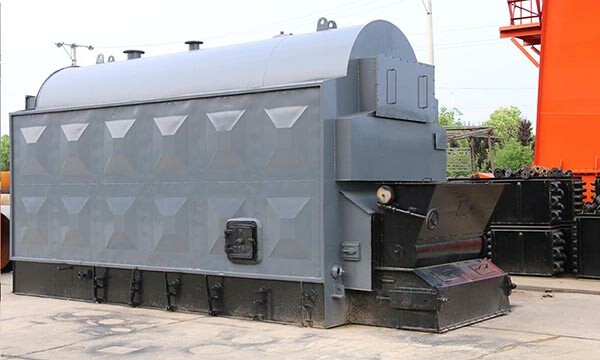
0.5-4 t/h
Horizontal Hand-Fired Biomass Boiler, 0.5-4 t/h
Batch-fired horizontal biomass boiler for wood, sawdust, rice husk and agro-residue, 0.5-4 t/h, manual firing door, natural or for...
View detailsSmall coal or biomass bathhouse boiler, 70-700 kW, with secondary-air smokeless combustion and an integrated hot water tank for rural and township baths.
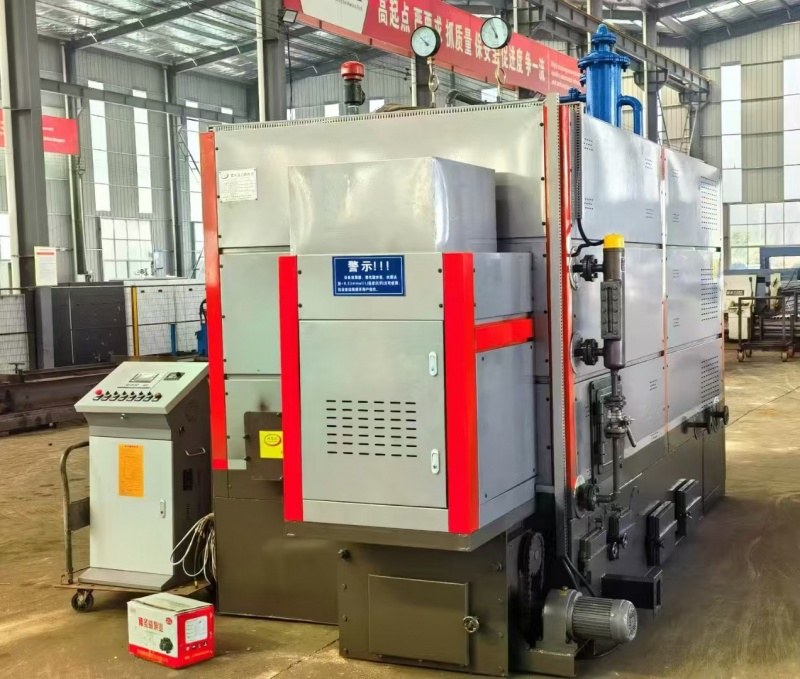
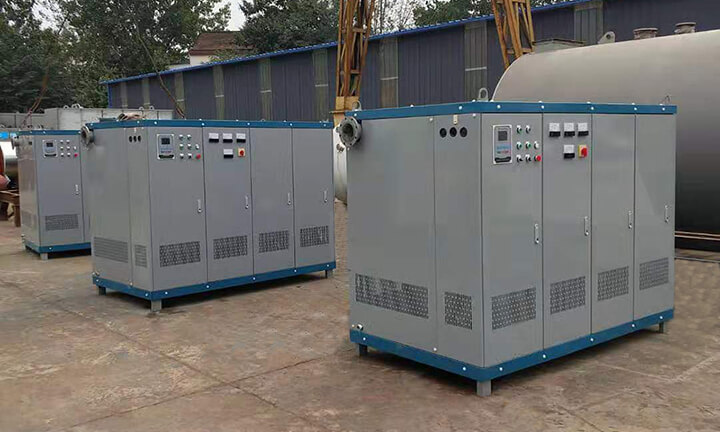
In a rural or township bathhouse the boiler is the business. It heats a tank of water to 45-50 °C for baths and showers, usually with a space-heating circuit for winter. The traditional unit is a small horizontal or vertical shell, 70 to 700 kW, firing coal or biomass on a fixed grate, with a hot water tank welded on or standing beside it. The smokeless variant adds secondary air above the bed and, in better designs, a settling chamber and a longer gas path, so volatiles distilled from fresh coal burn above the bed instead of leaving as black smoke.
The range matches a real spread of establishments: 70 kW for a village bathhouse with four to six showers, 700 kW for a township bathhouse with forty to fifty outlets, a sauna and a heating load. Most units sold sit between 140 and 420 kW, and most are bought on tank size rather than boiler rating, which is why the two have to be sized together.
Bituminous coal releases 20 to 30 per cent of its mass as volatile matter when it first heats. In a simple grate boiler those volatiles cross a cool zone above the bed and leave as visible smoke, which is where most of the black plume and much of the unburnt loss come from. Secondary air through nozzles in the arch, at 20 to 30 per cent of total air and real velocity, burns them in the freeboard; with the arch at 900 °C or more the plume goes from black to a faint haze within minutes of stoking.
The claim should be read for what it is. Smokeless means no visible black smoke in normal operation, not low emissions; particulate, sulphur dioxide and nitrogen oxides are unchanged in kind and only modestly reduced. That distinction matters when the unit is bought against an air-quality rule rather than a neighbour’s complaint.
The integrated tank is the practical heart of the design. A 280 kW unit with a 2 m³ tank heats the store overnight and holds 45 °C water for the morning opening without the fire at full output, and it buffers the stoking cycle so the temperature does not swing with every charge. Sizing at 1.5 to 2 litres per kW is a reasonable rule, and a larger tank is usually better value than a larger firebox.
Coal consumption is the number the owner watches: about 1 kg of 22 MJ/kg coal per bather, for 100 litres heated from 10 to 45 °C at 70 per cent efficiency. A 200-bather day is 200 kg of coal, 30 to 50 kg of ash and clinker, and two stoking rounds. Ash goes to a pit, is quenched and spread or carted away; a bathhouse without an ash plan has a dust problem by its second season.
With secondary air and a settling chamber, a well-run unit emits 150 to 300 mg/Nm³ of particulate at 9 per cent oxygen, 400 to 800 mg/Nm³ of sulphur dioxide from coal at 0.5 to 1 per cent sulphur, and 150 to 250 mg/Nm³ of nitrogen oxides. Without secondary air and with a short gas path, particulate rises to 500 to 1,000 mg/Nm³. Many townships now restrict new coal-fired bathhouse boilers inside a defined zone, so the practical life of a new coal unit is the life of the enforcement gap rather than the life of the steel.
Efficiency is honest at 68 to 75 per cent, with losses in unburnt carbon, excess air through a hand-stoked bed, and flue gas at 250-300 °C. Against a gas boiler at 96 per cent the fuel penalty is large, which is why the running-cost argument only favours coal where delivered coal is very cheap and the labour is unpaid family work.
Where a gas main reaches the site, a 0.35 to 0.7 MW condensing boiler replaces the coal unit in a day, with no ash handling, no fuel store and no fireman, at 96 to 98 per cent. Running cost depends on the gas price against coal delivered to the door, and in most townships where these units stand the gap has closed enough that the labour saving decides it.
Without a main, LPG works to about 200 kW but becomes awkward above that. Electricity is the other route: 700 kW draws about 715 kW and needs a dedicated transformer of roughly 750 kVA. The honest recommendation for most existing bathhouses is gas where the main exists, and a retained coal or biomass unit with secondary air and a taller stack where it does not, on the clear understanding that the second option is on borrowed time.
It removes visible black smoke in normal operation by burning volatiles above the bed with secondary air. It does not remove particulate, sulphur dioxide or nitrogen oxides, so it is not a low-emission appliance and should not be presented as one to a regulator.
Yes, with a different grate and air setting, and usually at a derated output because biomass is bulkier and has a lower calorific value per unit volume. A unit bought for coal and switched to wet wood will lose 20 to 30 per cent of its rated output and smoke badly.
A new burner, gas train and flue, a replacement boiler body in most cases, and the removal of the fuel store and ash pit. The tank, circulating pump and heating circuit can often be retained, which is why the changeover is usually a one-day job rather than a building project.
| Size class | 70 kW | 140 kW | 280 kW | 420 kW | 700 kW |
|---|---|---|---|---|---|
| Heat output | 70 kW | 140 kW | 280 kW | 420 kW | 700 kW |
| Integrated tank | 0.5 m³ | 1 m³ | 2 m³ | 3 m³ | 5 m³ |
| Coal burn at 70% | 23 kg/h | 47 kg/h | 93 kg/h | 140 kg/h | 233 kg/h |
| Bath outlets served | 4-6 | 8-12 | 15-25 | 25-35 | 40-50 |
0.5-4 t/h
Batch-fired horizontal biomass boiler for wood, sawdust, rice husk and agro-residue, 0.5-4 t/h, manual firing door, natural or for...
View details
0.2-2 t/h
Horizontal coil steam generator, 0.2-2 t/h at 0.4-1.0 MPa, fired on pellets, sawdust or rice husk, with under 30 litres of water a...
View details
0.7-14 MW hot water
A hot water boiler package for greenhouse horticulture, sized 0.7-14 MW and delivering low-grade heat at 60-90 °C for root-zone he...
View detailsExternal links open the publisher’s website and are provided for background reading.
Include the capacity (t/h or MW), fuel, working pressure and site country so the proposal matches your permit limits.
We appoint one or two partners per country to quote, deliver and service our boilers locally. Territory protection, factory pricing and commissioning support are part of the agreement.