
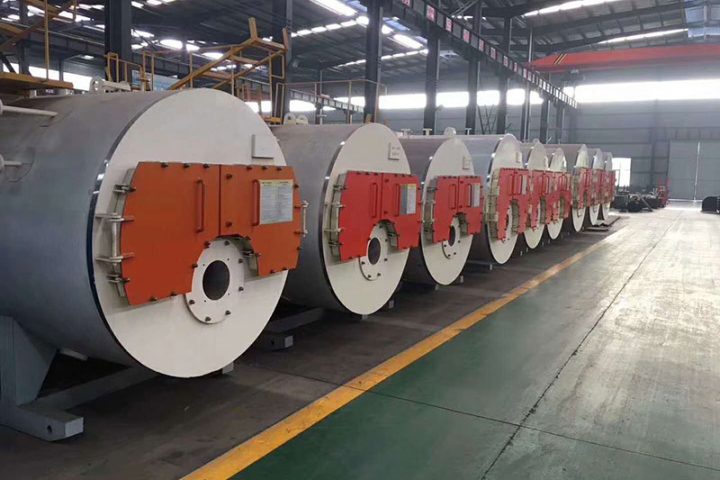
0.7-14 MW hot water
Hot Water Boiler Package for Greenhouse Horticulture
A hot water boiler package for greenhouse horticulture, sized 0.7-14 MW and delivering low-grade heat at 60-90 °C for root-zone he...
View detailsHorizontal coil steam generator, 0.2-2 t/h at 0.4-1.0 MPa, fired on pellets, sawdust or rice husk, with under 30 litres of water and a five-minute cold start.
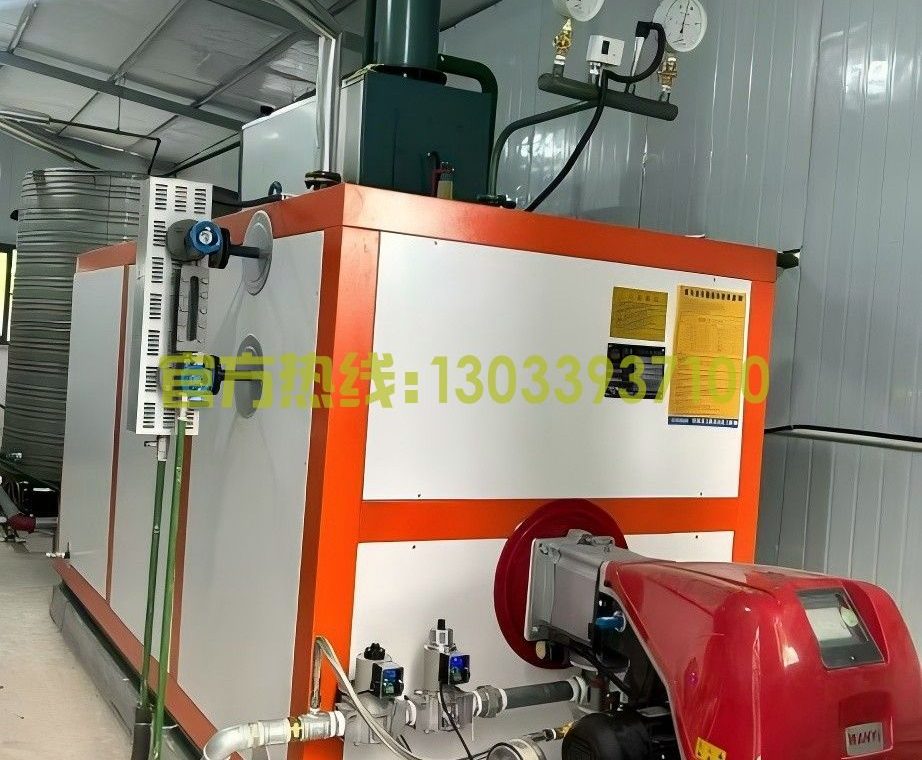
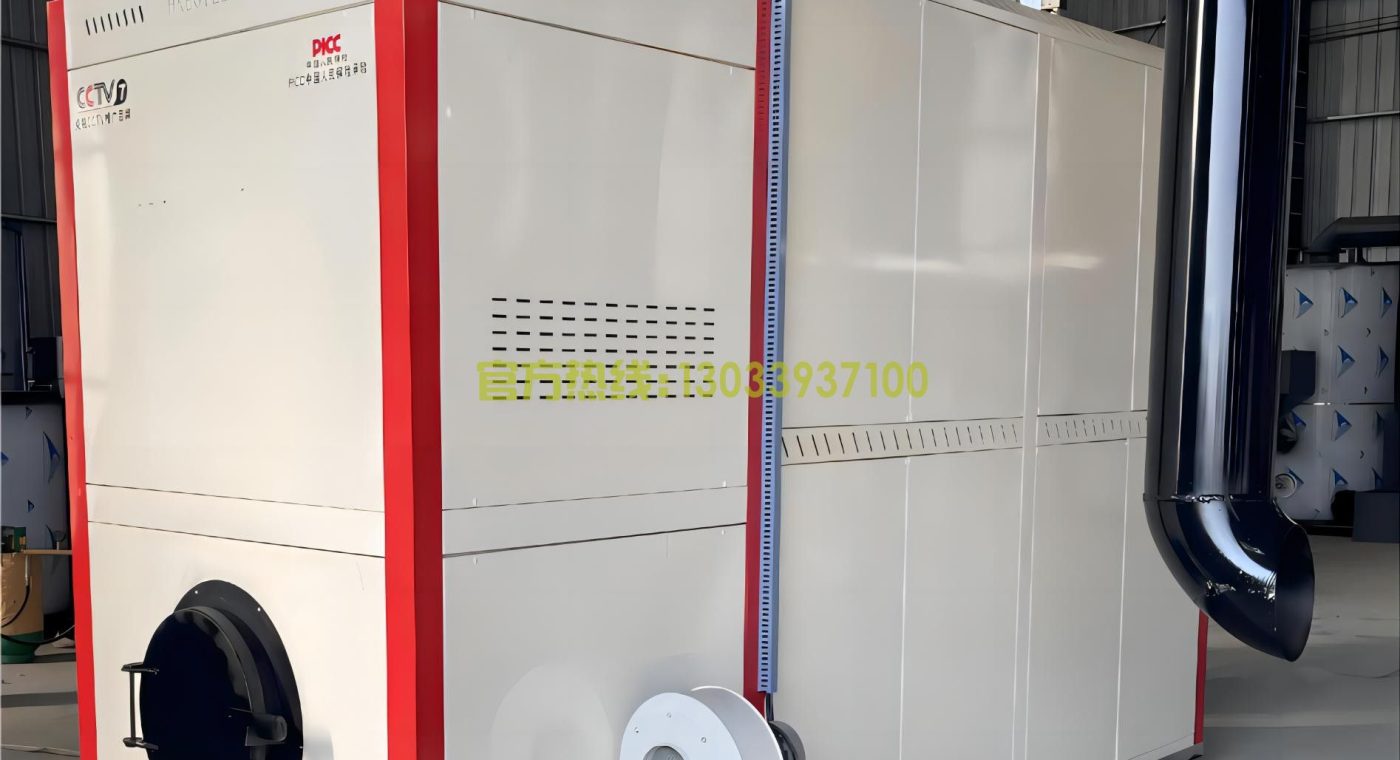
The horizontal biomass steam generator is a packaged unit for 0.2 to 2 t/h of saturated steam at 0.4 to 1.0 MPa, 151 to 184 °C. Feedwater is forced through a multi-pass coil that forms the heating surface, inside an insulated casing with the firing at the front. A 1 t/h unit occupies 2.6 m by 2.5 m and reaches working pressure in five to eight minutes, because there is no large body of water and no refractory mass to heat first.
Fuel arrives from a day silo by screw conveyor. Pellets of 6 to 10 mm are the easiest fuel and give the rated output; sawdust briquettes and dry chips run well on a modified grate; rice husk needs a deeper bed, more primary air and more ash space, and wears the feed screw because of its silica.
In China the distinction is written into TSG G0001-2012, which excludes a unit whose design normal water level volume is below 30 litres. A coil generator stays under that figure, so it is treated as a steam generator rather than a boiler, and the mandatory manufacturing inspection for boilers does not apply. The threshold is definitional and fixed by the drawings; the European pressure equipment directive, by contrast, governs the pressure part on its own terms rather than by water volume, and most countries decide boiler status from pressure, volume and heat input together. On an export project the classification follows the destination’s rules.
The technical consequence matters more than the paperwork. A 1 t/h shell boiler holds four to five cubic metres of water, roughly 3 GJ of stored heat, about a tonne of steam in reserve. A coil generator holds under 30 litres, some 20 MJ, less than 10 kg of steam. It follows the load instead of buffering it, which suits demand that moves over minutes but not a single user opening a large valve.
Because there is no reservoir, the feedwater system carries the control duty. A 200 kg/h step on a 1 t/h unit is a fifth of capacity, and pressure falls within seconds unless the feed pump and firing rate respond together. Keep any single user below a third of rated output, and fit a small accumulator where a press demands a sharp draw.
Water quality is the operating risk. Tubes are small, heat flux is high, and a millimetre of scale inside a 32 mm tube raises the wall temperature enough to shorten life sharply. Hardness should be held near 0.03 mmol/L, with a softener and polisher, dissolved oxygen controlled and a conductivity trip on the feed line. That is stricter than a shell boiler needs, and not optional.
On 4,500 kcal/kg pellets with an economiser, thermal efficiency is 88 to 92 per cent on lower calorific value, with flue gas at 160 to 190 °C and excess air at 1.4 to 1.6. On chips at 30 per cent moisture it falls to 84 to 88 per cent, because the water in the fuel has to be evaporated; every ten points of moisture above 12 per cent costs about 1.5 points.
The fuel arithmetic is easy to check against a quotation. One tonne of steam at 0.7 MPa absorbs about 2.7 GJ above 20 °C feedwater; at 90 per cent efficiency and 18.8 MJ/kg, a 1 t/h unit burns about 160 kg/h of pellets. Over 5,000 hours that is 800 tonnes a year, so a figure well below 160 kg/h implies a better fuel or an optimistic efficiency.
The fit is a small plant with a steady process load and cheap local fuel: a food plant blanching vegetables and running jacketed kettles, a laundry with presses and dryers, a feed mill conditioning mash, a furniture works drying timber. Ash handling belongs in the plan, since husk at 12 to 18 per cent ash leaves 20 to 30 kg/h at 1 t/h, and fly ash has to be drawn from the economiser hopper before it blinds the passes. The table gives size classes rather than catalogue models, because coil length and firing arrangement are set per fuel and site.
| Evaporation | Pressure | Steam temperature | Pellet consumption | Flue gas | Footprint L×W |
|---|---|---|---|---|---|
| 0.2 t/h | 0.4 MPa | 151 °C | 32 kg/h | 165 °C | 1.8×1.4 m |
| 0.5 t/h | 0.7 MPa | 170 °C | 80 kg/h | 175 °C | 2.2×1.8 m |
| 1 t/h | 0.7 MPa | 170 °C | 160 kg/h | 185 °C | 2.6×2.5 m |
| 2 t/h | 1.0 MPa | 184 °C | 320 kg/h | 195 °C | 3.4×2.8 m |
In China, a unit whose design normal water level volume is below 30 litres falls outside TSG G0001-2012 and is treated as a generator rather than a boiler. Other countries apply their own rules, so the exemption must be confirmed against the drawings and local regulations before it is relied on.
Yes, with a deeper grate, more primary air and a larger ash space. Husk carries 12 to 18 per cent ash, so the ash handling and the feed screw wear are the limiting factors rather than combustion.
The coil has small tubes and a high heat flux, so scale raises the wall temperature quickly. Hardness near 0.03 mmol/L, a polisher and a conductivity trip are needed; a shell boiler of the same output would tolerate far more.
| Rated evaporation | 0.2 t/h | 0.3 t/h | 0.5 t/h | 1 t/h | 1.5 t/h | 2 t/h |
|---|---|---|---|---|---|---|
| Rated pressure | 0.4 MPa | 0.4 MPa | 0.7 MPa | 0.7 MPa | 1.0 MPa | 1.0 MPa |
| Steam temperature | 151 °C | 151 °C | 170 °C | 170 °C | 184 °C | 184 °C |
| Pellet consumption | 32 kg/h | 48 kg/h | 80 kg/h | 160 kg/h | 240 kg/h | 320 kg/h |
| Flue gas temperature | 165 °C | 165 °C | 175 °C | 185 °C | 190 °C | 195 °C |
| Reference footprint L×W | 1800×1400 mm | 2000×1500 mm | 2200×1800 mm | 2600×2500 mm | 3000×2600 mm | 3400×2800 mm |
0.7-14 MW hot water
A hot water boiler package for greenhouse horticulture, sized 0.7-14 MW and delivering low-grade heat at 60-90 °C for root-zone he...
View details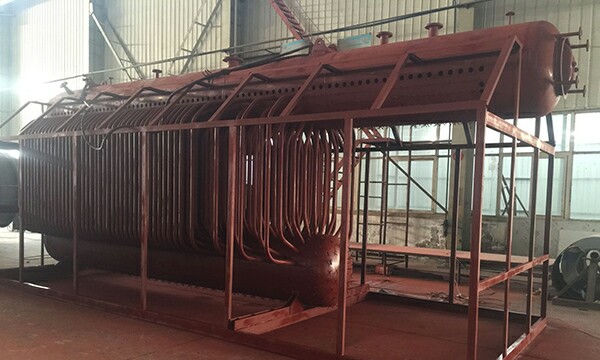
4-20 t/h (2 t/h model also built)
Double-drum water-tube biomass boiler, 4-20 t/h, shipped in two sections with membrane walls and an S-pass dust drop.
View details6 t/h
The SZL6-1.25-T delivers 6 t/h of steam at 1.25 MPa and 194 °C from biomass pellets, wood chips, rice husk or palm kernel shell, a...
View detailsExternal links open the publisher’s website and are provided for background reading.
Include the capacity (t/h or MW), fuel, working pressure and site country so the proposal matches your permit limits.
We appoint one or two partners per country to quote, deliver and service our boilers locally. Territory protection, factory pricing and commissioning support are part of the agreement.