
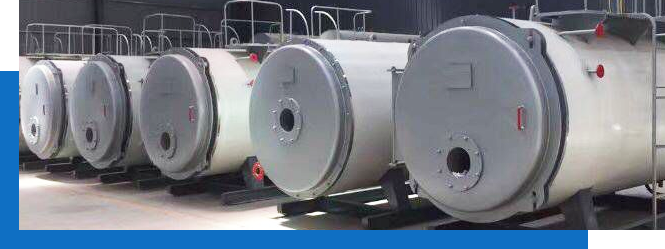
Industrial boiler
Pressure Vessels and Storage Tanks, D1/D2
Custom pressure vessels and storage tanks, 2-100 m³, in Q245R or Q345R, built under our D1/D2 licence with full NDT and hydrostati...
View detailsSteam accumulator, 5-80 m³, storing flash steam at 1.0-2.5 MPa so a boiler can run at steady load through sharp demand peaks.
A steam accumulator is a horizontal pressure vessel two-thirds full of saturated water. Charging steam from the boiler passes through a distributor at the bottom and condenses, heating the water and raising the vessel pressure. When a press, a batch cooker or a rolling mill opens a valve, the vessel pressure falls, the stored water flashes, and the released steam goes to the load. The boiler keeps running at its steady rating while the accumulator supplies the difference.
The value is in the shape of the load, not in its average. A plant that needs 4 t/h for twenty minutes every hour has an average demand of 1.3 t/h but a peak that would otherwise force a 4 t/h boiler, a 4 t/h feedwater train and a 4 t/h chimney. An accumulator sized for the peak lets a 1.5 t/h boiler run flat out all day, which is better for efficiency, emissions and equipment life.
The useful storage is the difference in sensible heat between the charged and discharged states, divided by the latent heat at the lower pressure. Take a vessel charged at 1.6 MPa and discharged to 0.5 MPa. Saturated water enthalpy falls from about 858 kJ/kg to 640 kJ/kg, and the latent heat at 0.5 MPa is about 2093 kJ/kg. Each kilogram of stored water therefore releases roughly 0.10 kg of steam.
A 40 m³ vessel holds about 23 t of water at two-thirds fill, so it can release roughly 2.4 t of steam during a drawdown — enough to carry a 3 t/h deficit for most of an hour while the boiler holds its steady output. The same arithmetic run at a smaller pressure band, say 1.0 to 0.7 MPa, gives only about 0.03 kg of steam per kilogram of water, which is why the charging pressure is set as high as the boiler and the process allow.
The shell and heads are built from Q245R for the lower pressure classes and Q345R where the wall thickness or the temperature demands it. Design pressure is chosen to match the boiler’s maximum working pressure, typically 1.0, 1.6 or 2.5 MPa, with a design temperature at the corresponding saturation point. Corrosion allowance is 2 mm for clean condensate systems and 3 mm where the water chemistry is less predictable or the vessel is expected to sit for long periods partly drained.
Internals matter as much as the plate. The charging steam enters through a perforated distributor or a set of sparger pipes arranged so that it condenses in the water rather than bursting through the surface. A cyclone or wire-mesh drier at the outlet keeps carry-over out of the steam main, and a baffle at the outlet prevents water slugs during a hard drawdown. The vessel is insulated with rock wool and clad, because a bare accumulator loses more heat than it stores in a day.
Each vessel is pressure-tested with water at 1.25 times its design pressure, held long enough for a full visual examination of every seam and nozzle connection. Longitudinal and circumferential welds are radiographed or ultrasonically checked to the extent its design category requires, and the procedure and welder qualifications are recorded against the vessel. Nozzle reinforcement is checked by calculation, and the finished vessel is stamped and documented before dispatch.
Manufacture is covered by our D1/D2 pressure vessel licence, which is the appropriate category for low and medium pressure vessels of this kind. Third-party inspection can be arranged where the client’s insurer or local authority requires it.
The accumulator is selected after the load duration curve, not before it. Plot steam demand against time for a representative week, identify the peak and its duration, and calculate the storage needed to bridge it at the boiler’s steady output. Then check the charging window: the boiler must have enough spare capacity between peaks to reheat the vessel, or the accumulator will be flat when the next peak arrives.
Where the peak is short and repeated, the accumulator often pays for itself against the capital cost of a larger boiler, a larger feedwater pump set and a taller flue. It also improves steam quality at the point of use, because the vessel acts as a separator and a buffer against pressure swings in the main.
Start from the load duration curve. The storage volume is the steam deficit during the peak divided by the flash fraction between charging and discharge pressure. Add 20 per cent margin, then confirm the boiler has enough spare capacity to recharge between peaks.
Yes, provided the boiler's maximum pressure is above the process pressure by enough to give a useful flash fraction. A 1.0 MPa boiler feeding a 0.4 MPa process gives a workable band; a 0.7 MPa boiler feeding 0.6 MPa does not.
The same as the boiler, since the stored water is boiler water. Softened, deaerated feed with the correct alkalinity keeps the corrosion allowance intact and prevents sludge accumulation at the bottom of the vessel.
| Nominal volume | 5 m³ | 15 m³ | 40 m³ | 80 m³ |
|---|---|---|---|---|
| Design pressure | 1.0 MPa | 1.6 MPa | 1.6 MPa | 2.5 MPa |
| Design temperature | 184 °C | 204 °C | 204 °C | 225 °C |
| Shell material | Q245R | Q245R | Q345R | Q345R |
| Corrosion allowance | 2 mm | 2 mm | 3 mm | 3 mm |
| Hydrostatic test | 1.25× design | 1.25× design | 1.25× design | 1.25× design |
| Insulation | 80 mm rock wool | 100 mm rock wool | 100 mm rock wool | 120 mm rock wool |
Industrial boiler
Custom pressure vessels and storage tanks, 2-100 m³, in Q245R or Q345R, built under our D1/D2 licence with full NDT and hydrostati...
View details
Industrial boiler
Shell-and-tube heat exchanger, 10-250 m², in Q245R or Q345R with 304/316 tubes, for steam, hot water and process duties.
View details
10-50 t/h feedwater
Tray-type thermal deaerator, 10-50 t/h, removing oxygen to below 15 ppb and heating feedwater to 104-105 °C before it reaches the...
View detailsExternal links open the publisher’s website and are provided for background reading.
Include the capacity (t/h or MW), fuel, working pressure and site country so the proposal matches your permit limits.
We appoint one or two partners per country to quote, deliver and service our boilers locally. Territory protection, factory pricing and commissioning support are part of the agreement.