
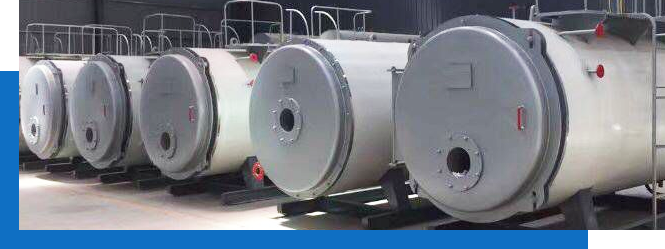
Industrial boiler
Steam Accumulator for Peak Load Shaving
Steam accumulator, 5-80 m³, storing flash steam at 1.0-2.5 MPa so a boiler can run at steady load through sharp demand peaks.
View detailsTray-type thermal deaerator, 10-50 t/h, removing oxygen to below 15 ppb and heating feedwater to 104-105 °C before it reaches the boiler.
Cold water straight from a softener is saturated with oxygen at about 8 mg/L. Feed that to a boiler and the oxygen comes out of solution at the hot surface, where it attacks the steel in small deep pits. The pits grow under deposits, are hard to find before failure, and are the most common cause of tube and shell penetration in plants that otherwise look well run. A deaerator removes the oxygen before it enters the boiler, and does it with steam that is already being paid for.
The same vessel heats the feedwater to 104-105 °C. That is not a side benefit: every 6 °C of feedwater temperature is worth roughly one per cent of fuel or electrical input, and the heat comes from low-pressure steam that would otherwise be vented or throttled.
Water enters at the top through spray nozzles that break it into fine droplets, then falls across a stack of stainless trays. Steam enters at the bottom and rises counter-current through the falling water. The water is heated to within a degree or two of saturation, and at that temperature the solubility of oxygen falls to nearly zero; the gas leaves with the small quantity of steam vented from the top.
The trays do the work. Each tray spreads the water into a thin film and re-mixes it, so the contact area is large and the path is long enough for the oxygen to diffuse out of the droplets. A spray-only deaerator is cheaper and shorter, but it struggles to reach 15 ppb; a tray stack reaches the target with a modest steam flow and tolerates load changes from 20 to 100 per cent.
The vessel runs at 0.02 to 0.05 MPa gauge, which fixes the saturation temperature at 104 to 105 °C. That is deliberately just above 100 °C: it keeps air from leaking in, gives the vent a positive flow, and stays below the limit where the feedwater pump suction would need a high-level tank. The vent must be sized to release the non-condensable gases plus a small steam purge, and it should be visible — a vent that has been closed to stop the plume is a deaerator that is no longer working.
The storage section below the trays holds 5 to 25 m³, giving the boiler 5 to 15 minutes of feedwater buffer. That volume also lets the level control ride through a sudden demand without tripping the feed pump, and it gives the chemical scavenger time to work before the water reaches the boiler.
Size the deaerator for the maximum boiler evaporation plus margin for blowdown and any process return, not for the average load. A 20 t/h boiler with 3 per cent blowdown needs about 21 t/h of deaerated water, and the tray stack should be selected for that figure at the design steam flow. Oversizing is not harmful but it costs steam for heating; undersizing shows up as oxygen carry-over at high load.
Placement matters hydraulically. The deaerator must sit high enough above the feed pump suction to give the necessary net positive suction head at 105 °C, which typically means 3 to 5 m of static head or a low-level receiver with a booster pump. Putting it on the floor and relying on a long suction line is the classic installation error.
The immediate effect is a higher feedwater temperature entering the boiler, which reduces the heat needed per tonne of steam and cuts thermal stress on the shell. The longer-term effect is the absence of oxygen pitting, which extends the interval between inspections and the life of the pressure part. Chemical consumption also falls: with 15 ppb residual oxygen instead of 8 mg/L, the scavenger dose drops by two orders of magnitude.
For plants above about 2 t/h, a deaerator is usually the cheapest reliability measure available. Below that size, the steam demand for deaeration can be disproportionate, and a combination of a feedwater preheater and good chemical treatment may be the better answer.
Yes, but at a much lower dose. A tray deaerator removes the bulk of the oxygen; a small residual scavenger, typically catalysed sulphite or a tannin blend, mops up what remains and protects the condensate system.
Above about 2 t/h the steam cost of deaeration is easily repaid by lower corrosion and higher feedwater temperature. Below that, a preheater and careful chemical control are often more economic.
Yes. The storage section is normally sized for 5-15 minutes of boiler output and serves as the feed tank, which removes a separate vessel from the plant layout.
| Feedwater capacity | 10 t/h | 20 t/h | 35 t/h | 50 t/h |
|---|---|---|---|---|
| Operating pressure | 0.02 MPa | 0.02 MPa | 0.03 MPa | 0.05 MPa |
| Outlet temperature | 104 °C | 104 °C | 105 °C | 105 °C |
| Residual oxygen | ≤15 ppb | ≤15 ppb | ≤15 ppb | ≤15 ppb |
| Storage volume | 5 m³ | 10 m³ | 18 m³ | 25 m³ |
| Shell material | Q245R | Q245R | Q245R | Q245R |
| Internals | 304 trays | 304 trays | 304 trays | 304 trays |
Industrial boiler
Steam accumulator, 5-80 m³, storing flash steam at 1.0-2.5 MPa so a boiler can run at steady load through sharp demand peaks.
View detailsIndustrial boiler
Custom pressure vessels and storage tanks, 2-100 m³, in Q245R or Q345R, built under our D1/D2 licence with full NDT and hydrostati...
View details
Industrial boiler
Shell-and-tube heat exchanger, 10-250 m², in Q245R or Q345R with 304/316 tubes, for steam, hot water and process duties.
View detailsExternal links open the publisher’s website and are provided for background reading.
Include the capacity (t/h or MW), fuel, working pressure and site country so the proposal matches your permit limits.
We appoint one or two partners per country to quote, deliver and service our boilers locally. Territory protection, factory pricing and commissioning support are part of the agreement.