
About Yuanda Boiler: Six Decades of Boiler Manufacturing in Henan
Six decades of boiler making in Taikang County, Henan: 60,000 m² works, 300+ staff, B-class boilers, D1/D2 vessels, export to 80+ countries.
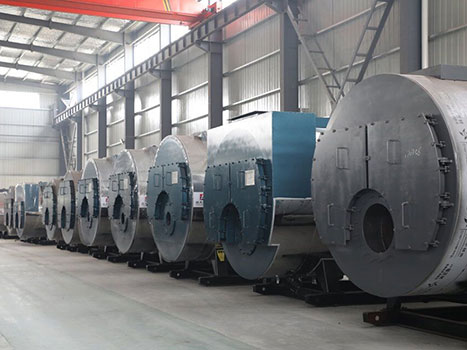
Six decades on one site in Henan
Yuanda Boiler is the trading name of Zhoukou Yuanda Taikang Boiler Co., Ltd., a manufacturer based in the South Industrial Agglomeration Area of Taikang County, Zhoukou, Henan Province. Boilers have been built on this site since the 1960s, which makes the company unusual among Chinese boiler makers of its size: many were founded in the 1990s or later, often by engineers who had trained in works like this one.
That kind of continuity is difficult to imitate. Welding procedures, the habits of the inspection department and the working relationships with plate and tube suppliers have had sixty years to settle into routine. The practical result is a workshop where the answer to “how do you normally do this?” is a documented procedure rather than an opinion, and where the engineers who answer technical questions have usually spent time on the shop floor.
The company employs more than 300 people and holds registered capital of RMB 95.56 million. The production base covers 60,000 m²: fabrication halls, a pressure-vessel shop, inspection and test bays, plate and tube storage, and a dispatch yard with room to assemble and test packaged units at the top of the range. Because boiler and vessels are built on one site, the chain between design and delivery is short and interfaces are controlled by one inspection department.
Where the boilers are built
The halls are laid out by process rather than by product. A shell destined for a 20 t/h fire-tube boiler and a drum for a water-tube unit pass through the same cutting, forming and welding stations. That keeps machine utilisation high and means a small order does not wait behind a large one for a free machine.
Plate arrives as certified stock and is cut on CNC flame and plasma tables, then sheared, edge-planed and either bent on a press brake or rolled on CNC rolls. Edge planing matters more than it sounds: a square, clean weld preparation is the difference between a root pass that fuses properly and one that has to be ground out and re-welded. Rolled shells are checked against templates, and ovality is measured before fit-up rather than after welding, when correction becomes expensive.
Longitudinal and circumferential seams are laid down by automatic submerged-arc welding. CO2 shielded and TIG sets handle tube-to-tubesheet joints, nozzles and small connections where a tractor cannot reach. Each welder works within a qualified procedure and a defined range of thickness and position, and the welder identification is stamped beside the seam so that any repair can be traced to the person and the procedure behind it.
Inspection has its own equipment rather than borrowing from production: X-ray and ultrasonic sets for volumetric examination of seams, a universal testing machine for tensile and bend specimens, a metal composition analyser for confirming alloy identity, and hardness testers for checking the heat-affected zone after welding and heat treatment. Records are filed by serial number, so a boiler delivered in 2024 can still be traced to the plate heat number that went into its shell.
Two test bays complete the picture. In the hydrostatic bay a finished boiler is filled, pressurised to the level the code requires and inspected at every seam, tube joint and nozzle. In the airtightness bay, gas-fired units are checked for leakage before the burner and gas train are fitted, because a gas train proved against a leaking furnace is a false result.
Thirty-seven series, 167 models
The catalogue runs to 37 series and 167 standard models. It covers fire-tube steam and hot water boilers, water-tube SZS units, vertical LSS boilers, electric WDR and LDR types, biomass chain-grate and moving-grate designs, coal-fired units, thermal oil heaters, hot air furnaces, steam generators and atmospheric or vacuum hot water boilers. Annual capacity is 2,000 steam tons of industrial boilers and 5,000 t of pressure vessels.
Range breadth is not the same as range depth, and the company is careful about the difference. Thermal designers, draughtsmen and controls engineers work in the same building as the shop, which keeps drawings honest. A food plant needing 4 t/h at 1.25 MPa saturated steam is buying a standard model, quoted from a table and delivered on a predictable schedule. A chemical plant needing 12 t/h at 1.6 MPa with superheat is buying an engineered unit: modified drum internals, a different tube arrangement, a control philosophy agreed in writing and a drawing approval cycle that takes longer. Both leave through the same gate, and both are inspected to the same procedures.
Export support after the ship sails
Equipment from this works has been delivered to more than 80 countries in Asia, Europe, Africa and South America. Export orders are handled by a small desk that stays with the file from quotation to commissioning rather than handing it between departments. That desk produces the packing list, the certificate of origin, the mill certificates, the approved drawings and the operation and maintenance manual in English, and it checks the details that cause most overseas problems: supply voltage and frequency, fuel composition and pressure, ambient conditions, and any local registration requirement the buyer has flagged.
Commissioning engineers travel to site for installation supervision and start-up, and the same engineers remain reachable afterwards. Where a control system allows remote access, parameters and trend data can be read without a flight; where it does not, photographs, alarm logs and a video call usually settle the question faster than a site visit. Spare parts are held as standard kits for the common models, and every wear item in the manual carries a part number so that a repeat order does not depend on someone remembering a description.
What “quality first, integrity” means on a quotation
The company sums up its approach in four words: quality first, integrity. On a quotation that translates into sizing the unit against the load curve rather than against a round number. If a 6 t/h boiler covers the demand with sensible standby, the proposal says 6 t/h, even when a 10 t/h unit would be an easier sale and a larger invoice.
It also means stating what is excluded. A quotation that leaves out the economiser, the water softener, the chimney or the installation scope is not cheaper; it is simply incomplete, and the difference surfaces later at the worst possible moment. Buyers are entitled to a document they can compare line by line with a competitor’s, and that is what the sales engineers are asked to produce.
None of this makes a boiler immortal. It makes it predictable: known materials, documented welds, tested seams, a manual that matches the machine, and a spare parts list that will still mean something in ten years. For a plant engineer, predictability is most of what reliability actually is.
Reference material
- U.S. DOE — Process heating basics
- IEA — Bioenergy in the energy system
- Boiler fundamentals — reference overview
External links open the publisher’s website and are provided for background reading.
Request a quote
Tell us the capacity, fuel and working pressure. Our engineers reply with a technical proposal within one working day.
Become a Yuanda Boiler agent
We appoint one or two partners per country to quote, deliver and service our boilers locally. Territory protection, factory pricing and commissioning support are part of the agreement.