
700-7000 kW (60-600 ×10⁴ kcal/h)
YGL Biomass Thermal Oil Heater, 700-7000 kW
Horizontal chain-grate biomass thermal oil heater, 700-7000 kW, liquid phase to 320 °C at under 1.0 MPa, with coil banks matched t...
View detailsBatch-fired horizontal biomass boiler for wood, sawdust, rice husk and agro-residue, 0.5-4 t/h, manual firing door, natural or forced draft, fire tubes.
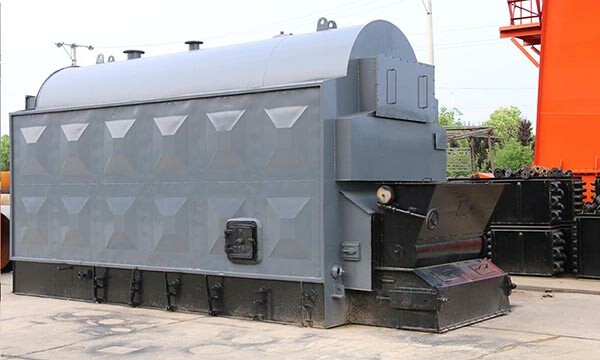
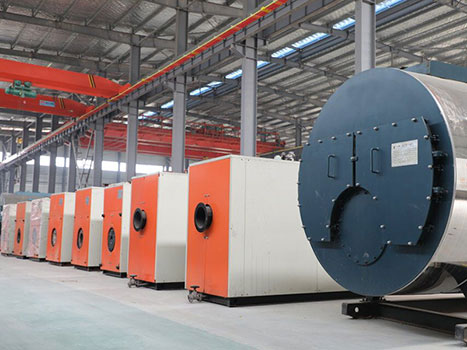
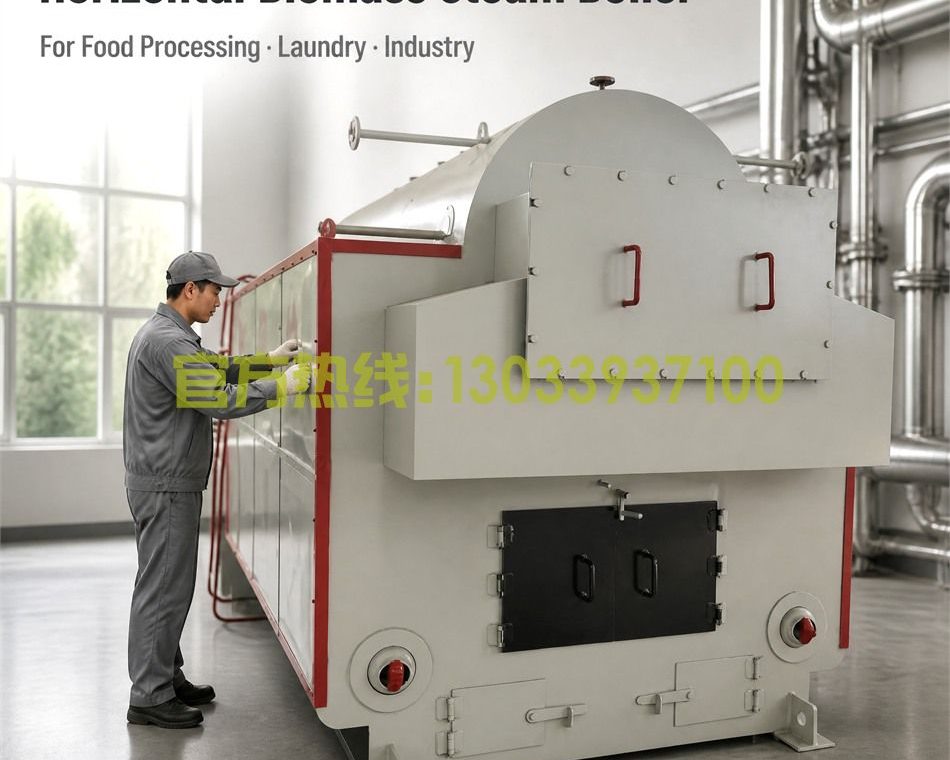
A horizontal hand-fired boiler is a shell with fire tubes, a fixed or lightly cooled grate, a firing door and an ash door. Fuel is thrown onto the grate in batches, burns in a bed, and the gas turns through the fire tubes to the chimney. Draft comes from a chimney of 8 to 12 m or an induced-draught fan. No feeder, no grate drive, no automatic ash removal, no PLC. It is the cheapest way to raise steam from solid fuel, and it is still built because in the right place nothing is as robust.
Ratings run from 0.5 to 4 t/h at 0.7 to 1.25 MPa. The pressure part is conventional; the difference from a chain-grate unit is entirely in how fuel reaches the fire and how the fire is managed.
The fireman’s round is the operating reality. A 2 t/h unit at 75 per cent efficiency on wood at 15 MJ/kg needs about 240 kg of fuel per tonne of steam, so at full load it eats roughly 480 kg/h. That goes in through the door in charges of 80 to 120 kg every 10 to 15 minutes: four to six charges an hour, each opening the door, raking the bed level, throwing fuel to the back and front alternately, closing up. Between charges the bed is poked and the ash drawn.
That is one person’s full attention for a shift, and about 1.2 people per shift once relief is counted. It is skilled work: a good fireman holds an even bed, a thin smoke and a steady pressure; a poor one swings between a cold fire and a roaring one, with the safety valve lifting and the stack black. Training costs money, and purchase comparisons usually leave it out.
Expect 70 to 78 per cent on the lower calorific value with good fuel and an attentive fireman, and 65 to 70 per cent in service with variable fuel. The losses are specific: unburnt carbon in the ash, 5 to 12 per cent; excess air that cannot be trimmed because the bed is uneven, 4 to 8 per cent; flue gas at 250-320 °C because there is rarely an economiser, 8 to 12 per cent. Cycling adds another 3 to 5 points for a unit sized at the peak and run at half load.
A well-run chain-grate holds 80 to 84 per cent across its range, so the gap is real. What the hand-fired unit wins is capital cost, tolerance of fuel a chain-grate cannot take, and the ability to burn whatever residue the plant produced this week.
Wood in logs, offcuts and pallet scrap; sawdust in moderation, mixed with larger pieces so the bed does not smother; rice husk, which burns well but makes much ash and needs a grate that passes it; agro-residue such as maize cob, cotton stalk and bagasse. Moisture below about 25 per cent is the hard limit, which is why a covered store matters more than any other equipment, and piece size must be consistent, because a bed of dust and a bed of 300 mm logs behave completely differently.
Smoke at stoking is unavoidable. Every charge distils volatiles before the fresh fuel ignites, and for 5 to 15 minutes the stack shows grey to black smoke, Ringelmann 2 to 3. A secondary-air nozzle above the fire door shortens that and cuts the plume, but does not remove it. A plant inside a residential area, or under a visible-emissions rule, should not choose this technology.
Hand-fired makes sense where three conditions hold: fuel is cheap or free because it is the plant’s own residue; annual running is under about 1,500 hours, so labour per tonne matters less than capital; and labour is available and affordable. It also suits remote sites where a chain-grate’s gearbox, grate bars and feeder would be unmaintainable.
Above 1,500 hours a year, or above 2 t/h, the arithmetic turns. A chain-grate at 82 per cent against 73 per cent saves about 0.4 GJ per tonne of steam, which over 4,000 hours at 2 t/h is 3,200 GJ a year, and it removes the fireman at the same time. That boundary is worth drawing before the chimney is built rather than after.
Only with a modified grate and a forced-draft fan, and even then the bed tends to smother and the output is unstable. Sawdust is best mixed with larger wood, or burned in a purpose-built unit with a mechanical stoker. Rice husk is easier because its ash falls through a suitably slotted grate.
8 to 12 m for natural draft, depending on rating and fuel moisture, and enough to clear the roof line by 3 m or more. A short stack gives weak draft, smoky combustion and a downdraught problem on windy days; a forced-draft fan allows a shorter stack but adds parasitic power.
Not economically. A chain-grate or stoker conversion changes the grate, the furnace volume, the air distribution and the control philosophy, which amounts to a new boiler in an old shell. If automatic firing is likely within a few years, buy the chain-grate now.
| Size class | 0.5 t/h | 1 t/h | 2 t/h | 4 t/h |
|---|---|---|---|---|
| Rated evaporation | 0.5 t/h | 1 t/h | 2 t/h | 4 t/h |
| Wood burn at 15 MJ/kg | 120 kg/h | 240 kg/h | 480 kg/h | 960 kg/h |
| Grate area | 0.5 m² | 0.9 m² | 1.8 m² | 3.6 m² |
| Efficiency, wood on LCV | 70-78% | 70-78% | 70-78% | 70-78% |
| Chimney height, natural draft | 8 m | 9 m | 10 m | 12 m |
700-7000 kW (60-600 ×10⁴ kcal/h)
Horizontal chain-grate biomass thermal oil heater, 700-7000 kW, liquid phase to 320 °C at under 1.0 MPa, with coil banks matched t...
View details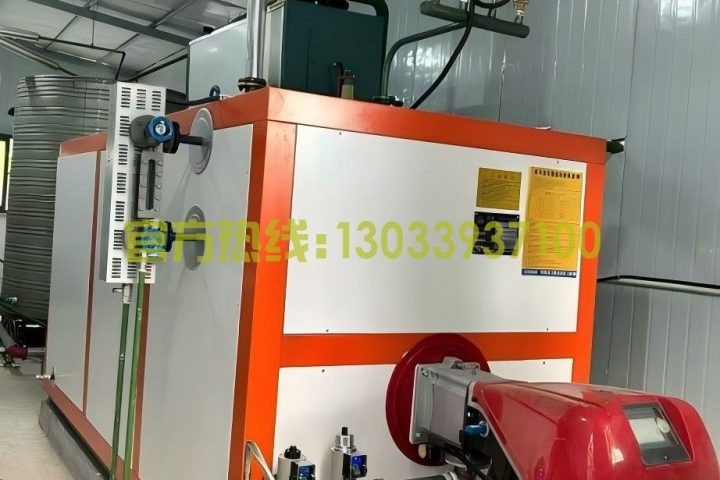
0.2-2 t/h
Horizontal coil steam generator, 0.2-2 t/h at 0.4-1.0 MPa, fired on pellets, sawdust or rice husk, with under 30 litres of water a...
View details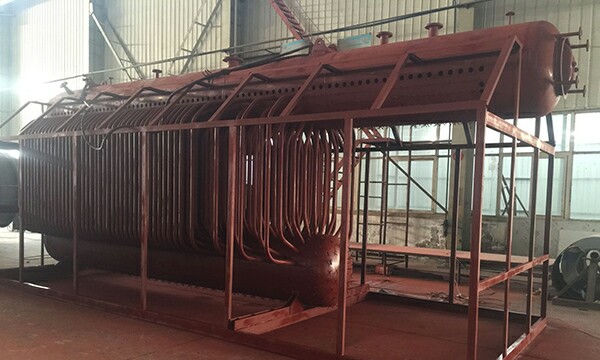
15 t/h
The SZL15-1.25-T delivers 15 t/h of steam at 1.25 MPa and 194 °C from biomass pellets, wood chips, rice husk or palm kernel shell,...
View detailsExternal links open the publisher’s website and are provided for background reading.
Include the capacity (t/h or MW), fuel, working pressure and site country so the proposal matches your permit limits.
We appoint one or two partners per country to quote, deliver and service our boilers locally. Territory protection, factory pricing and commissioning support are part of the agreement.