
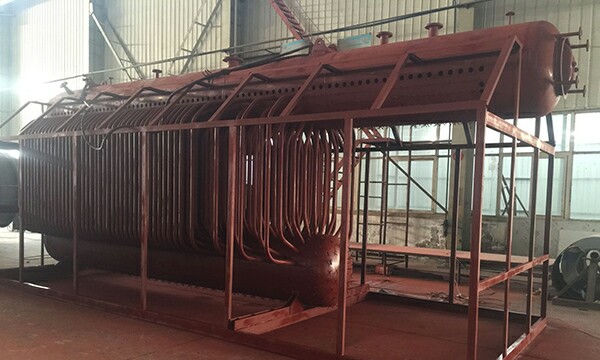
4-20 t/h (2 t/h model also built)
SZL Assembled Chain Grate Biomass Boiler, 4-20 t/h
Double-drum water-tube biomass boiler, 4-20 t/h, shipped in two sections with membrane walls and an S-pass dust drop.
View detailsSmall packaged biomass boiler, 0.5-4 t/h, with a reciprocating moving grate for wet chips, briquettes and husk.
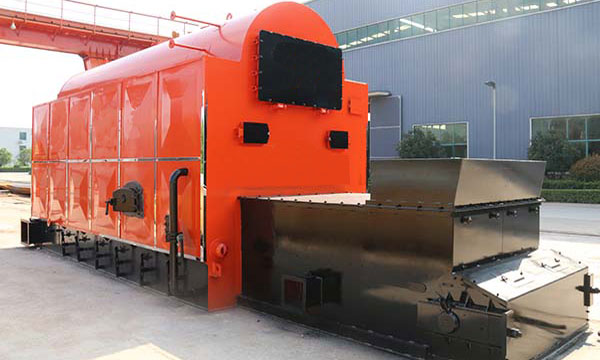
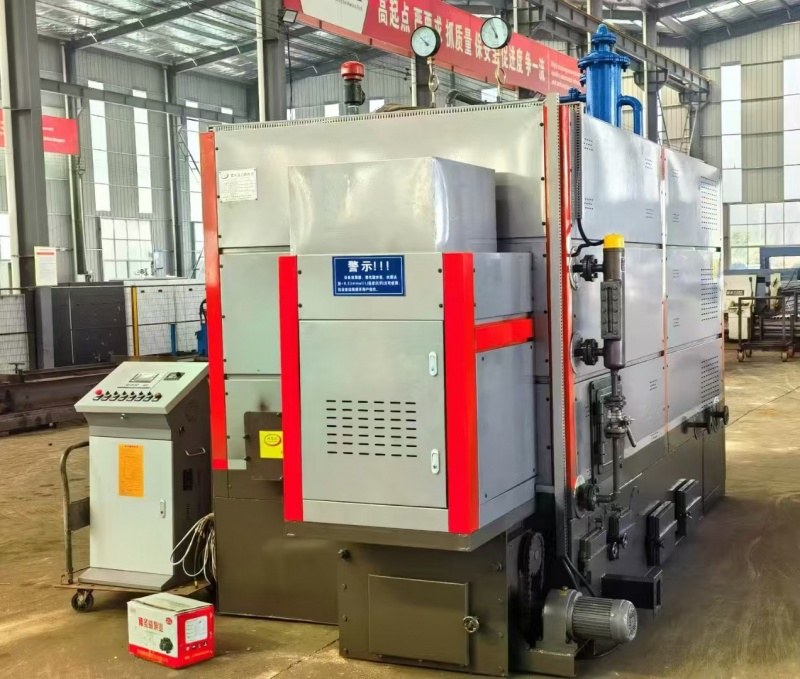
The DZH is the packaged answer for plants that need 0.5-4 t/h of steam and cannot guarantee a dry, uniform fuel. It is a horizontal three-pass water-fire-tube boiler with a reciprocating moving grate rather than a continuous chain. Fuel arrives from a day hopper through a variable-speed screw feeder and is spread across the grate, where stepped rows push the bed forward in short strokes. Steam is delivered at 0.7-1.6 MPa and 170-204 °C.
The moving grate is the reason to choose this model. Chain grates need fuel that sits still on a moving belt; wet chips and briquettes bridge at the gate or form a sticky mat that burns unevenly. Reciprocating rows break that mat on every stroke, drop ash through the step gaps and expose fresh surface to the flame.
Grate rows alternate fixed and moving, driven by a hydraulic ram or an eccentric at 4-12 strokes per minute with a 40-80 mm stroke. Primary air is split into four to six zones under the grate, each with its own damper, so drying, ignition and burnout can be trimmed separately. Bed depth runs 150-300 mm.
Fuel preparation is modest but not optional. Chips are screened to about 30 mm, with 50 mm tolerated on the larger models; briquettes up to 50 mm are acceptable if they are not so dense that they sit unburnt. Moisture to 30% is routine and 35% is workable with air preheating, but every 10 points of moisture costs roughly 1.5-2 efficiency points, because the water must be evaporated and leaves with the gas. Rice husk runs well on its 15-20% ash.
The furnace is designed for a volumetric heat release of about 150-250 kW/m³ and at least two seconds of gas residence above 850 °C. That is what burns the volatiles, which make up 70-80% of the dry mass of most biomass. Secondary air enters above the bed at the front wall and, on the larger sizes, at the rear, closing the CO balance and lifting carbon out of the fly ash.
Control is oxygen-trimmed, holding 4-6% O2 at the economiser outlet, which is about 1.3-1.5 excess air. Below that the bed goes dark and CO rises; above it stack loss climbs by roughly a point for every 0.1 of excess air coefficient. Feeder and grate drive follow load, but the response is deliberately slow: a grate holds several minutes of fuel, so the loop damps steam pressure rather than chasing it.
Unburnt carbon is the honest weak point of any grate unit. Slag typically carries 5-10% carbon and fly ash 15-25%, together worth 3-6 efficiency points. The operator’s levers are bed depth, grate speed and air split: a thin, fast bed throws fuel off the grate end, a deep, slow bed clinkers. Keeping the two in balance is most of the skill in running the plant, which is why loads below about 40% are best avoided or buffered.
Rated efficiency is 80-84% on lower calorific value. Exit gas is 125-180 °C depending on size, and an economiser pays on anything running over 4,000 hours a year. With wet fuel an air preheater helps the bed dry and ignite, but the cold-end metal must stay above the acid dew point; chlorine in biomass can push that to 60-70 °C, so the preheater is designed for a minimum wall temperature rather than a fixed air temperature.
Ash leaves the grate end into a hopper and is removed by a screw conveyor, continuously on the larger sizes. Expect 2-5% ash from clean chips and 12-18% from husk; clinker is governed by ash fusion, so fuel softening below 1,100 °C needs a different arch and a more conservative grate load. Flue gas passes a cyclone and a pulse-jet bag filter, holding particulate under 30 mg/Nm³. NOx from staged combustion sits at 150-250 mg/Nm³, with SNCR where a 100 mg/Nm³ limit applies; SO2 is normally below the limit without treatment.
| Item | DZH0.5 | DZH1 | DZH2 | DZH4 |
|---|---|---|---|---|
| Rated evaporation | 0.5 t/h | 1 t/h | 2 t/h | 4 t/h |
| Rated pressure | 0.7/1.0 MPa | 0.7/1.0/1.25 MPa | 0.7/1.0/1.25 MPa | 1.25/1.6 MPa |
| Steam temperature | 170/184 °C | 170-194 °C | 170-204 °C | 194/204 °C |
| Grate area | 1.28 m² | 2.1 m² | 3.36 m² | 5.2 m² |
| Exhaust gas temperature | 179 °C | 163-165 °C | 125-137 °C | 144/145 °C |
| Shipping weight | 8 t | 10-11 t | 14-15 t | 22 t |
Selection comes down to fuel and hours. Below 1 t/h with a variable fuel, the DZH is usually cheaper than a chain grate; above 4 t/h, or with a steady pellet supply, the DZL or SZL gives better efficiency and longer grate life.
About 35% moisture with air preheating, 30% without. Above that the bed cools, ignition moves away from the gate and unburnt carbon rises sharply. Drying fuel by 10 points is worth roughly 1.5-2 efficiency points.
Moving rows break up sticky or bridging fuel mechanically on each stroke, which suits wet chips and briquettes. Chain grates need fuel that stays put on the belt and tolerate long or matting material less well.
Continuously on the 2 t/h and 4 t/h models through a screw conveyor; the smaller units discharge into a hopper emptied per shift. Rice husk produces enough ash to need a conveyor at any size.
| Model | DZH0.5 | DZH1 | DZH2 | DZH4 |
|---|---|---|---|---|
| Rated evaporation | 0.5 t/h | 1 t/h | 2 t/h | 4 t/h |
| Rated pressure | 0.7/1.0 MPa | 0.7/1.0/1.25 MPa | 0.7/1.0/1.25 MPa | 1.25/1.6 MPa |
| Steam temperature | 170/184 °C | 170-194 °C | 170-204 °C | 194/204 °C |
| Grate area | 1.28 m² | 2.1 m² | 3.36 m² | 5.2 m² |
| Exhaust gas temperature | 179 °C | 163-165 °C | 125-137 °C | 144/145 °C |
| Shipping weight | 8 t | 10-11 t | 14-15 t | 22 t |
4-20 t/h (2 t/h model also built)
Double-drum water-tube biomass boiler, 4-20 t/h, shipped in two sections with membrane walls and an S-pass dust drop.
View details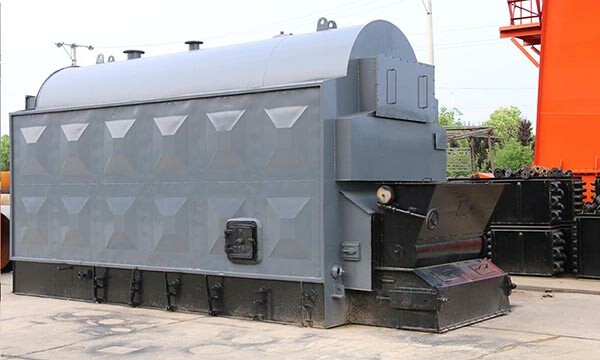
0.5-4 t/h
Batch-fired horizontal biomass boiler for wood, sawdust, rice husk and agro-residue, 0.5-4 t/h, manual firing door, natural or for...
View details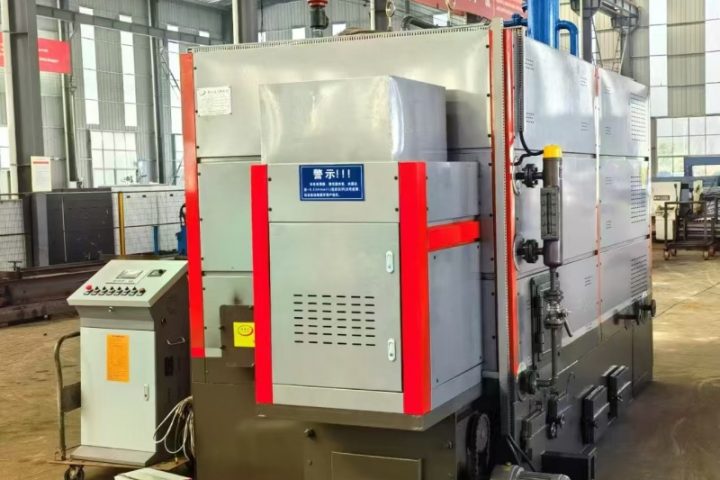
70-700 kW (0.06-0.6 MW)
Small coal or biomass bathhouse boiler, 70-700 kW, with secondary-air smokeless combustion and an integrated hot water tank for ru...
View detailsExternal links open the publisher’s website and are provided for background reading.
Include the capacity (t/h or MW), fuel, working pressure and site country so the proposal matches your permit limits.
We appoint one or two partners per country to quote, deliver and service our boilers locally. Territory protection, factory pricing and commissioning support are part of the agreement.