
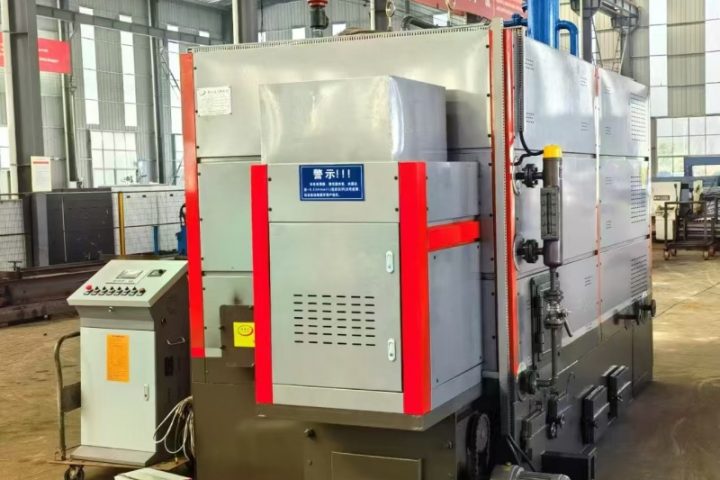
70-700 kW (0.06-0.6 MW)
Smokeless Bath and Space Heating Boiler, 70-700 kW
Small coal or biomass bathhouse boiler, 70-700 kW, with secondary-air smokeless combustion and an integrated hot water tank for ru...
View detailsVertical biomass steam generator, 0.1-1 t/h at 0.4-0.7 MPa, gravity feed and natural draft, under 2 m² of floor, 72-80% efficiency and a real labour load.
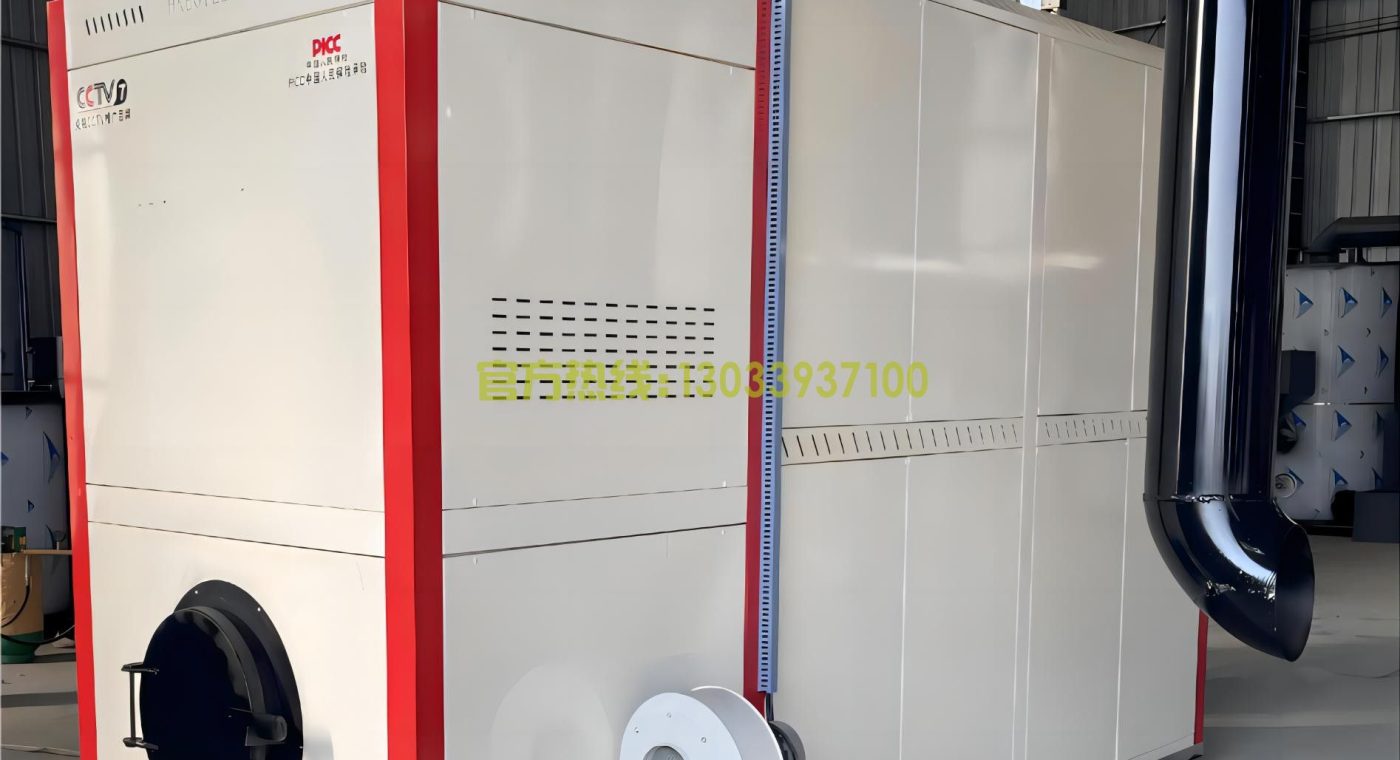
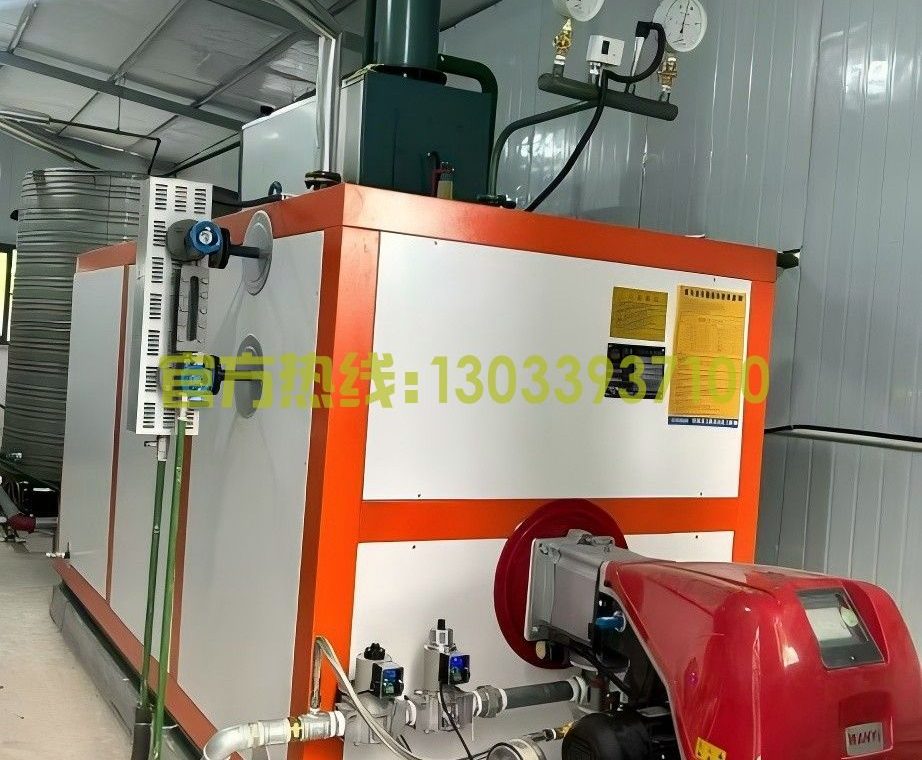
The vertical biomass steam generator is the smallest practical way to make steam from solid fuel: 0.1 to 1 t/h at 0.4 or 0.7 MPa, standing on a footprint of one square metre to 1.4 m by 1.4 m, with a height of 2.2 to 3.2 m. Fuel falls by gravity from a hopper onto a small grate, the fire burns upward into a water-jacketed or coiled body, and the gas leaves through a stack. There is no fuel pump, no forced-draught fan and no compressed air: the unit can run where the only services are water and a chimney.
Natural draft is the defining choice, and it sets the performance. A stack of 5 to 7 m produces only 20 to 40 Pa of draft, so the fuel bed and the gas passages must be open, and excess air settles at 1.8 to 2.2 rather than the 1.4 to 1.6 of a fan-driven boiler. That is where the honest efficiency figure comes from: 72 to 80 per cent on lower calorific value, with flue gas leaving at 220 to 300 °C. Stack loss is the largest item at 12 to 18 points, unburnt carbon in the ash takes 4 to 7, and radiation from the hot casing 2 to 3.
The hopper holds 60 to 300 kg, which is one and a half to three hours at rated output, so somebody refuels two or three times a shift. Wet fuel bridges at the hopper throat and has to be broken down with a rod; pellets at 8 per cent moisture flow freely, chips at 35 per cent do not. Ash is raked from the grate by hand, and on husk the ash volume is large enough that the fire has to be let down once a day to clear it. Plan on one to two hours of operator attention per day, and on that person being trained, because a neglected bed either clinkers or burns through the grate.
Fuel consumption follows directly from the efficiency. One tonne of steam at 0.7 MPa absorbs about 2.7 GJ, so at 76 per cent and 16.5 MJ/kg the unit burns roughly 215 kg of pellets per tonne of steam. That is 5 to 10 per cent more fuel than a chain-grate boiler at 82 per cent, and the difference is the price of no fan, no grate drive and no automatic control.
The body can be a coil, kept under 30 litres at design normal water level so that it falls outside the Chinese boiler regulation and is treated as a generator, or a small shell holding 40 to 80 litres, which is a boiler by definition and carries the inspection and operator obligations that go with that. The coil version starts in five to ten minutes and follows load; the shell version holds ten minutes of steam and rides out a draw. Which one is permissible depends on the destination, not on preference, so the classification has to be settled before the drawings are fixed.
The unit suits a workshop, a greenhouse, a small laundry, a sauna, a concrete curing bay or a feed mill, where steam is wanted for one or two shifts and the alternative is an electric generator with a heavy tariff or a gas connection that does not exist. It does not suit three-shift operation: the labour, the ash and the manual firing make it a one-shift machine, and a plant that needs steam around the clock should look at a chain-grate boiler or two units on a common header.
Steam quality is modest but adequate for the duties above. Carry-over depends on the steam space and on keeping the water line steady, and a small separator at the outlet is worth fitting where the steam reaches a press or a steriliser. The stack must be insulated and capped, and the fuel store kept dry: a hopper of damp pellets is the most common cause of a unit that will not reach pressure.
| Evaporation | Pressure | Efficiency | Pellet consumption | Hopper | Footprint |
|---|---|---|---|---|---|
| 0.1 t/h | 0.4 MPa | 72% | 22 kg/h | 60 kg | 1.0×1.0 m |
| 0.3 t/h | 0.4 MPa | 74% | 66 kg/h | 120 kg | 1.2×1.2 m |
| 0.5 t/h | 0.7 MPa | 76% | 108 kg/h | 180 kg | 1.3×1.3 m |
| 1 t/h | 0.7 MPa | 80% | 205 kg/h | 300 kg | 1.4×1.4 m |
Only for the feedwater pump and the controls, typically 1 to 3 kW. Combustion air comes from natural draft, so the unit will make steam through a power cut as long as the feed pump has an alternative drive or the load is shut off.
At 80 per cent efficiency and 16.5 MJ/kg, about 205 kg of pellets per tonne of steam. On wet chips the figure rises steeply, because the water in the fuel has to be evaporated.
Only with a proper boiler room or a fire-rated enclosure, a stack to roof level and the clearances the local rules require. The unit itself is small, but solid fuel firing needs ash handling, fuel storage and a flue.
| Rated evaporation | 0.1 t/h | 0.2 t/h | 0.3 t/h | 0.5 t/h | 0.7 t/h | 1 t/h |
|---|---|---|---|---|---|---|
| Rated pressure | 0.4 MPa | 0.4 MPa | 0.4 MPa | 0.7 MPa | 0.7 MPa | 0.7 MPa |
| Thermal efficiency | 72% | 73% | 74% | 76% | 78% | 80% |
| Pellet consumption | 22 kg/h | 45 kg/h | 66 kg/h | 108 kg/h | 147 kg/h | 205 kg/h |
| Hopper capacity | 60 kg | 90 kg | 120 kg | 180 kg | 240 kg | 300 kg |
| Footprint L×W | 1.0×1.0 m | 1.1×1.1 m | 1.2×1.2 m | 1.3×1.3 m | 1.4×1.4 m | 1.4×1.4 m |
| Overall height | 2200 mm | 2400 mm | 2600 mm | 2900 mm | 3100 mm | 3200 mm |
70-700 kW (0.06-0.6 MW)
Small coal or biomass bathhouse boiler, 70-700 kW, with secondary-air smokeless combustion and an integrated hot water tank for ru...
View details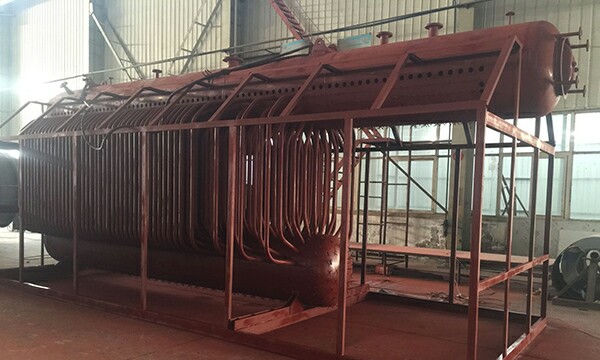
10 t/h
The SZL10-1.25-T is a 10 t/h, 1.25 MPa biomass steam boiler delivering 194 °C steam at 88% efficiency. An assembled chain-grate, t...
View details10-50 t/h
Steam boiler package for paper and pulp mills: SZL biomass or SZS gas fired, 10-50 t/h at 1.25-2.5 MPa. Designed for continuous lo...
View detailsExternal links open the publisher’s website and are provided for background reading.
Include the capacity (t/h or MW), fuel, working pressure and site country so the proposal matches your permit limits.
We appoint one or two partners per country to quote, deliver and service our boilers locally. Territory protection, factory pricing and commissioning support are part of the agreement.