Biomass Steam Boiler for Wood Processing Plant
Wood processing plants typically need a steady and continuous heat source for drying, steaming, pressing, conditioning, and other production steps. In many factories, steam is one of the most practical and widely used heating methods because it offers stable temperature control, fast heat transfer, and convenient distribution through pipelines.
A biomass steam boiler is a suitable solution for many wood processing plants, especially when the factory has access to wood chips, bark, sawdust, offcuts, wood shavings, or other biomass residues. Instead of treating these materials only as waste, they can be used as boiler fuel to generate steam for production.
For sawmills, plywood factories, MDF plants, particle board plants, veneer processing lines, and timber drying facilities, choosing the right biomass steam boiler can help reduce fuel costs, improve energy utilization, and support long-term production stability.
This article explains how biomass steam boilers are used in wood processing plants and what factors should be considered before selecting a boiler system.
1. Why Wood Processing Plants Need Steam Boilers
Wood processing involves several heating and drying processes. Steam is commonly used because it provides reliable heat and can be easily controlled according to production requirements.
Common steam applications in wood processing plants include:
- Timber drying kilns
- Veneer drying
- Wood steaming
- Plywood hot press heating
- MDF and particle board production
- Glue preparation and heating
- Wood treatment processes
- Humidification
- Hot water preparation
- Process heating for auxiliary equipment
In many wood processing plants, steam demand may change according to production shifts, material moisture content, drying time, and production capacity. Therefore, the boiler system should not only meet the maximum steam demand, but also operate efficiently under partial load conditions.
A stable steam supply helps improve drying consistency, reduce production interruption, and maintain product quality.
2. Why Choose a Biomass Steam Boiler
Biomass steam boilers are widely used in wood processing plants because the fuel source is often available directly from the production process.
Wood processing plants usually generate a large amount of biomass by-products, such as:
- Wood chips
- Sawdust
- Bark
- Wood shavings
- Veneer waste
- Offcuts
- Wood pellets
- Palm residues or agricultural biomass, depending on region
Using these materials as boiler fuel can help reduce dependence on natural gas, diesel, or coal. For factories with stable biomass fuel supply, a biomass steam boiler can be an economical and practical heat source.
The main advantages include:
- Uses local or in-house biomass fuel
- Reduces fuel purchasing cost
- Suitable for continuous steam production
- Helps utilize wood processing residues
- Can support medium and large steam demand
- More suitable for areas without gas pipeline supply
- Flexible fuel options depending on boiler design
However, biomass fuel quality is very important. Moisture content, particle size, ash content, and feeding stability all affect boiler combustion performance.
3. Main Biomass Boiler Types for Wood Processing
Different biomass boiler structures can be used according to fuel type, steam capacity, and site conditions.
Fixed Grate Biomass Steam Boiler
Fixed grate boilers are suitable for smaller steam capacity and relatively simple biomass fuel. They are often used in small wood workshops or factories with stable fuel size.
The structure is simple, but fuel feeding and ash removal may require more manual operation depending on the design.
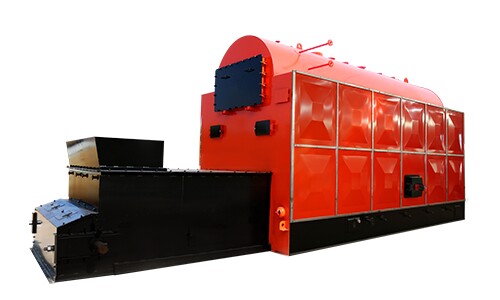
Chain Grate Biomass Steam Boiler
Chain grate biomass boilers are commonly used for medium and large steam demand. They can provide continuous fuel feeding, stable combustion, and easier operation compared with manual feeding systems.
They are suitable for fuels such as wood chips, biomass pellets, and mixed biomass fuels with relatively stable particle size.
Reciprocating Grate Biomass Boiler
Reciprocating grate boilers are suitable for biomass fuels with higher moisture content or less uniform particle size. The moving grate helps improve fuel mixing, drying, and combustion.
For wood processing plants using bark, wet wood chips, or mixed wood waste, a reciprocating grate system may be more suitable.
The final boiler structure should be selected according to fuel characteristics, steam demand, automation requirements, and investment budget.
4. Boiler Capacity Selection
Boiler capacity is one of the most important parameters in a wood processing steam system. It is usually expressed in kg/h, ton/h, or lb/h.
If the boiler capacity is too small, steam pressure may drop during peak production. This can affect drying speed, hot press temperature, and production efficiency. If the boiler capacity is too large, the plant may face higher investment cost and lower operating efficiency during low-load operation.
When selecting boiler capacity, the following factors should be considered:
- Number of steam-using machines
- Steam consumption of each production line
- Drying kiln capacity
- Hot press heating demand
- Simultaneous operation rate
- Required heating time
- Steam pipeline loss
- Condensate recovery rate
- Future production expansion
For wood drying and board production, steam demand can vary significantly. A professional boiler supplier should calculate the steam load based on the real process data instead of only selecting by factory size.
5. Choose the Right Steam Pressure
Steam pressure should match the process equipment requirements. Higher pressure is not always better. The correct pressure depends on the required steam temperature and heat transfer conditions.
Common steam pressure options for wood processing plants include:
- 0.7 MPa
- 1.0 MPa
- 1.25 MPa
- 1.6 MPa
For many wood processing applications, 1.0 MPa or 1.25 MPa steam boilers are commonly used. Some production lines may require different pressure levels, so pressure reducing valves may be used to supply lower-pressure steam to specific equipment.
Before selecting boiler pressure, the factory should confirm the requirements of drying kilns, hot presses, heat exchangers, and other steam-using equipment.
6. Biomass Fuel Quality Is Critical
Fuel quality has a direct impact on biomass boiler performance. Unlike gas or oil, biomass fuel is not always uniform. Moisture content, size, density, and ash content can vary significantly.
Important biomass fuel factors include:
- Moisture content
- Particle size
- Fuel density
- Ash content
- Calorific value
- Impurities such as sand, metal, or stones
- Fuel storage condition
- Feeding system compatibility
For example, dry wood chips and wood pellets are easier to burn efficiently. Wet bark or high-moisture sawdust may require a more suitable grate system, larger furnace volume, or additional drying consideration.
If the biomass fuel moisture is too high, combustion temperature may decrease, boiler efficiency may drop, and steam output may become unstable. Therefore, fuel analysis is strongly recommended before final boiler selection.
7. Fuel Feeding and Storage System
A biomass steam boiler is not only the boiler body. The fuel storage and feeding system are also very important for stable operation.
A complete biomass fuel system may include:
- Fuel storage area
- Hopper
- Screw conveyor
- Belt conveyor
- Fuel feeding device
- Furnace feeding system
- Anti-backfire device
- Ash discharge system
For wood processing plants, fuel storage should be designed carefully. Sawdust and wood chips can absorb moisture easily, and very dry wood dust may create fire and dust safety risks. Proper ventilation, fire prevention, and dust control should be considered.
The feeding system should match the fuel type. Sawdust, wood chips, bark, and pellets may require different feeding designs to avoid blockage, uneven feeding, or unstable combustion.
8. Boiler Efficiency and Energy Saving
Fuel cost is a major long-term operating cost for wood processing plants. A well-designed biomass boiler system can help improve fuel utilization and reduce waste.
Energy-saving measures may include:
- Suitable furnace design
- Proper grate combustion system
- Air preheater
- Economizer
- Good boiler insulation
- Automatic air and fuel control
- Condensate recovery system
- Proper steam pipeline insulation
- Regular ash cleaning and maintenance
For biomass boilers, ash and soot accumulation can reduce heat transfer efficiency. Regular cleaning and maintenance are necessary to keep the boiler operating efficiently.
An economizer can recover heat from flue gas and preheat boiler feed water, improving overall system efficiency. For factories with long operating hours, this can bring practical fuel savings.
9. Emission Control and Dust Removal
Biomass combustion produces flue gas, ash, and dust. Therefore, emission control equipment should be selected according to local environmental regulations and fuel characteristics.
Common emission control equipment may include:
- Multi-cyclone dust collector
- Bag filter
- Wet scrubber
- Desulfurization system, if required
- Induced draft fan
- Proper chimney design
Wood biomass usually has lower sulfur content than coal, but dust control is still important. If the plant uses bark or mixed biomass fuel, ash content may be higher and dust removal requirements may increase.
Before ordering the boiler, the factory should confirm local emission standards and select suitable dust removal equipment.
10. Water Treatment and Boiler Safety
Water treatment is essential for steam boiler operation. Poor water quality can cause scaling, corrosion, poor heat transfer, and pressure part damage.
A biomass steam boiler system should usually include:
- Water softener
- Feed water tank
- Dosing system
- Blowdown system
- Deaerator, if required
- Feed water pump
Scaling inside the boiler can reduce efficiency and increase fuel consumption. In serious cases, it may cause overheating and damage to boiler tubes or pressure parts.
Safety protection is also essential. A qualified steam boiler should be equipped with:
- Safety valves
- Pressure gauges
- Water level control
- Low water level protection
- Overpressure protection
- Furnace pressure protection
- Automatic alarm system
- Emergency shutdown function
The boiler should comply with local pressure equipment regulations and inspection requirements.
11. Automation and Operation Control
Modern biomass steam boilers can be equipped with automatic control systems to improve operation stability and reduce labor intensity.
Common automation functions include:
- Automatic fuel feeding
- Automatic water feeding
- Steam pressure control
- Furnace temperature monitoring
- Fan control
- Grate speed adjustment
- Low water level alarm
- Overpressure alarm
- Fault protection
- Touch screen control
Compared with gas or oil boilers, biomass boilers usually require more attention to fuel feeding, ash removal, and combustion adjustment. A reasonable automation system can help reduce manual workload and improve steam supply stability.
For wood processing plants with continuous production, stable boiler control is especially important.
12. How to Choose a Reliable Biomass Boiler Supplier
A biomass steam boiler project requires more than a standard boiler body. The supplier should understand biomass fuel combustion, steam load calculation, auxiliary equipment matching, and boiler room layout.
A reliable biomass boiler supplier should be able to provide:
- Steam load calculation
- Biomass fuel analysis support
- Boiler model selection
- Grate system recommendation
- Fuel consumption estimation
- Fuel feeding system design
- Dust removal equipment selection
- Boiler room layout suggestions
- Technical drawings
- Installation guidance
- Operation training
- Spare parts support
- After-sales service
For overseas wood processing projects, the supplier should also consider voltage, fuel conditions, shipping, documentation, local regulations, and installation communication.
Choosing an experienced manufacturer can help reduce project risk and improve long-term boiler performance.
Conclusion
A biomass steam boiler is a practical heating solution for wood processing plants, especially when the factory has access to wood chips, sawdust, bark, offcuts, or other biomass residues.
When selecting a biomass steam boiler, the factory should consider steam capacity, working pressure, fuel moisture, fuel size, boiler structure, feeding system, emission control, water treatment, automation level, and local safety regulations.
A suitable biomass boiler system can help wood processing plants make better use of biomass residues, reduce fuel cost, and provide stable steam for drying, steaming, pressing, and other production processes.
For a wood processing boiler project, it is recommended to provide fuel type, fuel moisture content, steam demand, required pressure, working hours, production process, installation space, and local emission requirements. With this information, a professional boiler manufacturer can design a more reliable and efficient biomass steam boiler solution.
FAQ
1. What biomass fuels can be used in a wood processing steam boiler?
Common fuels include wood chips, sawdust, bark, wood shavings, offcuts, veneer waste, and wood pellets. The final fuel suitability depends on moisture content, particle size, ash content, and boiler feeding system design.
2. What steam pressure is commonly used in wood processing plants?
Many wood processing plants use steam pressure around 1.0 MPa or 1.25 MPa. The exact pressure should be selected according to drying kilns, hot presses, heat exchangers, and other process equipment.
3. Is sawdust suitable for a biomass steam boiler?
Yes, sawdust can be used as biomass fuel, but the feeding system must be designed properly. Very fine or high-moisture sawdust may cause feeding blockage or unstable combustion if the system is not suitable.
4. How can a biomass boiler improve fuel utilization?
Fuel utilization can be improved by proper grate design, stable fuel feeding, air control, economizer installation, good insulation, condensate recovery, and regular ash cleaning.
5. What information is needed before selecting a biomass steam boiler?
The main information includes required steam capacity, working pressure, biomass fuel type, moisture content, particle size, working hours, production process, installation space, and local emission requirements.