Water is the biggest component you are paying to evaporate
Biomass arrives at the boiler gate with water in it, and the water content is not a minor quality variable. Wood chips at 50% moisture are half water by weight. Every kilogram of that water must be heated from ambient to 100 °C, evaporated, and then superheated to the stack temperature, and none of that heat produces steam. The energy comes out of the fuel’s calorific value before the boiler ever sees it.
The effect on the fuel bill is direct and large. A tonne of oven-dry wood carries roughly 18-19 MJ/kg of higher calorific value. At 30% moisture the lower calorific value is about 12.5 MJ/kg; at 50% it is about 8.5 MJ/kg. The same boiler, asked for the same steam output, burns half again as much fuel per tonne of steam at 50% moisture as at 30%, and it does so while the fuel supplier may be charging by wet weight. The commercial argument and the engineering argument point the same way, which is unusual and worth using.
The arithmetic of wet fuel
A useful approximation for wood and agricultural residue is that lower calorific value falls by about 2.44 MJ per kilogram for every 10% of moisture, starting from the dry value. The 2.44 MJ is the latent heat of water at 25 °C plus the sensible heat to bring it to the reference temperature; it is the unavoidable penalty for the water present. Drying the fuel before combustion does not avoid the penalty, it moves it to a dryer that burns fuel to do the work.
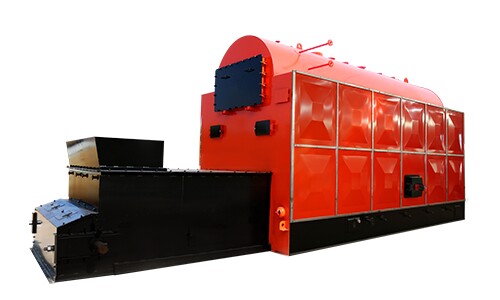
Take a 6 t/h DZL biomass boiler at 82% efficiency, asked to produce 6 t/h of steam at 1.25 MPa from 20 °C feed. The heat required is 6 × 2,701 MJ/h, or 4.5 MW. At 82% efficiency the fuel input must be 5.5 MW, or 19.8 GJ/h. At 12.5 MJ/kg that is 1,584 kg/h of fuel; at 8.5 MJ/kg it is 2,329 kg/h, a 47% increase. If the fuel is bought by wet tonne at the same price per tonne, the wet fuel is not cheaper at all, it is more expensive per unit of heat.
This is why fuel contracts should be written on energy or on dry matter, not on wet weight alone. A supplier delivering 50% moisture at the same price per tonne as 30% moisture is selling water at the price of wood, and the boiler pays for it twice: once at the gate and again in reduced capacity.
What wet fuel does inside the furnace
The furnace consequences go beyond calorific value. Wet fuel takes longer to ignite, because the first heat arriving at the particle goes into drying rather than pyrolysis. The ignition front moves down the grate, the bed becomes uneven, and the boiler loses its stable flame at low load. Operators respond by raising the excess air and the grate speed, which increases the flue gas volume and the unburnt carbon in the ash.
The flame temperature falls, which slows the combustion of the char and increases CO. The boiler may need more secondary air to burn the volatiles, and the induced draught fan runs at its limit to pull the extra gas volume through. A DZL or SZS unit selected for 30% moisture fuel will not reach its rating at 50%; the derate is typically 15-25%, and it appears as a boiler that cannot hold pressure during a wet spell rather than as a clean efficiency loss.
There is also a corrosion penalty. Wet fuel produces more water vapour in the flue gas and a lower acid dew point margin, and the cold end of the economiser and the stack run closer to condensation. The economiser for a biomass boiler should be sized with a bypass or a higher cold-end temperature than a gas unit, and the stack should be insulated.
Storage: drying, heating and the risk of fire
Biomass in a pile is not inert. Microbial activity starts at about 20% moisture and accelerates above 30%, generating heat faster than the pile can lose it. The centre of a large heap can reach 70-80 °C, and above that the fuel begins to oxidise chemically and the risk of spontaneous combustion becomes real. A pile that is warm to the touch and smells sweet is already digesting itself, losing dry matter and calorific value.
The design response is a covered, ventilated store with a concrete floor, walls that allow the pile to be turned, and a strict limit on pile height. Wood chips store best at 25-35% moisture, in piles no more than 4-5 m high, turned or reclaimed in rotation so that no batch sits for months. Temperature probes at 2 m depth, read weekly, with an alarm at 60 °C and a prohibition on entering a hot pile, are the minimum. Water spray on a hot pile makes it worse by feeding the biology; the correct action is to spread and cool the fuel, or to burn it.
Storage volume follows from consumption and the delivery interval. At 1,600 kg/h and 6,000 hours a year the boiler burns 9,600 t. A ten-day stock is 260 t; at a bulk density of 250 kg/m³ for wood chips that is over 1,000 m³ of pile, which is a building, not a bunker. Pellets at 650 kg/m³ need less space but cost more and carry their own dust explosion risk. The store is usually the largest civil item in a biomass project and the one most often undersized.
Receiving, sampling and the contract
Moisture is measured at delivery, by oven drying a sample or by a calibrated meter, and the result should be written on the ticket and used in the payment calculation. Sampling matters: a grab sample from the top of a truck reads drier than the load. A probe sampling at several depths, combined into one composite, is the honest method, and both parties should witness it.
The contract should specify a moisture range, a calorific value floor, an ash content ceiling and a penalty for out-of-range deliveries. It should also specify the particle size distribution, because a biomass boiler’s fuel handling and grate are designed around a range; fines below 3 mm burn differently from chips at 30 mm, and oversize pieces bridge in the silo.
The table shows how moisture moves the fuel requirement for the 6 t/h example. The last column is the fuel flow the boiler must be fed to hold its rating.
| Moisture, wet basis | Lower calorific value | Fuel for 4.5 MW | Relative fuel cost |
|---|---|---|---|
| 20% | 14.6 MJ/kg | 1,355 kg/h | 0.86 |
| 30% | 12.5 MJ/kg | 1,584 kg/h | 1.00 |
| 40% | 10.5 MJ/kg | 1,886 kg/h | 1.19 |
| 50% | 8.5 MJ/kg | 2,329 kg/h | 1.47 |
| 55% | 7.5 MJ/kg | 2,640 kg/h | 1.67 |
Above about 55% moisture most biomass boilers will not hold their rating at all, and the fuel is better described as a slurry. The practical target for a DZL or SZS biomass unit is 25-35% at the feeder, achieved by covered storage and by ordering fuel that has been dried or seasoned before delivery.
The cheapest moisture control is often the least technical: buy in spring and summer when fuel dries, cover it before the autumn rain, and reclaim from the oldest part of the pile first. A boiler house that treats its fuel store as a warehouse rather than a dump saves more energy than most burner adjustments, and it does so without a single instrument.