
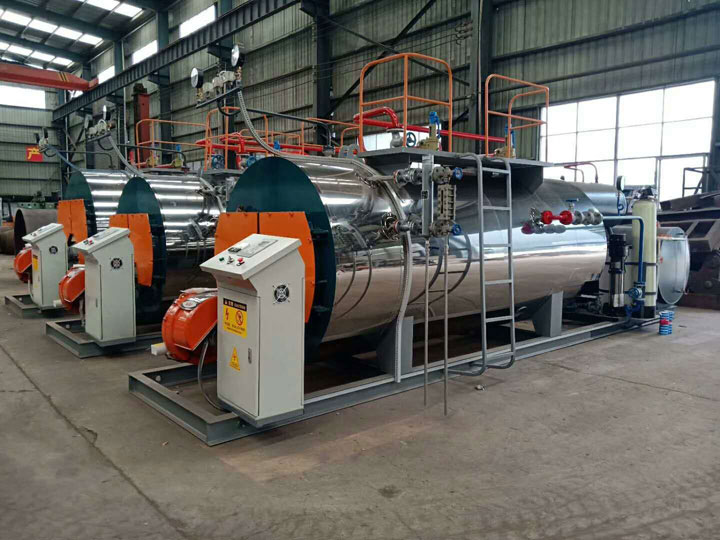
Cost per tonne of steam is the single number that lets you compare boiler options, justify a project, or check whether your plant is running efficiently. It is not a catalogue figure: it is built from your fuel price, your feedwater quality, your load profile and your maintenance regime. This article sets out a transparent method, then works an example for a 6 t/h saturated steam boiler. All numbers below are illustrative engineering assumptions, not quotations or guarantees; substitute your own site data.
The formula
Cost per tonne of steam is the sum of six cost streams divided by the tonnes of steam actually delivered at the outlet:
Cost/t = (Fuel + Feedwater + Chemicals + Electrical power + Maintenance + Labour) / Steam output (t)
Two rules keep the calculation honest. First, use net steam output, not boiler nameplate capacity. Second, allocate fixed costs (labour, maintenance contracts) over realistic annual output, not peak output. If you are still sizing the plant, the capacity and cost guide explains how load factor changes the denominator.
Step 1: Fuel cost
Fuel dominates almost every steam cost calculation. You need three inputs: fuel energy content, boiler efficiency and fuel price.
- Energy required per tonne of steam: heating 1 t of feedwater at 20 °C to saturated steam at 10 bar(g) absorbs roughly 2,770 kJ/kg (enthalpy of steam ~2,780 kJ/kg minus feedwater enthalpy ~84 kJ/kg), i.e. about 2.77 GJ/t. Blowdown and deaeration losses add to this.
- Boiler efficiency: use seasonal efficiency on gross calorific value (GCV). A well-maintained fire-tube boiler on natural gas typically sits around 90–94% (GCV basis); older or fouled units can drop to 80–85%.
- Fuel price: your delivered cost per kWh, per GJ or per litre/tonne, converted to a common unit.
Worked example: 2.77 GJ/t ÷ 0.92 efficiency = 3.01 GJ/t of fuel energy. At an assumed gas price of 12 currency units per GJ, fuel cost is about 36.1 units per tonne of steam. Note that a 5-point efficiency drop (92% to 87%) raises fuel cost by roughly 6%, which is usually the largest single lever you have.
Step 2: Feedwater and chemicals
Water cost has two parts: make-up volume and treatment. A boiler with 5% blowdown and 90% condensate return needs about 0.15 t of make-up per tonne of steam (0.10 t for condensate loss plus 0.05 t for blowdown). At an assumed 2.0 units per m³ for softened water, that is roughly 0.30 units per tonne of steam.
Chemicals (oxygen scavenger, scale inhibitor, alkalinity control, plus blowdown adjustment) are usually quoted per m³ of make-up. At an assumed 3.0 units per m³ of make-up, the chemical cost is about 0.45 units per tonne of steam. Poor feedwater quality increases both blowdown rate and chemical dose, so water treatment is a cost driver, not a fixed overhead.
Step 3: Electrical power and auxiliary loads
Electricity covers the burner fan, feedwater pump, controls and, where fitted, an economiser circulation pump or air compressor. For a 6 t/h packaged boiler, total auxiliary draw is commonly in the 15–30 kW range at full firing, falling with load. Assume 22 kW average and 0.12 units per kWh: 22 × 0.12 = 2.64 units per hour, or about 0.44 units per tonne at 6 t/h output. At part load the specific consumption per tonne rises, which is why load factor matters.
Step 4: Maintenance and labour
Maintenance includes statutory inspections, burner servicing, gaskets, refractory, water-treatment consumables and spares. A common planning assumption is 2–4% of boiler capital cost per year. For illustration only, if the installed boiler package is valued at 300,000 units, 3% gives 9,000 units per year. Spread over 6 t/h × 6,000 operating hours = 36,000 t/year, that is 0.25 units per tonne.
Labour covers boiler operation, water testing and supervision. If one operator spends 25% of a shift on the boiler at an assumed fully loaded rate of 30 units per hour, that is 7.5 units per hour, or 1.25 units per tonne at 6 t/h. Automatic controls and remote monitoring reduce this line item; manual blowdown and daily testing increase it.
Worked example: 6 t/h boiler, summary table
Assumptions: saturated steam at 10 bar(g), feedwater 20 °C, 92% efficiency (GCV), 5% blowdown, 90% condensate return, 6,000 operating hours per year, average load 80% (4.8 t/h average, 28,800 t/year). Prices are illustrative placeholders only.
| Cost stream | Basis / assumption | Units per tonne of steam | Share |
|---|---|---|---|
| Fuel | 3.01 GJ/t at 12 units/GJ | 36.10 | ~88% |
| Feedwater | 0.15 t make-up at 2.0 units/m³ | 0.30 | ~1% |
| Chemicals | 0.15 m³ make-up at 3.0 units/m³ | 0.45 | ~1% |
| Electrical power | 22 kW at 0.12 units/kWh | 0.44 | ~1% |
| Maintenance | 3% of 300,000 units over 28,800 t | 0.31 | ~1% |
| Labour | 25% of one operator at 30 units/h | 1.56 | ~4% |
| Total | Indicative only | ~39.2 | 100% |
Read the table as a structure, not a price. Fuel is roughly 85–90% of the total in most gas-fired installations; in oil-fired or biomass plants the split shifts but fuel still dominates. That is why efficiency, blowdown control and condensate return deserve more attention than squeezing chemical or labour costs.
Checklist before you calculate
- Actual annual steam output in tonnes (from a steam meter, not nameplate).
- Fuel consumption and fuel price in a single consistent unit (GJ or kWh, GCV basis).
- Measured or test-sheet boiler efficiency at your typical load, not the datasheet best point.
- Feedwater temperature, make-up volume and condensate return percentage.
- Blowdown rate and water-treatment chemical dose per m³ of make-up.
- Connected auxiliary load in kW and average operating hours.
- Maintenance spend for the last 12 months, including inspections and spares.
- Operator hours attributable to the boiler room.
Once you have these figures, the calculation takes minutes and the result is defensible in front of a finance team. Review it annually: a fuel price change of 20% moves the total by roughly 17%.
What to send us for a proposal
To size and specify a boiler against your real cost per tonne, send us: required steam flow and pressure (t/h and bar), steam quality (saturated or superheated), feedwater temperature and water analysis, fuel type and its calorific value, annual operating hours and load profile, available footprint and flue route, and any emissions limits. With those inputs we can match a unit from our product range to your duty and give you a configuration you can cost using the method above. We do not publish prices, because the right answer depends on your fuel, your load and your site — but we will tell you exactly which numbers drive the result.


