
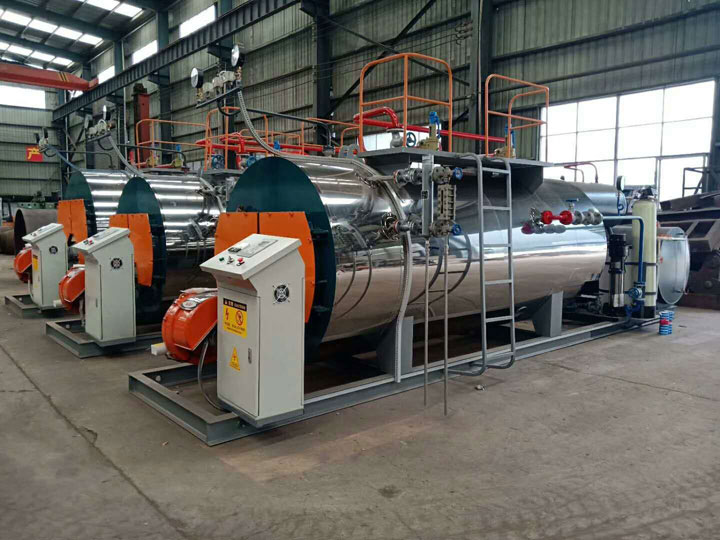
Every square metre of uninsulated boiler shell, pipe or fitting loses heat to the room continuously, and that heat is paid for twice: once as fuel and again as cooling load or overheating. A bare 150 °C steel surface in still air typically sheds on the order of 1.5–2.5 kW/m² by combined convection and radiation, while the same surface under 50 mm of mineral wool drops to roughly 0.15–0.25 kW/m². The arithmetic is simple enough to do before you call anyone, and it tells you where insulation money is best spent. This article covers surface loss calculation, insulation thickness selection, and the fittings — valves, flanges, supports — that are usually left bare. For equipment sizing context, see our capacity and cost guide.
1. Estimating surface heat loss
Combined convection and radiation loss from a surface is usually estimated with a simplified coefficient:
q = h · A · (Ts − Ta)
where q is loss in W, A is surface area in m², Ts is surface temperature, Ta is ambient air temperature, and h is a combined coefficient in W/(m²·K). For still air in an indoor plant room, h of 10–12 W/(m²·K) is a reasonable working value for flat surfaces; for cylinders add a curvature correction, and for outdoor or draughty locations use 15–25 W/(m²·K). These are engineering estimates, not measured values — treat them as a screening tool.
Worked example: a 2 m² section of bare boiler shell at 160 °C in a 25 °C room, h = 11 W/(m²·K): q = 11 × 2 × 135 ≈ 2,970 W, or about 3 kW. Over 6,000 operating hours that is roughly 18,000 kWh of heat that must be replaced by the burner.
2. Insulation thickness and surface temperature
Insulation performance is governed by the thermal conductivity of the material, λ, expressed in W/(m·K). Mineral wool and glass wool blankets typically sit around 0.040–0.055 W/(m·K) at mean temperatures of 100–200 °C; calcium silicate and cellular glass are higher, roughly 0.06–0.09 W/(m·K), but tolerate higher temperatures and moisture better. The design target is usually a surface temperature that is safe to touch (commonly 40–60 °C depending on location and access) rather than a fixed thickness.
The table below gives indicative results for a flat surface at 200 °C in 20 °C still air, using λ = 0.045 W/(m·K) and h = 11 W/(m²·K). Values are calculated estimates for comparison only.
| Insulation thickness (mm) | Approx. outer surface temp (°C) | Heat loss (W/m²) | Relative loss vs bare |
|---|---|---|---|
| 0 (bare) | 200 | ~1,980 | 100% |
| 25 | ~78 | ~640 | ~32% |
| 50 | ~55 | ~385 | ~19% |
| 75 | ~45 | ~275 | ~14% |
| 100 | ~39 | ~210 | ~11% |
Note the diminishing return: doubling from 50 mm to 100 mm roughly halves the loss again, but the first 50 mm captured about 80% of the available saving. Thickness selection is therefore an economic trade-off between insulation cost, space, and the value of the heat saved over the equipment life.
3. Valves, flanges and other fittings
Fittings are where most plants lose their insulation budget. A bare DN100 flange pair or a gate valve on a 180 °C line can lose heat at a rate comparable to 1–2 m of bare pipe, and there may be dozens of them. Removable insulation jackets or boxes for valves and flanges allow maintenance access while restoring most of the pipe insulation performance. As a rule of thumb, allow for fitting losses equal to 10–20% of the straight-pipe loss on a typical steam or hot-water distribution main, more on short runs with many branches.
- Insulate valve bodies and bonnets with removable jackets; leave stems and actuators accessible.
- Cover flange pairs with purpose-made boxes or wrap; bolt covers should remain removable.
- Do not forget pipe supports, hangers and expansion loops, which act as thermal bridges.
- Check that insulation is continuous through penetrations and at boiler manways and inspection doors.
4. From heat loss to fuel and cost
Convert recovered heat to fuel using boiler efficiency. If a boiler runs at 85% efficiency (GCV basis) and the fuel is natural gas at roughly 10 kWh/m³ (GCV), then each 1,000 kWh of avoided surface loss saves about 1,000 / 0.85 ≈ 1,176 kWh of fuel input, or roughly 118 m³ of gas. Multiply by your actual operating hours, load profile and fuel tariff to get annual savings. Do not use nameplate hours — use logged firing hours where available.
Payback is then (installed insulation cost) ÷ (annual fuel saving). What drives cost is not a single number: it is surface area, temperature class, material choice, whether the work is at height or in confined space, whether the plant must stay running (night or shutdown work), removal and disposal of old insulation, and the number of fittings requiring bespoke jackets. Large flat boiler shells are cheap per m²; congested pipe racks with dozens of valves are expensive per metre.
5. Practical checklist before you specify
- Walk the plant and list every bare surface: boiler shell, manways, headers, mains, branches, valves, flanges, supports.
- Record surface temperatures with a contact thermometer or thermal camera, plus ambient temperature.
- Measure or estimate areas: pipe area = π × D × L for each diameter run.
- Note operating hours and whether the line is continuous or intermittent.
- Identify access constraints: scaffolding, height, hot work permits, confined space.
- Check existing insulation condition — wet, crushed or missing cladding performs far below nominal.
- Confirm the fuel type, tariff and boiler efficiency so savings can be converted to money.
Our product range includes boilers and ancillaries where insulation and cladding details can be specified together with the pressure envelope.
What to send us for a proposal
To prepare an insulation scope and estimate, send: a marked-up drawing or photo set showing bare surfaces; pipe diameters and run lengths; surface and ambient temperatures; operating hours per year; fuel type and efficiency; and any access or shutdown constraints. If you also want to review whether the boiler itself is correctly sized for the load, include your load profile and we can cross-check it against the capacity and cost guide. With those inputs we can return a surface-loss estimate, a recommended thickness schedule, and a scope covering valves and flanges.


