
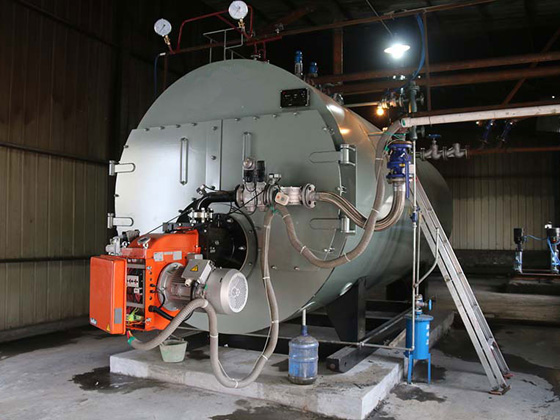
0.35-14 MW
WNS Pressurized Hot Water Boiler, 0.35-14 MW
Closed-loop pressurized hot water boiler for 95/70 and 115/70 systems, 0.35-14 MW, three-pass wet-back shell with modulating burne...
View detailsMembrane-wall water-tube steam boiler with staged combustion and FGR, 6-100 t/h at up to 2.5 MPa and 98% efficiency with heat recovery.
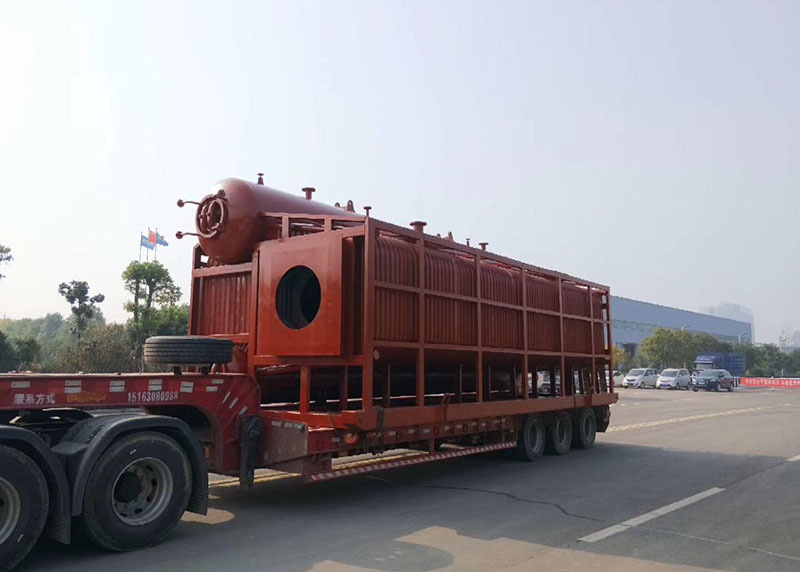
An SZS boiler separates the two jobs a shell boiler does at once. In a fire-tube design the shell is both the pressure boundary and the gas duct, so its diameter grows with output and its plate thickness grows with both diameter and pressure. In a water-tube design the pressure lives in tubes of 51-60 mm outside diameter, and the furnace is a separate gas space enclosed by those tubes.
The walls are membrane panels: water tubes welded edge to edge with a steel fin between them, formed into flat panels in the shop. The result is a gas-tight enclosure with no refractory behind it, apart from small areas at burner and inspection openings. That single change removes most of the maintenance a brick-lined furnace demands — no spalling into the convection bank, no dry-out curve after a rebuild, no slow warm-up to protect the brickwork.
Fire-tube output is limited by shell diameter. A 20 t/h shell is already close to the largest cylinder that can travel by road, and at 2.5 MPa the tubesheets become very thick, which drives cost and makes the tube-to-tubesheet welds harder to inspect and keep cool. Above that point the water-tube layout wins on almost every measure: the pressure envelope stays thin, the furnace volume can be made as large as the NOx target needs, and the unit ships as modules rather than one heavy lift.
What it gives up is simplicity. Water-tube boilers hold less water per unit output, respond faster, and punish bad chemistry harder: a scale layer on a tube seeing high heat flux raises metal temperature quickly, and there is no large water volume to absorb a load step. That is why the SZS is usually paired with a deaerator, continuous blowdown and an operator who watches conductivity rather than a level glass alone.
The flame fills the membrane-wall furnace, gas turns at the rear and crosses a convection bank built from bare and extended-surface tubes, then leaves for the economiser and condenser. Saturated steam collects in the drum on top; the drum also carries the internal cyclone separators that keep carryover low, which matters more here than in a shell boiler because the steam space is smaller relative to output.
Where process needs dry steam above saturation, a superheater is inserted between the furnace exit and the convection bank. Its surface is kept modest and the attemperator does the rest, because a superheater run too hot is the most expensive place on the boiler to have a tube fail.
Air is introduced in stages: the burner supplies a fuel-rich primary zone, and the balance arrives downstream through over-fire ports, so the flame core never reaches the temperature that makes thermal NOx quickly. Flue-gas recirculation then dilutes the oxidiser in that core with cooled gas drawn from the tail. Together they hold NOx at or below 30 mg/Nm³ at 3% oxygen, which is the design aim for this series and the limit applied in the strictest Chinese urban regulations.
That figure is a design target confirmed by a stack test after commissioning, not a certificate. Actual results move with burner adjustment, gas composition and the load point chosen for the test, and a unit tuned for 20 mg at full fire may read differently at half load.
Units up to about 20 t/h ship in a small number of pre-assembled modules that bolt together on site; larger ones are erected panel by panel, which is why the site programme lengthens and why foundation bolts and steel setting-out drawings matter so much. Typically the equipment is ready 25-45 days after drawing approval, with 5-10 days of site commissioning by our engineers.
The boiler suits plants with a steady base load — dairies, breweries, paper machines, chemical reactors, oilfield steam injection — and it follows load well within its control range but does not like being asked to swing from 20% to 100% several times an hour. Where the load profile is genuinely spiky, a smaller shell boiler as a swing unit alongside a base-load SZS is often the cheaper arrangement than one large water-tube unit asked to do both jobs.
Shell thickness and transport width become the limit: a 20 t/h fire-tube at 2.5 MPa is already a heavy, wide lift. Water-tube puts the pressure in small tubes, keeps the furnace volume free for NOx control, and ships as modules.
Demineralised or well-softened water with a deaerator and continuous blowdown, monitored by conductivity. Heat flux in a water-wall tube is high, so scale raises metal temperature fast and tube life falls with it.
Yes. A superheater is inserted after the furnace exit with attemperation to hold the outlet temperature, typically for process duties that need dry steam or for turbine supply.
| Model | SZS6-1.25/1.6/2.5-Q | SZS10-1.25/1.6/2.5-Q | SZS15-1.25/1.6/2.5-Q | SZS20-1.25/1.6/2.5-Q | SZS25-1.25/1.6/2.5-Q | SZS30-1.25/1.6/2.5-Q |
|---|---|---|---|---|---|---|
| Rated evaporation | 6 t/h | 10 t/h | 15 t/h | 20 t/h | 25 t/h | 30 t/h |
| Rated pressure | 1.25/1.6/2.5 MPa | 1.25/1.6/2.5 MPa | 1.25/1.6/2.5 MPa | 1.25/1.6/2.5 MPa | 1.25/1.6/2.5 MPa | 1.25/1.6/2.5 MPa |
| Heating surface (body) | 125.6 m² | 205.6 m² | 216.8 m² | 271.5 m² | 285.2 m² | 392.3 m² |
| Economiser surface | 63.4 m² | 132.2 m² | 283.6 m² | 411.2 m² | 504.8 m² | 471.2 m² |
| Condenser surface | 41.5 m² | 62.8 m² | 101.1 m² | 134.7 m² | 168.3 m² | 252.4 m² |
| Gas consumption (LNG) | 432 Nm³/h | 720 Nm³/h | 1080 Nm³/h | 1440 Nm³/h | 1800 Nm³/h | 2160 Nm³/h |
0.35-14 MW
Closed-loop pressurized hot water boiler for 95/70 and 115/70 systems, 0.35-14 MW, three-pass wet-back shell with modulating burne...
View details
50 t/h
The SZS50-1.6-Q is a 50 t/h D-type double-drum water-tube boiler delivering 1.6 MPa steam at 204 °C. It achieves 95% efficiency (L...
View details
0.1-2 t/h
Multi-pass packaged steam generator, 0.1-2 t/h at 0.4-0.7 MPa, small water content and fast start for pressing, food and sterilizi...
View detailsExternal links open the publisher’s website and are provided for background reading.
Include the capacity (t/h or MW), fuel, working pressure and site country so the proposal matches your permit limits.
We appoint one or two partners per country to quote, deliver and service our boilers locally. Territory protection, factory pricing and commissioning support are part of the agreement.