
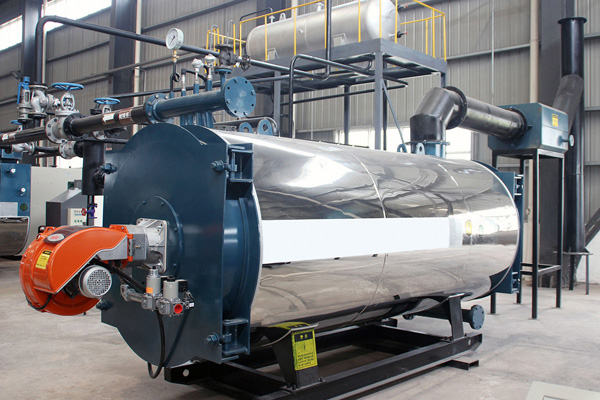
Every kilogram of high-pressure condensate or boiler blowdown that is throttled to a lower pressure releases flash steam. That steam is low-pressure but usable for deaeration, space heating, or low-pressure process loads. The engineering question is not whether flash exists, but how much, where it can go, and whether the recovered heat justifies the piping, vessels, and controls. This article gives the calculation method, header sizing logic, and the payback framework we use when evaluating flash recovery on industrial steam systems. For the equipment side, see our product range; for sizing context across boiler sizes, the capacity and cost guide is a useful companion.
1. The flash fraction calculation
When saturated liquid at pressure P1 is throttled to pressure P2, the sensible heat drop is converted into latent heat at P2. The flash fraction is:
x = (hf1 − hf2) / hfg2
where hf1 is saturated liquid enthalpy at P1, hf2 is saturated liquid enthalpy at P2, and hfg2 is latent heat at P2. All in kJ/kg.
Worked example: saturated condensate at 10 bar(g) throttled to 0.5 bar(g). Using standard steam tables: hf at 11 bar(a) ≈ 781 kJ/kg; hf at 1.5 bar(a) ≈ 467 kJ/kg; hfg at 1.5 bar(a) ≈ 2226 kJ/kg. Then x = (781 − 467) / 2226 ≈ 0.141, or about 14% by mass. A 1,000 kg/h condensate flow yields roughly 141 kg/h of flash steam at 0.5 bar(g).
For blowdown, the same equation applies, but the liquid is boiler water at saturation, so the flash fraction is slightly higher than for condensate at the same pressure because there is no subcooling. Continuous blowdown at 10 bar(g) flashed to 0.5 bar(g) gives approximately 15–16% flash by mass, depending on the feedwater and boiler water temperatures assumed.
2. Recovery header and vessel sizing
The flash vessel is a vertical separator sized on steam velocity, typically 1.5–3 m/s at the operating pressure to allow droplets to fall out. The header carrying flash steam to the point of use should be sized for 15–25 m/s steam velocity at low pressure; higher velocities increase pressure drop and noise. A common mistake is sizing the flash header like a high-pressure steam line, which produces an oversized, expensive pipe and slow response.
Table 1 gives indicative flash fractions and recovered heat for common pressure pairs. Assumptions: saturated liquid at the higher pressure, flash to the lower pressure, steam tables per IAPWS-IF97, no heat loss in the vessel or header.
| Upstream pressure (bar g) | Flash pressure (bar g) | Flash fraction (% mass) | Flash steam per 1,000 kg/h (kg/h) | Latent heat at flash pressure (kJ/kg) |
|---|---|---|---|---|
| 5 | 0.5 | ~10.5 | ~105 | ~2226 |
| 10 | 0.5 | ~14.1 | ~141 | ~2226 |
| 10 | 1.5 | ~9.5 | ~95 | ~2200 |
| 16 | 0.5 | ~17.5 | ~175 | ~2226 |
| 16 | 2.0 | ~12.0 | ~120 | ~2190 |
Values are indicative and should be recalculated for the actual boiler pressure, blowdown rate, and condensate return temperature. Subcooled condensate (for example, from a heat exchanger with a long drain leg) will flash less than the table suggests.
3. Where the flash steam can go
Flash steam is only worth recovering if there is a continuous, low-pressure load that would otherwise take live steam. Typical destinations:
- Deaerator heating: the most common and most robust use. Flash steam displaces low-pressure steam in the deaerator, directly reducing boiler fuel demand.
- Low-pressure process: tanks, dryers, or jacket heating at 0.5–2 bar(g), provided the load profile matches the flash availability.
- Space heating: seasonal, so it rarely justifies a dedicated recovery system on its own but can absorb surplus in winter.
If no load exists, flash recovery becomes a heat-recovery problem rather than a steam problem: condense the flash in a feedwater preheater or an economizer-style exchanger instead of venting it.
4. Payback logic without inventing numbers
Payback is driven by four variables, and we deliberately do not quote prices because they vary with pressure rating, materials, layout, and controls scope. The logic is:
- Recovered energy: flash mass flow × latent heat at the flash pressure, in kW. For 141 kg/h at 2226 kJ/kg, that is about 87 kW of recovered heat.
- Fuel displaced: recovered kW divided by boiler efficiency (typically 80–90% for industrial steam boilers on gas) gives the fuel input avoided. At 85% efficiency, 87 kW of steam heat corresponds to roughly 102 kW of fuel input.
- Operating hours: the same system on 8,000 h/year recovers far more than one on 2,000 h/year. Annual energy savings scale linearly with hours.
- Capital scope: flash vessel, safety valve, level and pressure controls, header, insulation, and tie-in to the existing deaerator or process. Retrofit difficulty (space, shutdown window, pipe routing) is often the largest cost driver, not the vessel itself.
A useful screening rule: if the recovered heat is below roughly 30–50 kW and operating hours are under 4,000 per year, the project is usually marginal unless it is bundled with a larger condensate or blowdown upgrade. Above 100 kW with continuous operation, flash recovery is normally worth a detailed study.
5. Checklist before you size anything
- Confirm actual boiler operating pressure, not design pressure.
- Measure or estimate continuous blowdown rate (often 1–5% of evaporation; manual skimming is not a steady source).
- Log condensate return temperature and flow over a full week, including weekends.
- Identify a continuous low-pressure load and its pressure requirement.
- Check whether the existing deaerator already receives flash from a condensate vessel.
- Verify flash vessel location relative to the deaerator to keep header pressure drop low.
- Confirm drain and overflow routing for the residual liquid.
- Review shutdown windows for tie-in and any permit implications.
What to send us for a proposal
To move from concept to a sized proposal, send: boiler operating pressure and evaporation rate; continuous blowdown rate or method of control; condensate return flow and temperature logs; the intended flash steam destination and its pressure and load profile; a sketch or photos of the boiler house layout around the blowdown and deaerator; and annual operating hours. With those inputs we can calculate the flash fraction, size the vessel and header, and set out the scope and cost drivers. Browse the product range for flash vessels and blowdown equipment, and use the capacity and cost guide to frame the boiler-side context before you request a proposal.


