
Steam is sold by mass but sized by heat
Boiler capacity is quoted in tonnes of steam per hour, and that figure hides a definition. A 1 t/h rating means the boiler evaporates 1,000 kg/h of saturated steam from feedwater at 20 °C at the rated pressure. Change the feedwater temperature and the same boiler makes a different mass of steam, because the heat required per kilogram has changed. At 1.25 MPa, saturated steam carries 2,785 kJ/kg and water at 20 °C carries 84 kJ/kg, so each kilogram absorbs 2,701 kJ. That is 750 kW for 1 t/h, a conversion worth memorising: 1 t/h is 0.75 MW, and 100 kW of process load is about 134 kg/h.
Sizing therefore starts with a heat balance in kW or GJ/h, not with a guessed tonnage. The tonnage follows once the pressure and the feedwater temperature are fixed. Most oversizing and most shortfalls come from skipping one of those two steps.
Build the demand inventory from the process
Walk the plant and list every steam consumer with its rated consumption at its own working pressure, then its realistic duty cycle. The listed figure on a machine nameplate is usually the manufacturer’s maximum, not the plant’s average. A jacketed kettle rated at 300 kg/h may draw that for 40 minutes and nothing for two hours.
Three sources of load are easy to miss. Steam tracing and pipe heating is small per metre but continuous over hundreds of metres. Deaeration and feedwater heating consume steam inside the boiler house, not at the process. And blowdown is a continuous draw that shows up as fuel, not as steam at the header. Add 3-5% for blowdown and 2-3% for radiation and margin losses in the boiler house itself.
Where the plant already runs, measure rather than estimate. A clamp-on ultrasonic flow meter on the main header for a week, logged at one-minute intervals, gives a load duration curve that no nameplate can match. Where the plant is new, take the equipment list and the batch recipes, and build the load from the process step times.
Diversity, peaks and the margin you actually need
Connected load is the sum of every consumer running flat out at once. It almost never happens, and sizing to it produces a boiler that runs at 30% load for its whole life, cycling, condensing in the stack and wasting money. Apply a diversity factor per consumer based on how it is operated, then add a peak factor for simultaneous starts.
The peak is shorter and larger than the average. A dyehouse starting three machines together, a press line charging, a laundry opening at 07:00: each draws 1.5-2 times the average for minutes. Either the boiler covers that peak, or a steam accumulator covers it, or the plant accepts a pressure dip. Decide which, because the three choices have very different costs.
A 10-20% margin above the corrected peak is enough where the load inventory is measured. Where it is estimated from nameplates, 25% is more honest. Beyond 30% margin, the boiler is being bought for a load that does not exist, and part-load efficiency and cycling losses will eat the difference.
Correct the rating to your feedwater and pressure
The datasheet rating assumes 20 °C feed. If the plant returns condensate and deaerates at 105 °C, the feed entering the boiler is around 104 °C and carries 436 kJ/kg. The heat needed per kilogram falls from 2,701 to 2,349 kJ, so a boiler rated 1.5 t/h at 20 °C will evaporate about 1.72 t/h at the same firing rate. That is not a bonus; it is the same boiler doing the same duty with less of its output spent heating cold water. It matters because a plant that sizes on the 20 °C rating and then installs a deaerator has bought a boiler 15% larger than it needed.
Pressure works the other way. Raising the design pressure from 1.25 to 1.6 MPa raises the saturated steam enthalpy only slightly, from 2,785 to 2,793 kJ/kg, but it thickens the shell and raises the cost. Specify the lowest pressure that satisfies the highest-pressure consumer plus the line loss, typically 0.1-0.2 MPa. A plant that asks for 1.6 MPa because one machine needs 0.8 MPa is buying steel it will never use.
A worked sizing for a food plant
The plant cooks, blanches, dries and cleans. Each consumer was metered for a week during normal production. The table shows rated draw, the observed duty factor and the resulting average. Pressures range from 0.3 to 0.6 MPa, so the header is set at 0.8 MPa at the boiler and reduced at each branch.
| Consumer | Rated draw (kg/h) | Duty factor | Average (kg/h) |
|---|---|---|---|
| Blancher | 380 | 0.90 | 342 |
| Jacketed kettles (4) | 240 | 0.65 | 156 |
| Clean-in-place | 120 | 0.50 | 60 |
| Tunnel dryer | 260 | 0.85 | 221 |
| Steriliser | 180 | 0.60 | 108 |
| Tracing and deaerator | 90 | 0.80 | 72 |
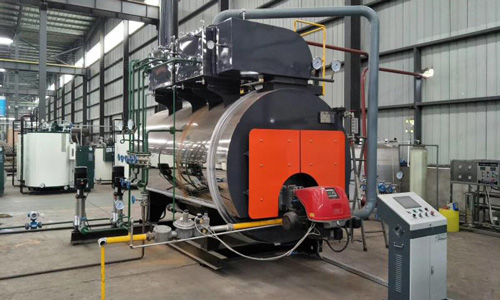
Connected load is 1,270 kg/h; the diversified average is 959 kg/h. The measured peak, when the dryer and blancher coincide with a CIP start, is 1,180 kg/h for 12 minutes. Adding 3% blowdown gives 1,215 kg/h, and a 15% margin on the peak gives 1,400 kg/h. The plant selected a 1.5 t/h fire-tube boiler at 1.0 MPa, with feedwater at 60 °C from a condensate receiver and no deaerator.
At 60 °C feed the heat per kilogram is 2,536 kJ. The 1.5 t/h rating corresponds to 4.05 GJ/h of heat, which at 2,536 kJ per kilogram is 1.60 t/h of actual evaporation, or 1.13 MW against the 1,215 kg/h peak. That is a 31% margin at the firing rate, which sounds generous but is the right answer for a boiler whose minimum stable fire is 25% of rating: the plant will run at 60-75% load most of the day, which is where a fire-tube boiler is happiest.
What to write in the specification
State the load in kg/h at the header, the pressure at the boiler outlet, the feedwater temperature, the blowdown allowance and the fuel. State the altitude if it is above 500 m, because burner output falls with air density. State the NOx limit with its reference oxygen. Then ask for the guaranteed efficiency at 100%, 75% and 50% load, not a single figure, because the part-load number is what the plant will actually pay for.
The most common sizing error is not arithmetic. It is specifying a boiler for the connected load, then discovering that the plant runs at 40% average and the boiler cycles eight times an hour. A second common error is forgetting that a 1.5 t/h boiler cannot deliver 1.5 t/h of steam at 0.3 MPa to a process that needs it at 0.6 MPa, because the reducing valve does not create energy. Size for the heat, correct for the feed, and keep the margin modest.


