

1-10 t/h
WNS Gas Steam Boiler Package for Pharmaceutical Plants
A packaged WNS gas steam boiler with clean steam generator, sized 1-10 t/h at 1.0-1.25 MPa, for fermentation, granulation, sterili...
View detailsVertical three-pass packaged steam boiler for small loads, 0.1-1 t/h at 0.7-1.0 MPa, with a 1.3 m square footprint and fast cold start.
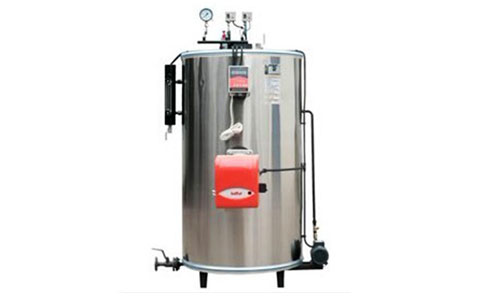
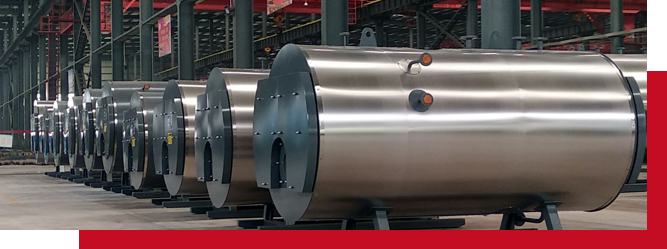
The LSS is a vertical shell with a cylindrical furnace standing on the centre line. The burner is mounted at the top and fires down into that furnace, which is where the first pass happens. At the bottom the gas turns into an annular bundle of water tubes, rises through it as the second pass, turns again at the top and descends through a second annulus as the third pass, leaving through a flue connection at the rear. The flame is long and fully developed before it reaches the reversal point, which is why a unit this small can still burn out cleanly at low excess air.
Everything sits inside one casing about 1.3 to 1.9 m square and 2.5 to 3.3 m tall. There is no separate economiser, no large external flue box and no bedplate longer than the boiler itself: the whole packaged unit arrives on a single skid, is set on a level slab, connected to gas, water, steam and drain, and started.
The water content is the defining number. A 0.5 t/h vertical holds around 1 m³ against perhaps 3.6 t in a horizontal shell of the same output. A cold start therefore takes minutes rather than the better part of an hour: the mass to heat is small and the heat flux is high. For a laundry opening at six in the morning, or a plant that needs steam for a single shift, that difference shows up directly in gas burnt before the first useful kilogram of steam.
The same number has a cost. A small water volume means little buffer. A sudden draw of 300 kg of steam drops the pressure faster than the burner can answer, and the resulting surge can carry moisture into the main. Steam quality depends on a separator and on steady demand; where the load is genuinely spiky, a small horizontal unit with a larger steam space is the more forgiving choice.
Floor area is the main argument. A 1 t/h vertical occupies about 1.9 by 1.8 m, where the equivalent fire-tube needs over 8 m² and a door swing in front. In a city-centre laundry, a hospital basement or a food unit rented by the square metre, that is decisive. Height is the price: check the headroom to the ceiling and the clearance above the flue before ordering.
The second argument is installation. No crane, no special foundation beyond a level slab, and the unit can be moved through a standard double door in sections if needed. The third is part-load behaviour: with a modulating burner and a small water volume, the boiler reaches its set point quickly and then holds it, so short duty cycles do not waste a long warm-up each time.
Heat flux in the furnace of a vertical boiler is high, and the tubes are close together. Scale that would be tolerable in a large shell boiler will lift metal temperature past the safe limit in a season, and the tube that fails is usually the one nearest the flame. Softened water is the minimum; where the unit runs continuously, a small reverse-osmosis set is worth the money. Blowdown should be done daily by the operator, not left to an automatic valve that nobody checks.
Low water protection is equally important. At this size the burner can dry the furnace in a very short time, so the low-water cut-out must be tested weekly and the probe cleaned at every service. The control panel carries high and low level alarms, very low level lockout, overpressure cut-out and flame failure protection as standard.
Choose the vertical unit for loads up to about 1 t/h where space is tight and duty is intermittent: clinics and sterilisers, small dairies and bakeries, garment pressing, greenhouse heating, bitumen tanks, and standby steam for a larger plant during maintenance. Above 1 t/h the number of vertical shells needed to cover the load makes the horizontal WNS the cheaper and more efficient answer, and the vertical’s footprint advantage disappears once you need two of them.
Fuel is normally gas or light oil; heavy oil is not offered because the small furnace and tight tube spacing cannot tolerate the ash and the preheat the fuel needs. Where gas pressure is marginal, check the burner’s minimum inlet pressure against the supply before the unit is ordered — a regulator that cannot hold 20 mbar at peak will cause more call-outs than any other part of the installation.
Typically within 5-10 minutes to working pressure, because the water content is around 1 m³ and the furnace heat flux is high. A horizontal shell of the same output needs considerably longer.
Yes where the load is intermittent and space is short. If the plant runs continuously near full output, a horizontal WNS is more efficient and gives steadier steam pressure, and the vertical's footprint advantage no longer compensates.
Only a level concrete slab able to carry the wet weight plus a margin, with the flue and drain positions set out. No separate bedplate or plinth is required, though the floor must take the point loads at the skid feet.
| Model | LSS0.3-0.7-Q | LSS0.5-0.7-Q | LSS0.7-0.7-Q | LSS1-1.0-Q |
|---|---|---|---|---|
| Rated evaporation | 0.3 t/h | 0.5 t/h | 0.7 t/h | 1 t/h |
| Working pressure | 0.7 MPa | 0.7 MPa | 0.7 MPa | 1.0 MPa |
| Steam temperature | 170 °C | 170 °C | 170 °C | 184 °C |
| Heating surface | 8.4 m² | 15 m² | 21.5 m² | 26 m² |
| Water content | 0.7 m³ | 1.05 m³ | 1.63 m³ | 1.65 m³ |
| Shipping weight | 2.1 t | 2.7 t | 3.64 t | 3.8 t |
1-10 t/h
A packaged WNS gas steam boiler with clean steam generator, sized 1-10 t/h at 1.0-1.25 MPa, for fermentation, granulation, sterili...
View details1-100 t/h (0.7-70 MW)
Packaged three-pass wet-back fire-tube steam boiler for gas and oil, 1-100 t/h at 1.25 MPa, with matched modulating burner and ful...
View details
10 t/h
The SZS10-1.6-Q is a 10 t/h D-type double-drum water-tube steam boiler rated at 1.6 MPa and 204 °C, firing natural gas, LPG, light...
View detailsExternal links open the publisher’s website and are provided for background reading.
Include the capacity (t/h or MW), fuel, working pressure and site country so the proposal matches your permit limits.
We appoint one or two partners per country to quote, deliver and service our boilers locally. Territory protection, factory pricing and commissioning support are part of the agreement.