

2 t/h
2 t/h Gas/Oil Steam Boiler WNS2-1.25-Q
The WNS2-1.25-Q is a packaged three-pass wet-back fire-tube steam boiler rated at 2 t/h and 1.25 MPa, delivering 194 °C steam at 9...
View detailsHorizontal three-pass hot water boiler for gas and oil, 0.35-70 MW at 85/65 °C, atmospheric shell with large water volume for stable heating output.
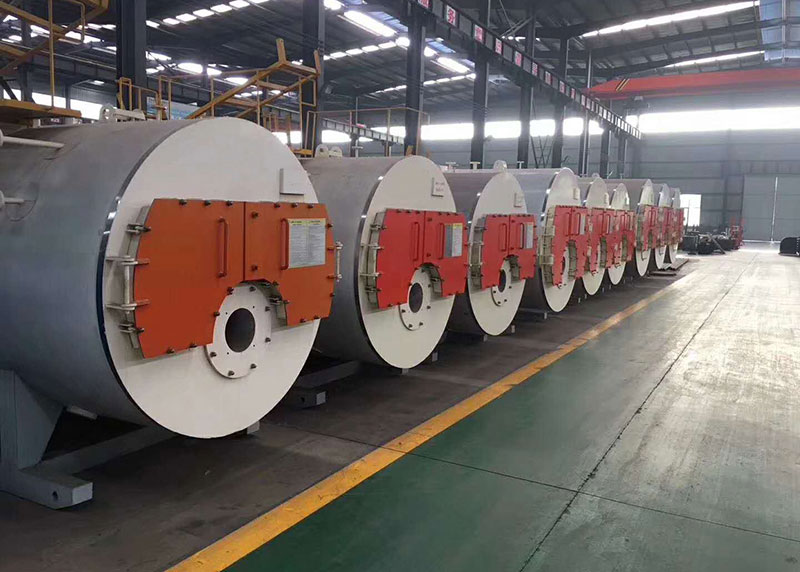
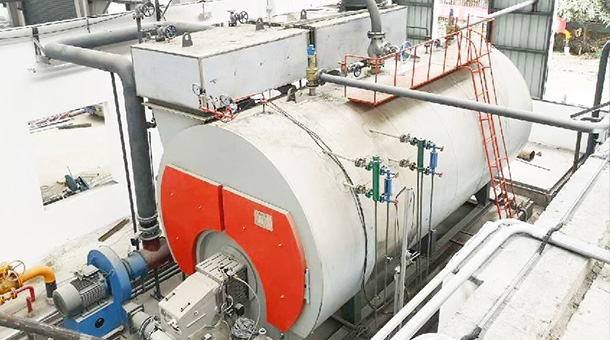
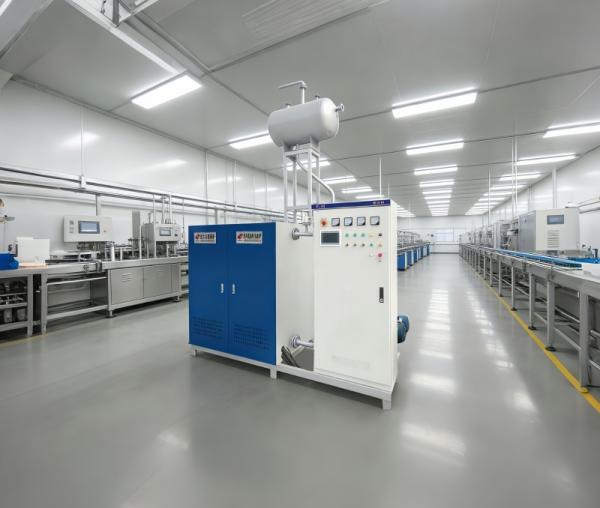
The WNS/CWNS hot water range uses the same shell as the steam series, with the steam space replaced by a flow path from the return connection to the outlet. Water enters at 65 °C, passes the furnace and the two convective bundles in a baffled path, and leaves at 85 °C. There is no water level to control, no steam drum and no superheater to protect; the control loop modulates the burner against flow temperature, with an independent high-limit cut-out behind it.
Water volume is large for the output, from 420 litres at 0.35 MW to 4,100 litres at 2.8 MW. The boiler therefore behaves as a thermal flywheel: short draw-offs and valve movements are absorbed by the water mass rather than answered by a burner start, which cuts cycling and keeps the flue gas clean at part load.
The CWNS build is open to atmosphere through the expansion tank, so the shell never sees gauge pressure. That allows a lighter shell, a simple rectangular plant room layout, and a unit that can sit in a basement without the clearances a pressure vessel demands. Rules on inspection differ between countries and the authority having jurisdiction should confirm the position before the plant room is drawn.
The cost is a temperature ceiling. Water at atmospheric pressure boils at 100 °C, so 85/65 and 95/70 are comfortable while 115/70 is not. Systems that need 115 °C, or a sealed loop with static head above the tank, use the pressurized version of the same shell.
Gas leaves the furnace at around 1,400 °C, turns in the water-backed reversal chamber, crosses the second-pass bundle and returns through the third, leaving at 150-165 °C. Efficiency depends on that final number, and the final number depends on the return water temperature. With gas firing, a 65 °C return stays well above the acid dew point and the last pass runs dry all winter.
Heavy oil changes the picture. Sulphur in the fuel raises the dew point, so the design keeps the return above 60 °C and the stack above 150 °C. Run below those values and the tube surfaces stay wet with sulphuric acid; the bundle then fails from the outside in, a failure that looks like bad steel but is really a water-temperature problem. A three-way mixing valve that holds the return above its limit is cheap insurance.
Size from the building load, not from the connected radiator capacity. A well-insulated office needs 50-70 W/m², an older factory 100-150 W/m², and the boiler should meet the design-day load at 80-90% output so there is reserve for the coldest week. Domestic hot water should be counted as a separate block when the calorifier is large, because it peaks at the same time as the heating on winter mornings.
Where the heating circuit is extensive, a primary-secondary arrangement with a plate heat exchanger protects the boiler from dirty system water and lets the primary loop run at a fixed flow with a buffer vessel. That also separates the boiler’s minimum flow requirement from the radiator circuit’s variable flow, which is the usual cause of short cycling in a directly connected system.
The unit needs a level slab, combustion air openings sized for the burner, and a chimney of at least 8 m or the height set by the local environmental approval, whichever is greater. Make-up water should be metered: a rising make-up figure is the earliest warning of a leak in an underground main. Insulate the hot water pipework and the expansion tank connection, and leave the front smoke box door swing clear, because that door will be opened every year.
CWNS is the atmospheric hot water build in the table above, open to atmosphere through the expansion tank. WNS denotes the pressurized shell used for steam and for hot water above 100 °C. Both share the three-pass wet-back layout.
Not as an atmospheric unit, because water at atmospheric pressure boils at 100 °C. A 115/70 regime needs the pressurized build at 1.0-1.25 MPa, which is a separate selection.
A flow-temperature sensor modulates the burner between low and high fire, typically at 5:1 turndown, with a fixed high-limit thermostat as backup. A buffer vessel or primary loop smooths the response where the load changes quickly.
| Model | CWNS0.35-85/65-Q | CWNS0.58-85/65-Q | CWNS0.7-85/65-Q | CWNS1.4-85/65-Q | CWNS2.1-85/65-Q | CWNS2.8-85/65-Q |
|---|---|---|---|---|---|---|
| Rated heat output | 0.35 MW | 0.58 MW | 0.7 MW | 1.4 MW | 2.1 MW | 2.8 MW |
| Working pressure | Atmospheric | Atmospheric | Atmospheric | Atmospheric | Atmospheric | Atmospheric |
| Outlet / return temperature | 85/65 °C | 85/65 °C | 85/65 °C | 85/65 °C | 85/65 °C | 85/65 °C |
| Thermal efficiency | 93-94% | 93-94% | 93-94% | 93-94% | 93-94% | 93-94% |
| Water content | 420 L | 900 L | 1050 L | 2300 L | 3700 L | 4100 L |
| Shipping weight | 1280 kg | 1900 kg | 2100 kg | 3750 kg | 4950 kg | 8100 kg |
2 t/h
The WNS2-1.25-Q is a packaged three-pass wet-back fire-tube steam boiler rated at 2 t/h and 1.25 MPa, delivering 194 °C steam at 9...
View details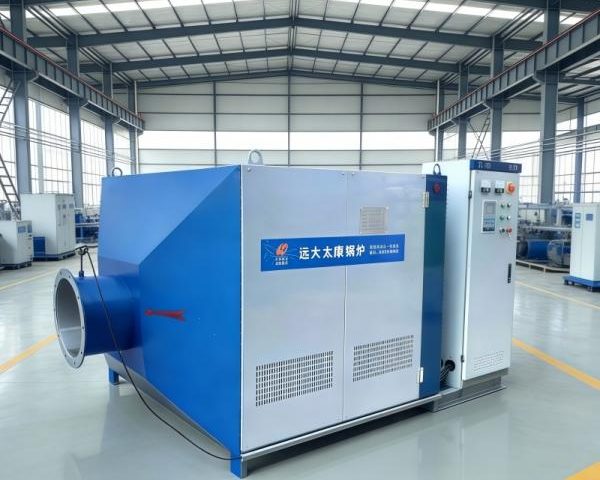
0.5-4 t/h
Small packaged condensing gas steam boiler, 0.5-4 t/h, low water volume, quick cold start and 96-97 per cent efficiency on the low...
View details1-20 t/h
Gas-fired steam boiler package for textile and dyeing plants. SZS or WNS boilers deliver 1-20 t/h at 1.0-1.6 MPa, handling batch d...
View detailsExternal links open the publisher’s website and are provided for background reading.
Include the capacity (t/h or MW), fuel, working pressure and site country so the proposal matches your permit limits.
We appoint one or two partners per country to quote, deliver and service our boilers locally. Territory protection, factory pricing and commissioning support are part of the agreement.