
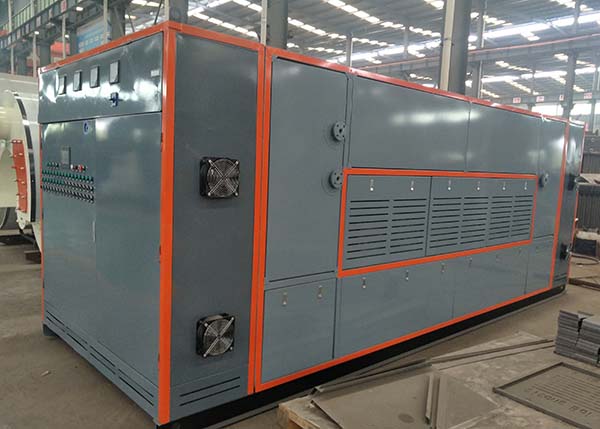
0.35-2.8 MW
CWDR Electric Hot Water Boiler, 0.35-2.8 MW
Horizontal electric hot water boiler, 0.35-2.8 MW at 85/60 °C, for district heating, hospitals and process hot water without a flu...
View detailsParallel 50-100 kW electric steam modules, 0.1-1 t/h at 0.4-0.7 MPa, staged by PLC so part-load efficiency holds and one module is always spare.
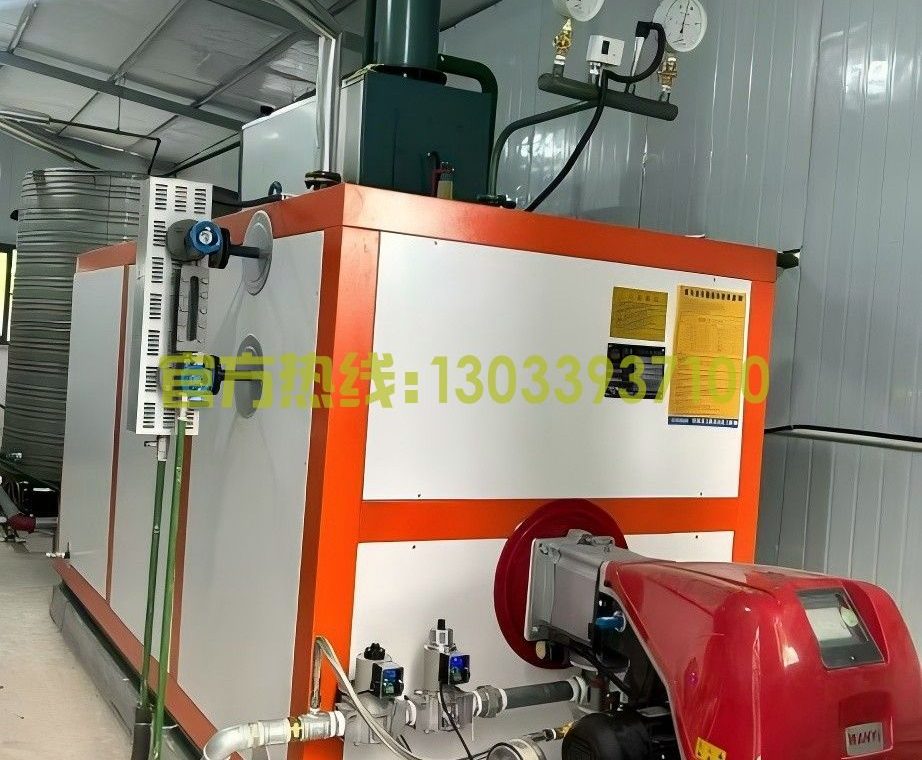
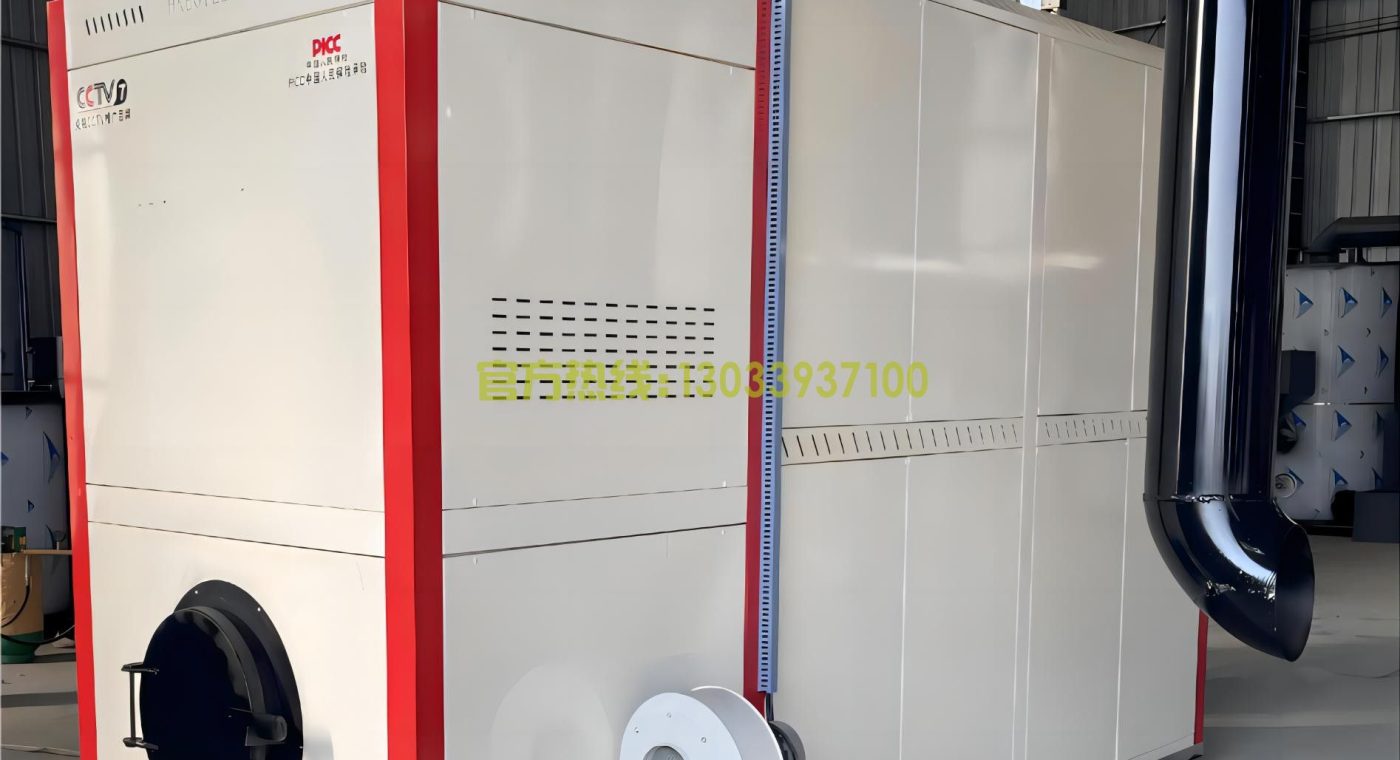
The modular electric steam generator is not one vessel but a bank of them. Each module is a complete packaged generator of 50, 60, 80 or 100 kW with its own element bundle, level electrodes, pressure switch, safety valve and controller; the modules share a feedwater manifold and a steam header and are coordinated by one master PLC. A single 100 kW module makes about 0.13 t/h, so a 1 t/h installation is eight modules and a 0.4 t/h installation is three.
The arrangement exists because electric steam is usually wanted in small quantities with a load that varies. A single 800 kW vessel would spend most of its life at 20 to 40 per cent load, switching a large element group on and off; eight modules can meet the same load with two running and six idle, then bring a third on line when demand rises.
An electric generator has no flue, so it has no stack loss and no purge loss, and its part-load behaviour is governed almost entirely by standing loss from the casing. A module at rest loses 1 to 2 per cent of its rating; a module at full output converts 97 to 98 per cent of the metered energy into steam. Staging keeps the running modules near full output, so the bank holds 96 to 97 per cent overall even at 30 per cent demand.
The arithmetic shows why this matters. At full load a tonne of steam takes about 760 kWh. At 30 per cent load on an 800 kW bank, two modules carry 240 kW while the casing loss of the whole bank stays roughly 12 kW, so the figure rises to about 810 kWh per tonne. A gas boiler of the same size, cycling at 30 per cent demand with a purge before every light-up, loses 2 to 4 efficiency points in the same band, and it cannot turn down below about a quarter of rating without stopping.
An 800 kW bank draws 1216 A at 380 V three-phase, which is a dedicated transformer of about 1,000 kVA and a cable run of two or three parallel 185 mm² feeders. Each module needs its own isolator and its own earth-leakage protection, set at 300 mA for equipment protection, and the master controller needs a signal from each breaker so that a module that is switched out is not counted as available. Resistive load has a power factor near unity and produces no harmonic current, which keeps the connection study simple; the switch-on step of a 100 kW module is about 152 A and is taken in sequence rather than all at once.
Utility connection is usually longer than manufacture: a new 1,000 kVA service takes eight to sixteen weeks in most networks, so the application should be lodged as soon as the steam load is fixed.
Modules discharge into a common header sized for 15 to 20 m/s at full output, with a non-return and an isolation valve on each branch so a module can be removed while the rest run. Each has its own blowdown connection to a common vessel, because the small water volume concentrates salts quickly and blowdown must be frequent rather than large. A softener sized at 1.1 times total evaporation, holding hardness near 0.03 mmol/L, is the difference between 20,000 hours of element life and an annual element bill.
The bank is normally specified with one module spare, so eight modules cover a 0.9 t/h duty and a failed unit costs capacity rather than steam. A module is isolated at its breaker, drained, and unbolted from the header in about four hours; because it is a packaged generator rather than a shell, the work does not need a pressure-vessel welder. There is no burner, no flame-detection chain and no flue to sweep. What remains is an annual electrical inspection, a water test and element replacement as a consumable item.
The master controller rotates the lead module so that running hours stay even, and it reports per-module current, which is the earliest sign of a failing element: a bundle that draws less current than its neighbours has already lost part of its surface to scale or a break.
| Modules | Evaporation | Connected power | Current at 380 V | Steam temperature | Footprint |
|---|---|---|---|---|---|
| 1 | 0.13 t/h | 100 kW | 152 A | 170 °C | 1.2×0.8 m |
| 3 | 0.39 t/h | 300 kW | 456 A | 170 °C | 2.8×1.0 m |
| 6 | 0.79 t/h | 600 kW | 912 A | 170 °C | 5.2×1.2 m |
| 8 | 1.05 t/h | 800 kW | 1216 A | 170 °C | 6.8×1.2 m |
Because part-load efficiency holds and a failure costs a fraction of the capacity. Eight modules can run two at full output at low demand, and one can be serviced while the rest supply steam.
About 800 kW connected, or 1216 A at 380 V three-phase, with a transformer of roughly 1,000 kVA. The utility connection is normally the longest item in the programme.
Yes. Each has its own small water volume and its own blowdown connection to a common vessel, because salts concentrate quickly and a shared line would let one module discharge through another.
| Modules of 100 kW | 1 | 2 | 3 | 4 | 6 | 8 |
|---|---|---|---|---|---|---|
| Rated evaporation | 0.13 t/h | 0.26 t/h | 0.39 t/h | 0.52 t/h | 0.79 t/h | 1.05 t/h |
| Connected power | 100 kW | 200 kW | 300 kW | 400 kW | 600 kW | 800 kW |
| Rated current at 380 V | 152 A | 304 A | 456 A | 608 A | 912 A | 1216 A |
| Steam temperature | 170 °C | 170 °C | 170 °C | 170 °C | 170 °C | 170 °C |
| Installed footprint L×W | 1.2×0.8 m | 1.9×0.8 m | 2.8×1.0 m | 3.6×1.0 m | 5.2×1.2 m | 6.8×1.2 m |
0.35-2.8 MW
Horizontal electric hot water boiler, 0.35-2.8 MW at 85/60 °C, for district heating, hospitals and process hot water without a flu...
View details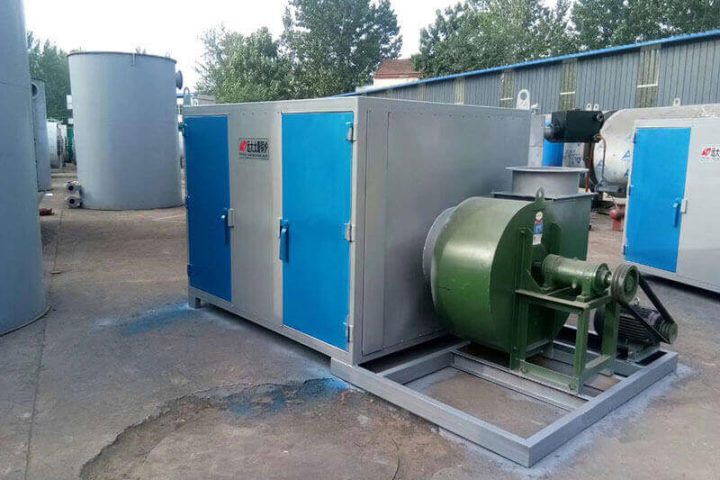
0.35-2.8 MW
Carbon-fibre infrared hot air furnace, 0.35-2.8 MW, delivering clean hot air at 80-300 °C for drying, curing and coating lines.
View details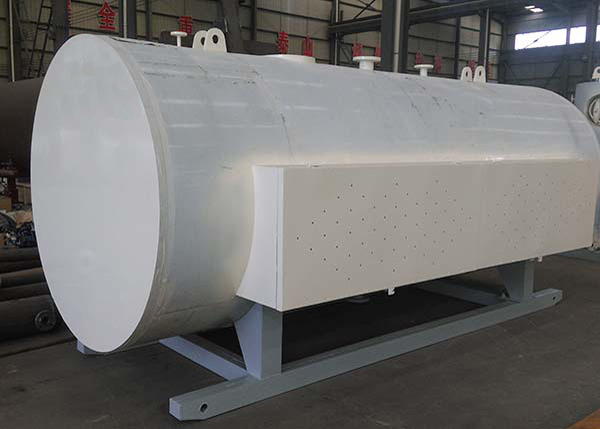
0.1-2 t/h (0.3-2 t/h in the standard table)
Horizontal electric steam boiler, 0.1-2 t/h at 0.7-1.25 MPa, with flange-mounted element bundles, PLC staging and no flue or burne...
View detailsExternal links open the publisher’s website and are provided for background reading.
Include the capacity (t/h or MW), fuel, working pressure and site country so the proposal matches your permit limits.
We appoint one or two partners per country to quote, deliver and service our boilers locally. Territory protection, factory pricing and commissioning support are part of the agreement.