
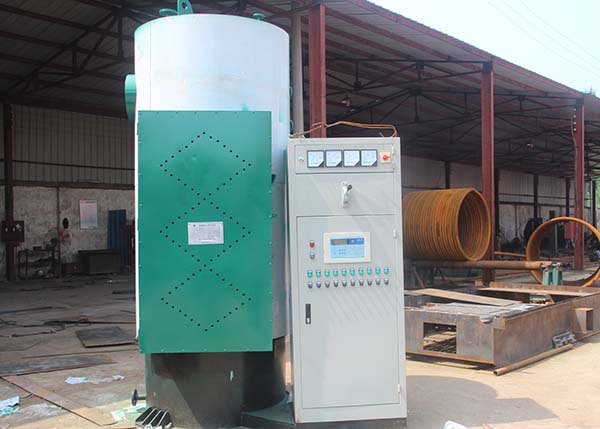
0.1-1 t/h
LDR Vertical Electric Steam Boiler
Vertical electric steam boiler, 0.1-1 t/h at 0.4-0.7 MPa, for laundries, sterilisers and small process loads where floor space is...
View detailsHorizontal electric steam boiler, 0.1-2 t/h at 0.7-1.25 MPa, with flange-mounted element bundles, PLC staging and no flue or burner.
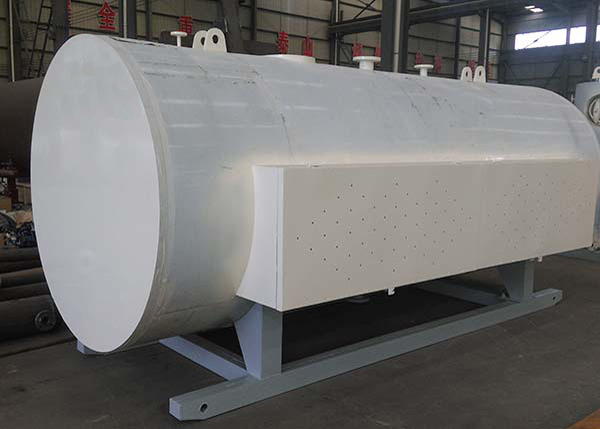
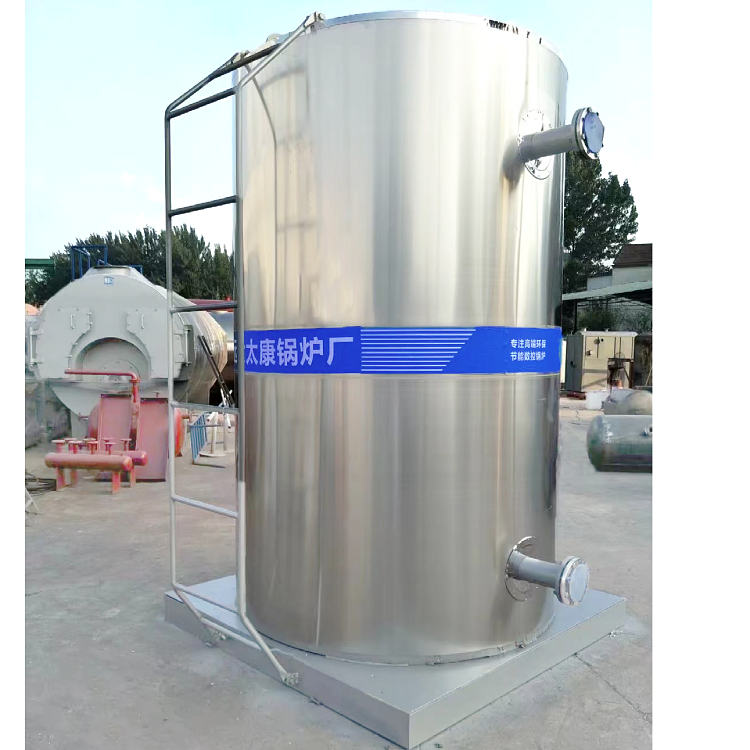
The WDR takes the pressure part of a conventional horizontal steam boiler and replaces the furnace tube and burner with immersed element bundles. Water fills the shell around the elements, steam collects above the water line, and the unit delivers saturated steam at 0.7 to 1.25 MPa. Because nothing burns inside the vessel, there is no fuel train, no forced-draught fan, no flue and no chimney, and the boiler house emits no nitrogen oxides, sulphur dioxide or particulates at the point of use.
Elements are assembled into concentrated bundles on a single flange. Each bundle is wired and sealed as one unit, so it can be isolated, unbolted and withdrawn without cutting the shell or draining the boiler. That is the practical difference against elements screwed in one at a time: a failed bundle is a short job with a spare on the shelf rather than a week of shell work. Element life is typically around 20,000 hours, and longer where feedwater hardness is controlled.
A PLC with touchscreen human-machine interface handles level, pressure and element staging. Elements switch in groups rather than all at once, which keeps the current step at each stage within the capacity of the supply transformer and avoids the voltage dip that one large contactor closing would cause. Pressure is held in a narrow band by proportional staging, and a cold boiler reaches working pressure in 15 to 25 minutes — quicker than a fire-tube unit of the same size, because there is no refractory mass to soak up heat.
Steam quality depends on steam space and on level control. The shell is sized with a generous steam space and a gravity or cyclone separator, so carry-over stays low. Electrode probes with automatic feedwater control hold the water line within about ±10 mm. Low-water cut-off, over-pressure trip, earth-leakage protection and element over-temperature protection are all interlocked through the same controller. The electrical cabinet stands separately from the boiler body, so contactors and circuit boards are not cooked by shell radiation.
One tonne of saturated steam at 1.0 MPa absorbs roughly 2.7 GJ above 20 °C feedwater. At 98 per cent efficiency the WDR draws about 760 kWh per tonne. A gas boiler of similar size, at 95 per cent efficiency and 35.6 MJ/Nm³, burns about 80 Nm³ per tonne. Electric steam therefore costs 760 times the electricity price per kWh, against 80 times the gas price per Nm³. The two are level when the kWh price is about one-tenth of the gas price per cubic metre; below that ratio, electricity is the cheaper fuel.
Maintenance tells a different story. There is no burner to service, no flame-detection chain to prove, no flue to sweep and no fuel safety interlock to test annually. What remains is element inspection, water treatment and the usual pressure-part checks. Against that, the site must carry the cost of transformer capacity and cable, and element replacement is a consumable item rather than a rare event.
Three cases recur. The first is cheap low-carbon power — hydro or nuclear tariffs — where the ratio above is comfortably met and the emissions question is settled at the grid rather than at the stack. The second is a dense urban site where NOx limits are tight and a gas boiler would need flue-gas recirculation, a taller chimney and continuous monitoring; an electric unit removes the permit argument altogether. The third is small or intermittent demand, such as a 0.3 t/h unit for a laundry, a bank of sterilisers or a pilot plant, where a gas boiler would idle most of the day and the standing losses of a burner and flue outweigh the tariff gap.
Above 2 t/h, parallel units are better than one large shell: each module can be isolated for service, the plant turns down further without cycling, and the electrical supply is split into smaller steps.
Standard scope covers the boiler body, element bundles, control cabinet, safety valves, level gauges, pressure gauge and pressure controller, with feedwater pumps and water softener offered as options. Site work is a level foundation, the power cable from the transformer or switchgear, feedwater and steam pipework, a blowdown line to a safe discharge point, and a softened water supply. Typical delivery is 25 to 45 days from drawing approval; commissioning takes 5 to 10 days.
Yes. There is no combustion, so no flue, chimney or fuel gas train is required. The room still needs ventilation for heat rejection and a blowdown discharge point, but the builder's work is far smaller than for a gas-fired boiler.
The failed bundle is isolated at its breaker, unbolted from its flange and withdrawn. The boiler can usually continue at reduced output on the remaining bundles while a replacement is fitted, because each bundle is independent and separately protected.
It depends entirely on the tariff ratio. Per tonne of steam the unit needs about 760 kWh, against about 80 Nm³ of gas. Electricity is cheaper when a kilowatt-hour costs less than about a tenth of a cubic metre of gas.
| Model | WDR0.3-0.7 | WDR0.5-0.7 | WDR1-1.0 | WDR2-1.0 |
|---|---|---|---|---|
| Rated evaporation | 0.3 t/h | 0.5 t/h | 1 t/h | 2 t/h |
| Rated pressure | 0.7 MPa | 0.7 MPa | 1.0 MPa | 1.0 MPa |
| Steam temperature | 170 °C | 170 °C | 184 °C | 184 °C |
| Installed power | 210 kW | 350 kW | 700 kW | 1400 kW |
| Thermal efficiency | 98% | 98% | 98% | 98% |
| Empty weight | 1.1 t | 1.5 t | 3.2 t | 4.3 t |
| Dimensions L×W×H | 1600×1000×1400 mm | 1800×1200×1500 mm | 3100×1520×1830 mm | 3640×1700×2000 mm |
0.1-1 t/h
Vertical electric steam boiler, 0.1-1 t/h at 0.4-0.7 MPa, for laundries, sterilisers and small process loads where floor space is...
View details
0.1-1 t/h from 50, 60, 80 or 100 kW modules
Parallel 50-100 kW electric steam modules, 0.1-1 t/h at 0.4-0.7 MPa, staged by PLC so part-load efficiency holds and one module is...
View details1 t/h
The WDR1-0.7 is a 1 t/h electric steam boiler producing 0.7 MPa steam at 170 °C. Heating elements sit in a horizontal shell with n...
View detailsExternal links open the publisher’s website and are provided for background reading.
Include the capacity (t/h or MW), fuel, working pressure and site country so the proposal matches your permit limits.
We appoint one or two partners per country to quote, deliver and service our boilers locally. Territory protection, factory pricing and commissioning support are part of the agreement.