
A burner swap is the smallest part of the job
Every conversion enquiry starts the same way: a coal boiler with years of shell life left, a gas main at the boundary, and a question about the cost of fitting a gas burner. The burner is the visible change and the least troublesome one. The difficult work sits behind it, in a pressure part designed around a grate, a long luminous flame and a flue gas carrying dust and sulphur.
Coal and gas are not interchangeable heat sources. A coal flame on a chain grate releases heat over a large, flat, luminous surface and radiates strongly to the water walls and the arch. A gas flame is short, transparent in the visible band and hotter at its core, and it gives up a smaller fraction of its heat by radiation. Change the fuel and the heat balance inside the same shell shifts: the furnace exit temperature rises, the convection bank absorbs more, and the stack temperature follows.
What the existing pressure part can and cannot accept
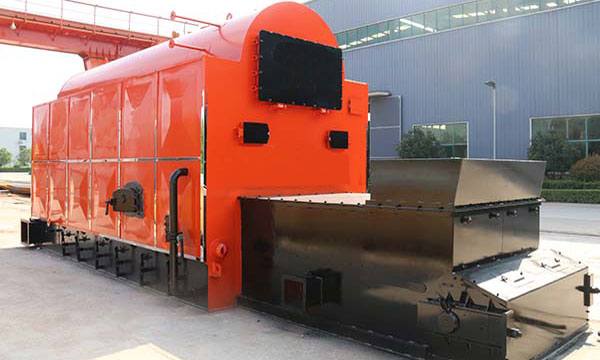
The first survey is dimensional. A DZL chain-grate boiler has a furnace above the grate, a front and rear arch, and a refractory-lined chamber whose volume was set by the burning rate of coal on that grate area, typically 0.35 to 0.6 MW per cubic metre of furnace. Gas firing needs a much smaller flame, but it needs residence time: 0.3 to 0.5 seconds between the burner throat and the tube bank to finish combustion and to let staged air and recirculated flue gas do their work on NOx. Many coal furnaces are long and low, with the volume distributed in a way that suits neither requirement.
The grate itself becomes dead floor. It must be covered, sealed and protected, because a gas flame impinging on cast iron grate bars at 1,100 °C will crack them, and leakage past the grate destroys the furnace pressure balance. The front wall usually needs a new opening, a burner quarl and a windbox, and the rear arch is often removed because it obstructs the flame and overheats. These are pressure-part and refractory works, not burner accessories.
Heating surface is the second question. Because the gas flame radiates less, the furnace absorbs perhaps 45-50% of the heat instead of 55-60%, and the convection passes must take up the difference. If the boiler was already marginal on surface, the exit gas temperature rises by 80-150 °C and efficiency drops by four to six points before any economiser is considered. Adding surface inside an existing shell is rarely practical; adding an economiser in the tail is, and it is usually part of the conversion scope.
The gas train and the safety envelope
Gas introduces a hazard that coal does not: an unburnt fuel-air mixture in an enclosed furnace. The boiler must be protected by a valve train with two safety shut-off valves and a bleed, a tightness test before every start, low and high gas pressure switches, an air pressure switch, flame detection with a proving period, and a burner management system that enforces a pre-purge of at least five furnace volumes before ignition. None of this exists on a coal unit and all of it is mandatory in any sensible jurisdiction.
The furnace and flue also need explosion relief. A gas explosion in a weak furnace can lift the shell off its saddles; relief panels sized on the furnace and flue volume, typically 0.05 to 0.1 square metres per cubic metre of enclosed volume, give the pressure somewhere harmless to go.
Draught, chimney and the water in the flue gas
Coal firing needs an induced draught fan sized for roughly 1.4 times stoichiometric air at 180-200 °C, and a chimney tall enough to hold the furnace under negative pressure. A packaged gas burner brings its own forced draught fan and needs only a modest negative pressure at the boiler outlet, 20 to 50 Pa. The existing induced draught fan is then far too large. Running it dampered wastes power and gives unstable control; the honest solutions are a variable speed drive, a smaller impeller, or removal of the fan in favour of the burner’s own draught where the chimney permits.
The chimney causes more trouble than the fan. Coal flue gas is dry by comparison: methane produces about 1.6 kg of water vapour per normal cubic metre burned, so gas flue gas runs at 15-18% water vapour against 5-8% for coal. The dew point rises to 55-60 °C, and a single-skin steel chimney that stayed dry on coal will run with condensate on gas. Inside a brick chimney that condensate dissolves mortar, and spalling appears within two or three winters. A stainless liner and a drain are part of the budget, not an afterthought.
The scope, item by item
The table sets out a typical 6 t/h coal-to-gas scope, for a DZL or SZL shell in reasonable condition.
| Item | Coal configuration | Gas conversion |
|---|---|---|
| Combustion equipment | Chain grate, coal feeder, arches | Gas burner, quarl, windbox, grate sealed |
| Furnace | Large plan area, low height | Residence volume checked, rear arch removed |
| Heating surface | Radiant-heavy balance | Convection duty increased, economiser added |
| Draught | Induced draught fan, damper control | Burner fan, induced fan on variable speed |
| Flue and chimney | Dry gas, masonry or steel stack | Liner, insulation, condensate drain |
| Safety | Pressure and level protection | Gas valve train, purge, flame proving, relief |
| Controls | Relay or basic PLC | Burner management, oxygen trim, remote alarm |
| Output | Rated capacity | Typically 80-90% of the coal rating |
The derate, and when replacement beats conversion
A converted boiler seldom reaches its coal rating on gas. The furnace volume limits the firing rate that burns cleanly, and the convection surface limits how much heat can be taken out of the gas. A 6 t/h coal boiler usually settles at 5 to 5.5 t/h on gas, a 10 t/h unit at 8.5 to 9 t/h. If the plant needs the full rating, a new WNS or SZS boiler is the right project.
Efficiency, on the other hand, improves sharply. A chain-grate unit burning coal runs at 80-84% on lower calorific value, with unburnt carbon in the ash and excess air that cannot be tuned below about 40%. A gas conversion with a correctly sized economiser reaches 92-95%, and with a condensing tail 96-98%. The fuel saving is real, and it is the reason conversions get approved. It should be calculated on the derated output, not the nameplate.
Replace rather than convert when the shell is over twenty years old, the tube records are missing, the pressure must rise above 1.25 MPa, or the limit is 30 mg/Nm³. A converted furnace rarely reaches 30 mg/Nm³ without recirculation ports that were never designed into it, whereas an SZS water-tube boiler with a purpose-built furnace reaches the figure as standard. The same logic applies to a coal-fired YGL thermal oil heater: its coil was sized for coal’s radiant heat and is left short by gas.
Where the shell is sound and the load is 4 t/h or less, conversion is often much the cheaper answer. The sequence is fixed: survey and heat balance, gas main check, pressure-part design and approval, fabrication of the burner opening, installation during a planned shutdown, purge and leak test, then a performance test at three loads. Budget six to nine months, most of it in approval and gas supply rather than in the boiler house.


