
Ninety-nine per cent efficient, and still expensive
An electric steam boiler converts 98-99% of its input into heat in the water, against 92-95% for a gas-fired WNS or SZS unit with an economiser. That sounds like a decisive advantage until the tariff arrives. The comparison that matters is cost per tonne of steam, and it is decided by the price of gas per unit of heat, the price of electricity per unit of heat, and the way the electricity price varies with time and with demand.
The efficiency gap is real but modest: about 5% of input. The price gap between gas and electricity per kilowatt hour is usually a factor of two to four. Electric boilers therefore win not on efficiency but on site conditions: no gas main, a constrained electrical connection that is already paid for, a process that needs steam for a few hours a day, or a tariff with a very cheap off-peak period. They lose wherever gas is available at a normal industrial price and the boiler runs continuously.
The arithmetic, without a price list
Start with heat. One tonne of steam at 1.25 MPa from 20 °C feed needs 2,701 MJ, or 750 kWh. A gas boiler at 93% efficiency needs 806 kWh of gas input; an electric boiler at 99% needs 758 kWh of electricity. The ratio of running cost is therefore the ratio of the two unit prices, adjusted by 1.06 in favour of electricity. If gas costs one unit per kWh and electricity costs 2.5 units, the electric boiler’s steam costs 2.36 times as much. If electricity is available at 1.2 units on an off-peak tariff and the boiler can use it, the gap narrows to 14%, and the electric boiler’s lower maintenance and no chimney can close it.
Demand charges change the picture again. An industrial electricity tariff usually has a charge per kilowatt of maximum demand, billed monthly, in addition to the energy charge. A 2 MW electric boiler that runs for two hours a day still sets a 2 MW demand, and the demand charge is paid for the whole month. That charge can double the effective cost of the steam. The boiler must be sized for the process peak, so the demand charge follows the peak, not the average.
Load factor is the variable that decides most cases. A boiler running 6,000 hours a year at 70% average load uses its connection well. A boiler running 600 hours a year at 50% load pays for a connection it barely uses. The first is a candidate for electricity only if the tariff is favourable; the second is a candidate because the alternative is a gas main, a chimney and a boiler house that would sit idle.
Where electricity genuinely wins
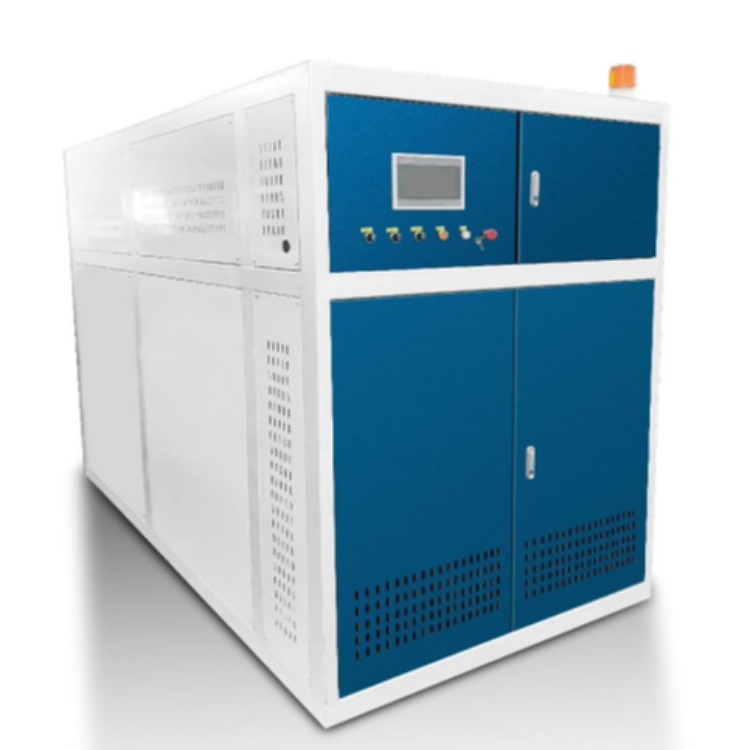
The strongest case is the site with no gas. A food plant, a laundry or a hospital in a city centre may have no gas main and no space for a fuel store and a chimney. An electric boiler needs a connection, a feedwater tank and a small footprint; the WDR horizontal electric range covers 0.1-2 t/h and the LDR vertical units fit into a plant room where a fire-tube boiler would not go. The absence of a flue also removes the NOx and CO emission points, which matters in a dense area.
The second case is peaking and backup. An electric boiler sized for the winter peak or the shift start can run for a few hours while the gas boiler carries the base load. It needs no chimney, no fuel supply and no purge cycle, and it starts in minutes. The same logic applies to a standby boiler that must be proven every month: an electric unit can be run at low output without the cycling losses of a gas boiler.
The third case is precise, low-capacity process steam. Laboratories, pharmaceutical pilot plants, food pilot lines and garment factories need 100-500 kg/h of steam at a controlled pressure, often intermittently. A 0.3-0.5 t/h electric boiler with a PLC gives that with very little housekeeping, and the electrode or resistive elements can modulate finely. A gas boiler of that size is possible, but the burner turndown and the flue installation dominate the project.
The load profile that decides
Electricity is a poor fit for a base-load boiler and a good fit for a load that is short, predictable and can be moved. Where the tariff has a night rate, a thermal store or a steam accumulator can shift the load: heat water or charge a steam accumulator at night, draw it during the day. The store is sized on the daytime deficit, and the arithmetic is the same as for any accumulator, with the electricity price replacing the fuel price.
The demand charge argues for limiting the maximum demand rather than shifting energy. A boiler that can be controlled to a maximum electrical input, with the gas boiler picking up the rest, keeps the demand charge down. That is a control strategy, not a boiler selection, and it should be designed before the connection is ordered.
The practical limits
Electric boilers are simple, but they are not maintenance-free. Heating elements have a finite life, typically around 20,000 hours, and they fail one at a time; the boiler loses capacity gradually and the elements should be replaced as a set at a planned outage. The elements are flanged and individually replaceable, which is why the WDR design separates the electrical cabinet from the boiler body: heat is the enemy of contactors and PLC cards.
The feedwater must still be treated. An electric boiler has no flame and no flue, but it has a shell, tubes and a water line, and scale on the elements causes local overheating and premature failure. Softened water with a conductivity limit, plus blowdown, is still required. The vessel is also a pressure vessel and needs the same safety valve, pressure switches and inspection cycle as a fuel-fired unit.
| Case | Electric boiler | Gas boiler | Deciding factor |
|---|---|---|---|
| No gas main on site | Good fit | Not possible without supply | Infrastructure |
| Base load, 6,000 h/year | Rarely economic | Usually cheaper | Unit price of heat |
| Short daily peak | Good fit with controls | Cycles inefficiently | Demand charge |
| Off-peak with storage | Can be competitive | No off-peak equivalent | Tariff and store size |
| City centre, no flue | Good fit | Flue and NOx limits | Site constraints |
| Standby and backup | Good fit | Needs flue and purge | Start-up and testing |
Two engineering details are worth checking before an electric boiler is ordered. The first is the connection capacity: a 2 t/h electric boiler draws about 1.5 MW, and the site transformer and cabling must carry it with the rest of the plant running. The second is the earthing and protection scheme, because a resistive load of that size is a different proposition from a burner control circuit. Both are site electrical engineering, not boiler engineering, and both are easy to underestimate.
The honest summary is that electricity is a premium fuel and an electric boiler is a premium way to use it. It wins where the alternative is no steam at all, where the load is short and the tariff is structured, or where the site cannot accommodate a flue. It rarely wins on a continuous base load against gas, and a payback calculation that shows otherwise usually has the tariff wrong.


