
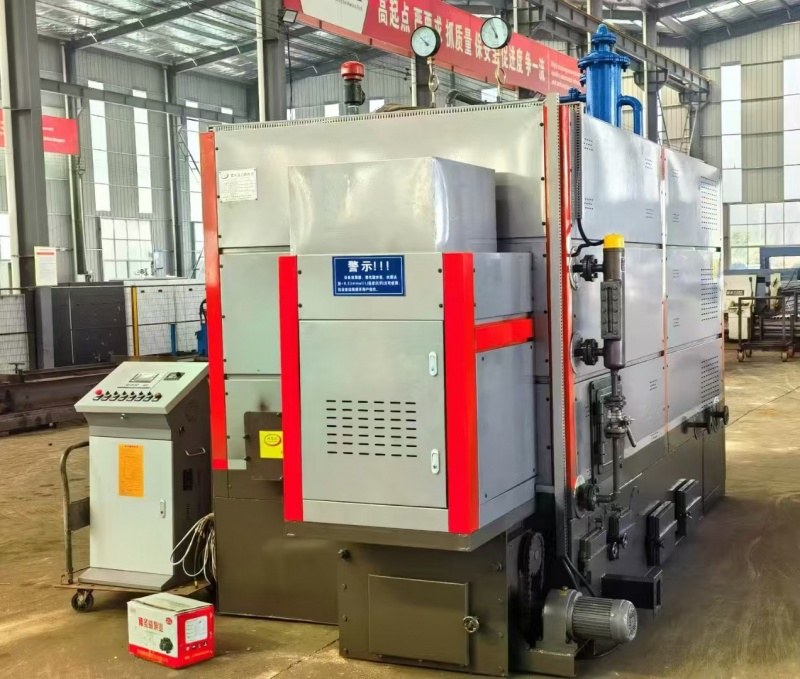
What dual fuel is actually for
A dual-fuel boiler carries two complete fuel trains into one combustion chamber: usually gas and light diesel, sometimes gas and heavy oil. It is not a way of saving money. Running on the second fuel almost always costs more per gigajoule, and the boiler is slightly less efficient on both fuels than a single-fuel unit would be. What it buys is continuity.
That matters most during a coal-to-gas transition, and for a year or two afterwards. The gas main is being laid, the pressure-reducing station is being commissioned, the utility is still issuing the supply contract, and the plant cannot stop. A dual-fuel package lets the site run on diesel while the gas connection is finished, then switch to gas as the primary fuel and keep the liquid train as the standby for interruption, curtailment or a price spike. The same logic applies where the gas contract is interruptible and the utility can call a shutdown on a cold morning.
The coal boiler itself is not part of this. A chain-grate furnace cannot be dual-fired with gas in any sensible way: the grate, the arches and the furnace volume suit a coal bed, and a gas flame in that volume is unstable and inefficient. Dual fuel means a package boiler designed for two fluids, and the coal unit either becomes the standby for one season or leaves the site.
The switchover, step by step
A changeover is a controlled sequence, not a valve movement, and the burner management system should enforce it rather than leaving it to the operator.
First, reduce load to 25-30% of rating. Below that the flame is unstable on either fuel, and above it the changeover produces a pressure excursion the process will see. Second, start the incoming fuel’s pilot and prove it: a pilot that lights and holds for five seconds is proven, one that lights and disappears is not. Third, open the incoming fuel’s safety shut-off valves and establish a small flame on the new fuel, then ramp the new fuel up while ramping the old down over two to three minutes, holding outlet pressure within 0.02 MPa. Fourth, close the outgoing fuel valves and purge the gun or the oil line with steam or air for three to five minutes so it does not coke in the hot furnace. Fifth, log the changeover with time, load, pressures and the reason.
Done by hand at the panel, this is acceptable on a small unit if the procedure is written and practised; done by moving two valves at once, it is how furnaces get flooded.
The reverse direction, gas to oil, needs the oil temperature and pressure established before the changeover: light diesel at 20-40 °C and 1.5-2.5 MPa at the nozzle, heavy oil at 120-140 °C. Atomising steam or air must be available and at pressure. Cold oil in the line produces a dribble, a smoky flame and unburnt fuel on the furnace floor.
The efficiency penalty, honestly
A gas-optimised boiler running on light diesel loses about two points. Part of it is excess air: a gas flame runs happily at 8-10% excess air, an oil flame needs 15-20% to finish combustion without smoke, and the extra air leaves the stack carrying heat. Part of it is the furnace: the volume and shape were set for a long, low-luminosity gas flame, and an oil spray needs a different residence pattern, so carbon monoxide rises slightly. Part of it is the atomising medium, which is either steam taken from the boiler or compressed air, and both cost something.
At 2 t/h the numbers are concrete. Gas at 35.8 MJ/Nm³ and 92.5% efficiency needs 167 Nm³/h. Light diesel at 42.6 MJ/kg and 90.5% needs 143 kg/h, or about 170 litres per hour. The daily diesel test run that keeps the standby train proven therefore costs real money, which is why many sites run it weekly and accept a longer proving interval.
The boiler itself may also carry a small rating derate on the second fuel, often 5-10%, because the burner’s maximum firing rate on oil is limited by the atomiser and the furnace volume. That belongs on the nameplate and in the operating instructions, not discovered during a gas interruption.
Safety interlocks that cannot be trimmed
Two fuel trains in one furnace demand more interlocking than either alone, and a fault on the idle fuel must not be masked by the running one.
On the gas side: two safety shut-off valves in series with a bleed between them, a valve proving or tightness test before every start, low and high gas pressure switches set at roughly 70% and 115% of rated pressure, and a gas detector in the boiler house alarming at 25% of the lower explosive limit and tripping at 50%. On the oil side: low and high oil pressure, low oil temperature where heavy oil is used, atomising medium pressure, and a shut-off valve at the burner that closes on any trip.
Shared: a pre-purge of at least five furnace volumes with the air damper open before any ignition attempt, a flame scanner for each fuel, because a UV cell set for gas will not reliably see an oil flame and an IR cell set for oil will not see a blue gas flame, an air proving switch, a high stack temperature trip, and a low water cut-out. The burner management system must hold a fuel selection that cannot be changed silently: a key switch or a password, with the selection logged.
One interlock is often missed: the fuel selection must be interlocked with the emissions and the reporting. If the site reports nitrogen oxides on gas and the burner is running on diesel at 150-180 mg/m³, the report is wrong. Tying the fuel selection signal to the CEMS and to the daily log is a small job that prevents an expensive conversation with the regulator.
| Item | Natural gas | Light diesel |
|---|---|---|
| Lower calorific value | 35.8 MJ/Nm³ | 42.6 MJ/kg |
| Flow at 2 t/h, 1.0 MPa | 167 Nm³/h | 143 kg/h |
| Burner efficiency | 92.5% | 90.5% |
| Excess air at full load | 8-10% | 15-20% |
| Fuel train | Double block and bleed, proving | Pump set, shut-off valve, filter |
| Flame detection | UV | IR |
| Rating on this fuel | 100% | 90-95% |
Living through the transition
The practical sequence for a coal-to-gas project is: install the new dual-fuel package alongside the coal boiler, commission it on diesel while the gas connection is completed, run both through a proving period, then make gas primary and keep diesel as standby. The coal boiler stays available until the gas supply has run through a full heating season without interruption, and is then decommissioned or kept as a cold standby under local rules.
During that period the site runs three fuels and one set of procedures, which must be explicit about which boiler carries which load, what the changeover trigger is and who may change fuel. The most common failure in these projects is not mechanical: it is an operator changing fuel at 03:00 without logging it, and a month of emissions and cost data that cannot be reconciled.
What to specify
Two independent fuel trains with their own safety shut-off valves and their own proving, a common burner management system with a logged fuel selection, dual flame scanners, the rating on each fuel stated on the nameplate, a written changeover procedure with the times and the load limits, and a spare set of nozzles and filters for the liquid fuel. Ask for the changeover to be demonstrated at 30% and 70% load during commissioning, and time it. A changeover that takes twelve minutes and loses 0.3 MPa is not the same product as one that takes three minutes and holds pressure.


