

6-100 t/h
SZS Water-Tube Gas/Oil Steam Boiler, 6-100 t/h
Membrane-wall water-tube steam boiler with staged combustion and FGR, 6-100 t/h at up to 2.5 MPa and 98% efficiency with heat reco...
View detailsA 10 t/h water-tube gas boiler at 1.25 MPa carries dyeing, stentering and finishing loads in Narayanganj, with an economizer and a 30 mg/Nm3 NOx burner.
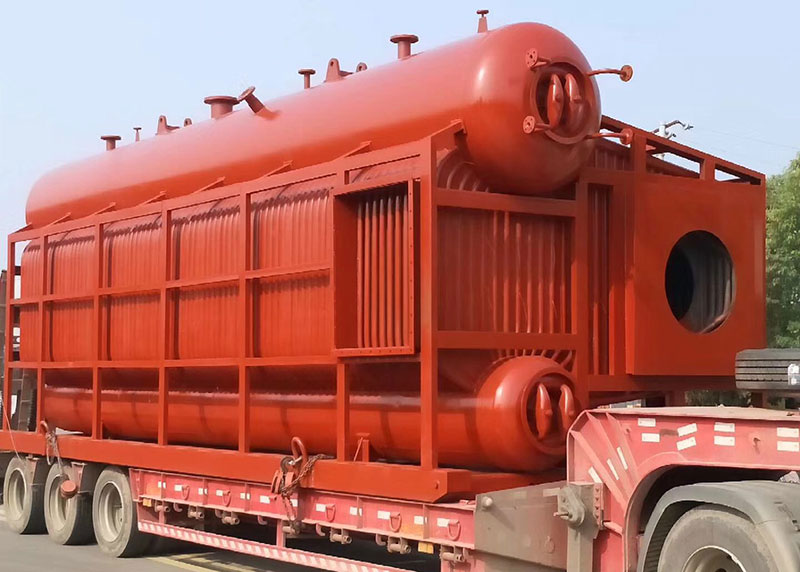
A dyeing and finishing mill in Narayanganj runs three shifts, and its steam demand is never flat. Jet dyeing machines draw hard for 40-60 minutes while a batch is heated from 40 to 130 °C, then drop to a holding load; stenters and a calendering line take a steadier 2-3 t/h. The boiler therefore has to follow a load that swings between about 3 and 9 t/h several times a shift, with a 10 t/h shell as the ceiling.
Steam is delivered at 1.25 MPa and roughly 194 °C saturated. That is high enough for the dye vessels and for the finishing calender, and low enough that the mill can use standard carbon steel pipe and a conventional condensate system.
At 10 t/h the choice is close, and the deciding factor here was floor space and the future third shift. An SZS is a double-drum water-tube unit with a membrane-wall furnace: the furnace is part of the pressure envelope, so the whole boiler is compact for its rating and the furnace volume is large enough to finish combustion before the gas turns into the convection bank. That gives a low NOx burner room to work and keeps the unit inside the 30 mg/Nm3 limit the buyer’s environmental clearance required.
Fire-tube units at this size are cheaper but the furnace volume per tonne of steam is smaller, and at 10 t/h with a high excess-air margin the flame length becomes the constraint. The water-tube design also tolerates a faster load ramp, which matters when six dye vessels open at once.
At 10 t/h and 1.25 MPa the boiler absorbs about 7.0 MW at the steam outlet. With a natural gas LHV near 35.6 MJ/Nm3 and 95% efficiency including the economizer, full-load gas demand is about 740 Nm3/h; at the 6 t/h average it sits near 445 Nm3/h. The feedwater train is a softener followed by a thermal deaerator, holding hardness below 0.03 mmol/L and oxygen below 0.05 mg/L, with the economizer dropping stack temperature to about 130 °C.
| Item | Value |
|---|---|
| Rated evaporation | 10 t/h |
| Steam pressure / temperature | 1.25 MPa / 194 °C |
| Full-load gas input | about 740 Nm3/h |
| Efficiency with economizer | about 95% |
| NOx (dry, 3% O2) | under 30 mg/Nm3 |
| Stack temperature | about 130 °C |
The boiler house was an existing shed with a 6 m clear height, so the SZS went in on a steel skid with the burner at the front wall and the economizer behind the outlet. The gas train is a double-block-and-bleed arrangement with a leak test before every start, and the burner is a low-NOx staged-gas type set up on the actual gas analysis rather than a generic methane figure.
Commissioning took eleven days: hydraulic test, alkali boil-out, steam blowing of the headers, safety-valve setting, then a 72-hour run at 7 t/h with the dye house connected. The one item that needed rework was condensate return: the mill’s original receiver was undersized, and returning too much hot condensate in one step tripped the deaerator level. A larger receiver and a modulating return valve fixed it.
The plant now holds 1.25 MPa through a dye-house peak without dropping below 1.15 MPa, which was the old boiler’s failure mode. Stack temperature and excess oxygen are logged hourly and the blowdown is automatic on conductivity, so the boiler runs at 3,000 ppm dissolved solids rather than the 5,000 ppm the operators used to keep by hand.
6-100 t/h
Membrane-wall water-tube steam boiler with staged combustion and FGR, 6-100 t/h at up to 2.5 MPa and 98% efficiency with heat reco...
View details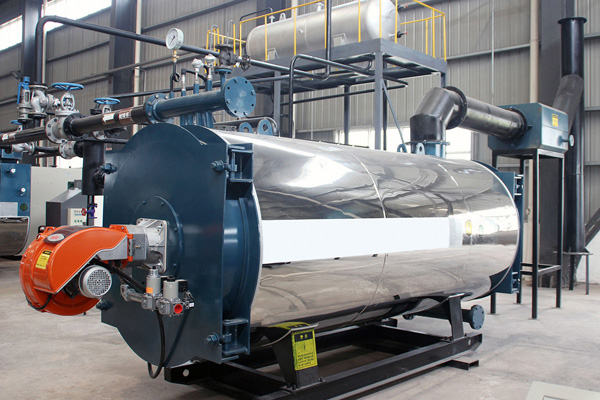
120-5,800 kW
Horizontal liquid-phase thermal oil heater, 120-5,800 kW, disc coil heating surface, 300-340 C at 0.8-1.0 MPa working pressure.
View details
10-50 t/h feedwater
Tray-type thermal deaerator, 10-50 t/h, removing oxygen to below 15 ppb and heating feedwater to 104-105 °C before it reaches the...
View detailsExternal links open the publisher’s website and are provided for background reading.
The connected load peaks at about 9 t/h when several jet dyeing machines heat at once. A 10 t/h shell leaves a margin without running the burner at its minimum for most of the day.
Yes. The gas train and burner were selected for a stated Wobbe range, and the mill can switch to vaporised LNG with a different orifice and a re-set combustion curve.
Softening plus thermal deaeration is enough for a water-tube unit at this pressure, provided hardness stays below 0.03 mmol/L and conductivity blowdown is automatic.
2024
Barranquilla, Colombia
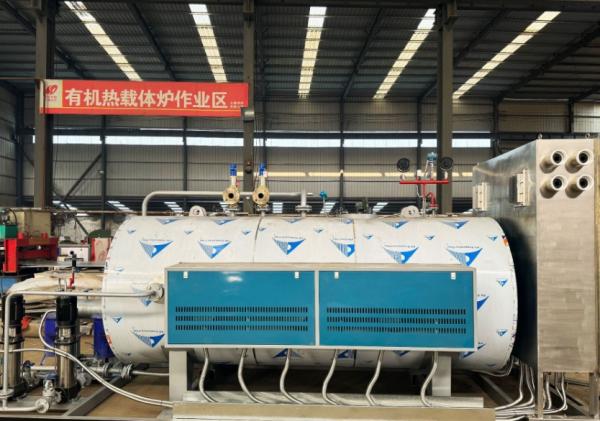
4 t/h gas steam boiler at 1.0 MPa on natural gas, commissioned in 2024 in Barranquilla, Colombia: the plant is on the coast and th...
View project
2024
Johannesburg, South Africa
A 5 t/h gas steam boiler supplies cooking, pasteurisation and CIP steam at a food plant in Johannesburg, with load-shedding resili...
View project
2025
Casablanca, Casablanca-Settat, Morocco
A gas-fired steam boiler was supplied for pasteurization duty at a brewery in Casablanca, Morocco, with installation and commissio...
View projectWe appoint one or two partners per country to quote, deliver and service our boilers locally. Territory protection, factory pricing and commissioning support are part of the agreement.