

50 t/h
50 t/h Water-Tube Gas/Oil Steam Boiler SZS50-1.6-Q
The SZS50-1.6-Q is a 50 t/h D-type double-drum water-tube boiler delivering 1.6 MPa steam at 204 °C. It achieves 95% efficiency (L...
View detailsHorizontal liquid-phase thermal oil heater, 120-5,800 kW, disc coil heating surface, 300-340 C at 0.8-1.0 MPa working pressure.
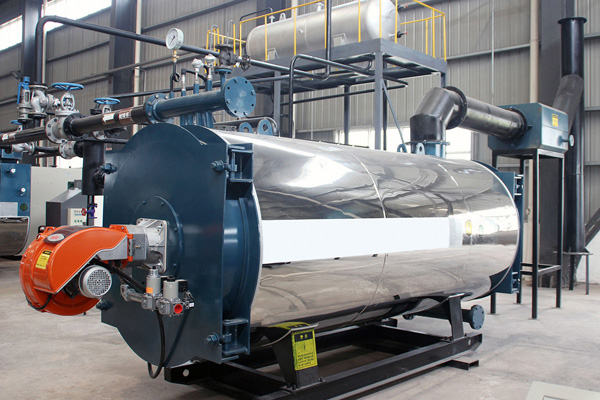
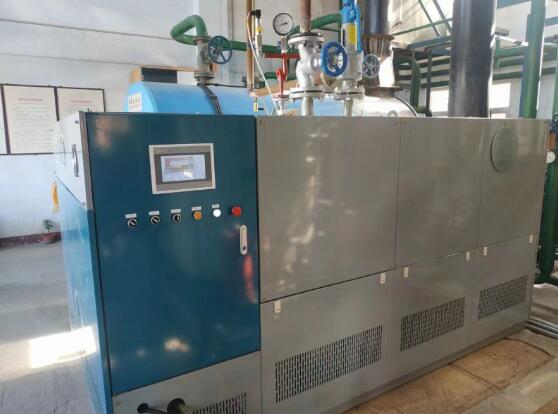
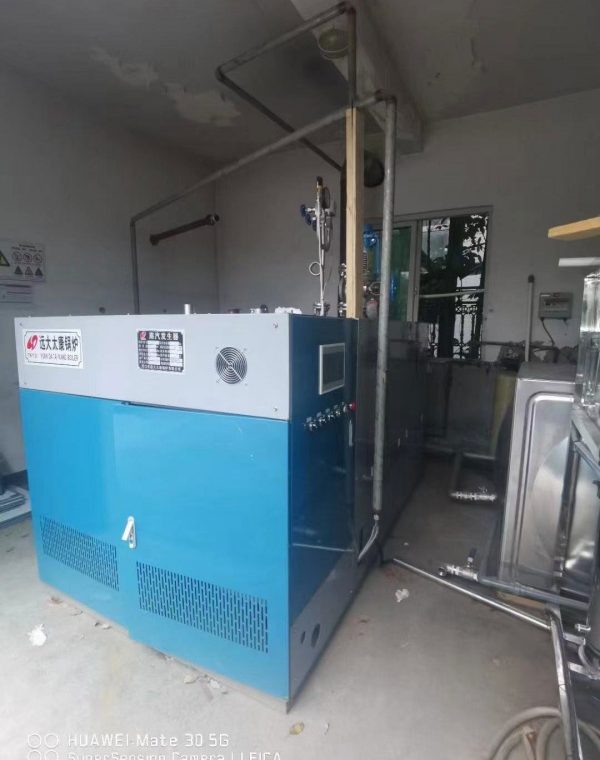
Water and steam are convenient carriers until the temperature climbs. Saturated steam at 340 °C sits at roughly 14.6 MPa, and the drum, the pipework and the feed system all scale with that number. A liquid-phase thermal oil heater reaches the same temperature at a working pressure of 0.8 to 1.0 MPa, because the oil never boils. Oil leaves the heater at 300 to 340 °C depending on grade and model, gives up heat in the user, and returns to be reheated. Nothing in the loop changes phase, so the loop is sized for pump head and velocity rather than for a pressure rating.
That single fact drives the economics. A high-temperature water or steam system at 340 °C needs heavy-wall pipe, a qualified welder for every joint, and a boiler house with a pressure rating; an oil system at the same temperature uses standard schedule pipe and a centrifugal pump. The trade is that oil carries less heat per kilogram and per cubic metre than water, so flow rates are larger and the pump consumes more power.
The heating surface is built from close-pitched circular coils rather than a tube wall and a water jacket. The inner coil forms the combustion chamber and takes the radiant heat; the flame envelope is matched to the coil diameter and length so that the coil is fully washed by flame and fully cooled by the oil inside. The middle and outer coils form the convective surface. Gas crosses them at a velocity chosen high enough to keep the coefficient up and low enough to avoid erosion and excessive draft loss.
Close pitching keeps the gas in contact with the surface and makes the package short, which is why a 1,200 kW heater fits in 4.1 m by 1.9 m. The real design limit is tube surface heat flux. If the flux is too high for the oil velocity inside the tube, the film at the wall overheats, the oil cracks, and coke lays down as an insulating layer that raises the wall temperature further. Coils are therefore sized generously and the pump is chosen to hold tube velocity in the band that keeps film temperature inside the oil supplier’s limit.
A centrifugal pump, duplicated with one standby on larger units, moves the oil. The expansion tank sits at the highest point of the loop, absorbs the volume change between cold and 340 °C, and sets the static head at the pump suction; it is tied in by a small-bore line so that it stays cool and does not act as a second radiator. A deaerator or a venting arrangement takes off water and light ends during the first heat-up. A filter on the return protects the coil, and flow is proved by a switch or by differential pressure across an orifice.
Start-up is staged for a reason. Cold oil is circulated for at least an hour, held at 100 to 120 °C until water is driven off, then raised in steps to the set point. Water in cold oil flashes at the pump and stops circulation, and a stopped flow with a live burner is how coils are destroyed. The burner is interlocked to drop out on low flow, high outlet temperature and high flue temperature.
Thermal efficiency is 90 to 95% depending on frame. Units above about 1,000 kW carry an air preheater in the tail, and the preheater is what separates the large frames from the small ones, because it recovers heat that would otherwise leave at 300 °C and puts it back into the flame. Fuels are natural gas, LPG, town gas, light oil and heavy oil; a heavy oil train needs heating and filtration ahead of the burner.
Typical duties are resin and plastics processing, textile stenters and dyeing ranges, asphalt and bitumen tanks, paint curing ovens, wood and board pressing, chemical distillation and concentration, and food frying lines. Sizing starts from the process heat load and the temperature difference across the user, not from the heater rating, because a loop that returns oil 40 °C colder than design will need a larger pump and may starve the coil.
Oil condition is the maintenance indicator. Sample twice a year for viscosity, acid number, flash point and insolubles. A rising acid number or a falling flash point means the oil is cracking, and the cause is usually a hot spot or a loss of flow rather than old age. Change oil on the supplier’s limits, not on running hours. Quotation on request, with coil, pump set, expansion tank and controls sized from the duty.
Because the loop stays liquid, the working pressure is 0.8-1.0 MPa instead of several MPa. Pipe, fittings and the plant room are simpler and cheaper, and there are no steam traps to lose.
It absorbs the volume change of the oil between cold and 340 C, provides the static head at the pump suction, and gives the loop somewhere to vent water and light ends during start-up.
Standard frames are rated 300 C or 320 C depending on size. Higher temperatures need a matched heat transfer oil and a check of film temperature against the oil data sheet, so the duty is confirmed at quotation.
| Model | YY(Q)W-350Y(Q) | YY(Q)W-700Y(Q) | YY(Q)W-1200Y(Q) | YY(Q)W-1800Y(Q) | YY(Q)W-2400Y(Q) | YY(Q)W-4100Y(Q) |
|---|---|---|---|---|---|---|
| Rated heat output | 350 kW | 700 kW | 1,200 kW | 1,800 kW | 2,400 kW | 4,100 kW |
| Design pressure | 1.3 MPa | 1.3 MPa | 1.3 MPa | 1.1 MPa | 1.1 MPa | 1.1 MPa |
| Working pressure | 1.0 MPa | 1.0 MPa | 1.0 MPa | 0.8 MPa | 0.8 MPa | 0.8 MPa |
| Maximum oil temperature | 300 °C | 300 °C | 320 °C | 320 °C | 320 °C | 320 °C |
| Oil content in the heater | 0.25 m³ | 0.5 m³ | 1.0 m³ | 1.18 m³ | 1.85 m³ | 3.2 m³ |
| Circulation flow | 28.1 m³/h | 56.2 m³/h | 75.6 m³/h | 96.7 m³/h | 151.2 m³/h | 200 m³/h |
50 t/h
The SZS50-1.6-Q is a 50 t/h D-type double-drum water-tube boiler delivering 1.6 MPa steam at 204 °C. It achieves 95% efficiency (L...
View details
2 t/h
The WNS2-1.25-Q is a packaged three-pass wet-back fire-tube steam boiler rated at 2 t/h and 1.25 MPa, delivering 194 °C steam at 9...
View details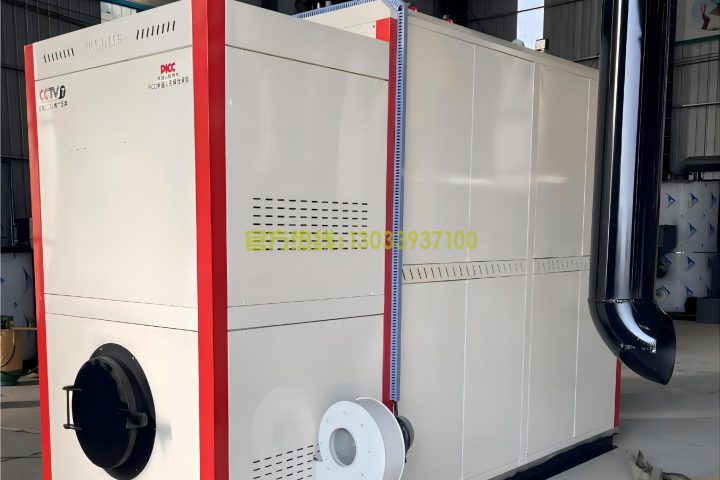
0.3-2 t/h
Skid-mounted steam package combining boiler, burner, feedwater module, softener and controls in one enclosure, 0.3-2 t/h at 0.7-1....
View detailsExternal links open the publisher’s website and are provided for background reading.
Include the capacity (t/h or MW), fuel, working pressure and site country so the proposal matches your permit limits.
We appoint one or two partners per country to quote, deliver and service our boilers locally. Territory protection, factory pricing and commissioning support are part of the agreement.