
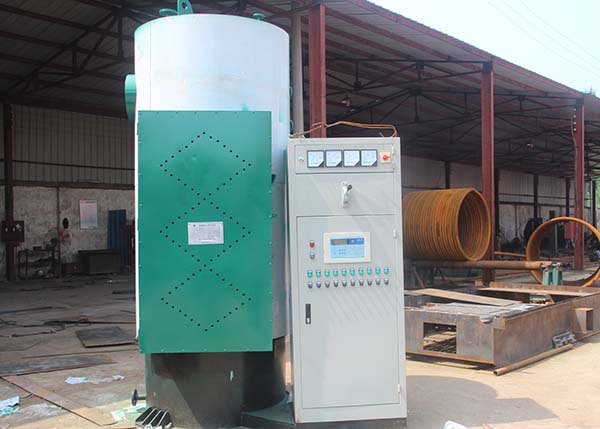
0.1-1 t/h
LDR Vertical Electric Steam Boiler
Vertical electric steam boiler, 0.1-1 t/h at 0.4-0.7 MPa, for laundries, sterilisers and small process loads where floor space is...
View detailsInduction-heated steam boiler, 0.15-6 t/h at 0.4-1.6 MPa, where the shell itself is the heating surface and there are no elements to burn out.
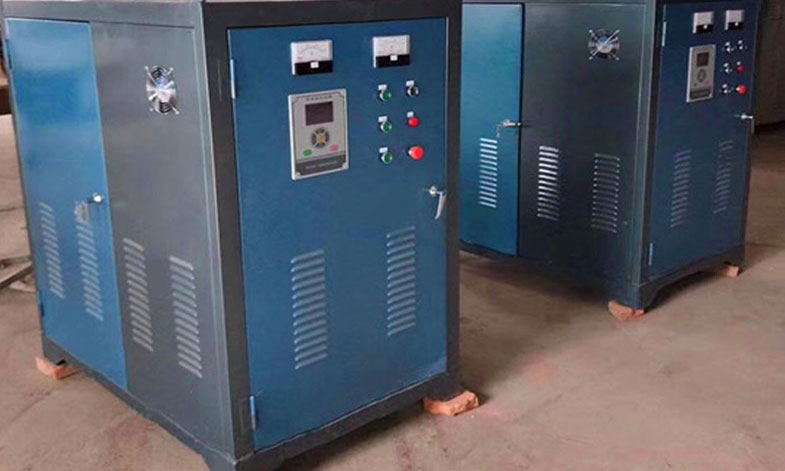
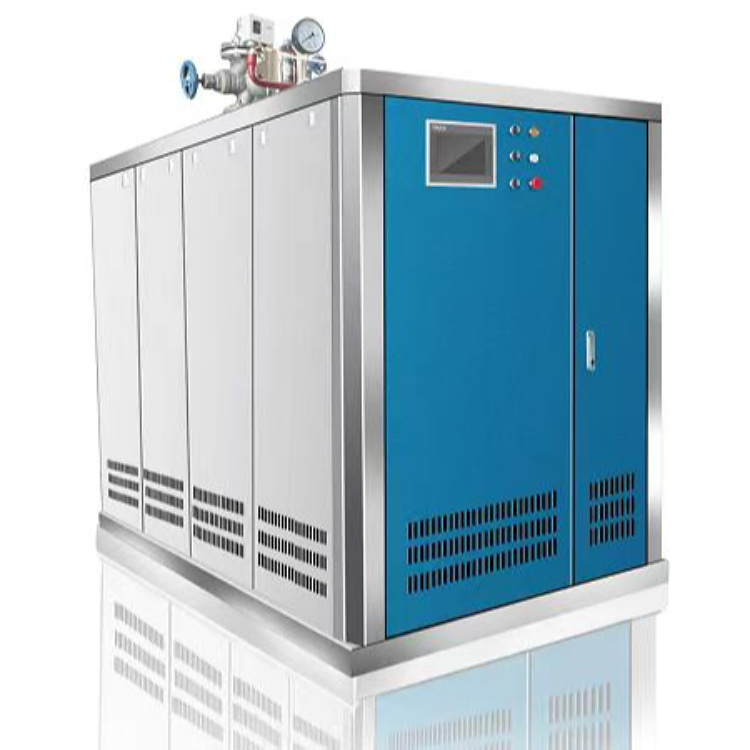
An electromagnetic boiler does not put a resistive element in the water. A coil wound around a section of the pressure shell is fed with high-frequency alternating current — typically 20 to 40 kHz — and the resulting alternating magnetic field induces eddy currents in the steel wall itself. The wall heats; the water on the other side boils. There is no wire, no sheath and no insulated terminal inside the vessel, only the same steel plate that has to be there anyway.
This changes the failure modes. A resistive element fails when its sheath corrodes, scales or loses contact with the water. An induction boiler has no immersed component to fail, so the usual cause of element burnout disappears, and with it the maintenance routine of draining, unbolting and replacing bundles. What remains is the coil, its cooling circuit and the control electronics, all outside the pressure boundary and accessible with the boiler full.
Because heat is generated in the plate, the flux is uniform around the heated section and there is no local hot spot at an element tip. The plate is thick relative to a sheath, so it tolerates a certain amount of scale before the wall temperature becomes a problem, and the thermal inertia is low: the heated mass is a few tonnes of plate and water, with no refractory to soak up heat. That is why an induction unit reaches working pressure in 8 to 15 minutes from cold, and why it can be stopped and restarted without a warm-up sequence.
The coil is water-cooled and sits in a housing outside the insulation. The insulation between coil and shell is a designed air gap plus refractory, not a consumable gasket, which keeps the electrical clearances stable over time. Coils are shielded so that the stray field at the boiler casing stays within occupational limits, and the casing itself is earthed as a bonded panel.
At 6 t/h the unit draws 4200 kW, or about 6400 A at 380 V. That is not a load to add to an existing board without a study. The rectifier front end produces harmonics, so a 12-pulse arrangement or an active filter is usually specified above about 1 MW to keep total harmonic distortion within the utility’s limit. Power factor is corrected at the unit, and the coil supply is isolated from the control supply so that a fault in one does not take out the other.
Where the site has a 6 kV or 10 kV supply, a step-down transformer dedicated to the boiler is normally the cleanest arrangement; it keeps the high-current 380 V run short and gives the plant a single point to isolate for maintenance.
Induction heating is tolerant, not indifferent. Hard water still deposits scale on the heated plate, and although the plate is thick, a millimetre of calcium carbonate costs efficiency and raises the wall temperature. Softened feedwater with hardness below 0.03 mmol/L, plus blowdown at the rate set by the local water analysis, keeps the heated section clean. Conductivity-based automatic blowdown is worth having on units above 1 t/h, where manual blowing is easily forgotten.
Because there are no elements to remove, internal inspection is simpler: the manhole gives access to the heated section for visual checking and, where necessary, chemical cleaning. A weak acid wash through the shell is straightforward and does not risk damaging element terminals.
Standard units run from 0.15 t/h to 6 t/h at pressures of 0.4, 0.7, 1.0, 1.25 or 1.6 MPa, with steam temperatures from 151 °C to 204 °C. Above 6 t/h, parallel shells are used. The footprint is compact for the output — a 4 t/h unit is about 6.1 m by 2.8 m — and the boiler can sit close to the process because there is no flue and no fuel gas train.
Typical duties are food and beverage processing, chemical reactors, rubber vulcanising, textile finishing, pharmaceutical clean steam via a packaged generator, and hotel or hospital steam for laundry and sterilisers. In each case the attraction is the same: full output within minutes, no combustion permit, and a pressure part with no consumable heating element inside it.
A resistance boiler heats the water through immersed sheathed elements. An electromagnetic boiler induces current in the steel shell, so the shell is the heating surface and there is no element inside the vessel to burn out or replace.
The conversion efficiency is comparable, around 96 per cent against 98 per cent for a good resistance boiler. The saving is in maintenance and downtime rather than in the meter, plus faster starts and no element replacement cost.
Usually yes. There is no flue, no fuel train and no combustion air requirement, so the unit can sit in a production area subject to local rules on pressure vessels and electrical protection.
| Model | DCS-0.5 | DCS-1 | DCS-2 | DCS-3 | DCS-4 | DCS-6 |
|---|---|---|---|---|---|---|
| Rated evaporation | 0.5 t/h | 1 t/h | 2 t/h | 3 t/h | 4 t/h | 6 t/h |
| Maximum power | 350 kW | 700 kW | 1400 kW | 2100 kW | 2800 kW | 4200 kW |
| Maximum current at 380 V | 532 A | 1064 A | 2128 A | 3192 A | 4256 A | 6384 A |
| Steam space | 180 L | 360 L | 720 L | 1080 L | 1440 L | 2160 L |
| Empty weight | 2.1 t | 4 t | 7.5 t | 10.5 t | 13.5 t | 19.5 t |
| Dimensions L×W×H | 2100×1200×2200 mm | 3100×2200×2300 mm | 4100×2200×2300 mm | 5100×2800×2500 mm | 6100×2800×2500 mm | 7100×3000×2500 mm |
0.1-1 t/h
Vertical electric steam boiler, 0.1-1 t/h at 0.4-0.7 MPa, for laundries, sterilisers and small process loads where floor space is...
View details
0.1-1 t/h from 50, 60, 80 or 100 kW modules
Parallel 50-100 kW electric steam modules, 0.1-1 t/h at 0.4-0.7 MPa, staged by PLC so part-load efficiency holds and one module is...
View details
0.1-2 t/h (0.3-2 t/h in the standard table)
Horizontal electric steam boiler, 0.1-2 t/h at 0.7-1.25 MPa, with flange-mounted element bundles, PLC staging and no flue or burne...
View detailsExternal links open the publisher’s website and are provided for background reading.
Include the capacity (t/h or MW), fuel, working pressure and site country so the proposal matches your permit limits.
We appoint one or two partners per country to quote, deliver and service our boilers locally. Territory protection, factory pricing and commissioning support are part of the agreement.