
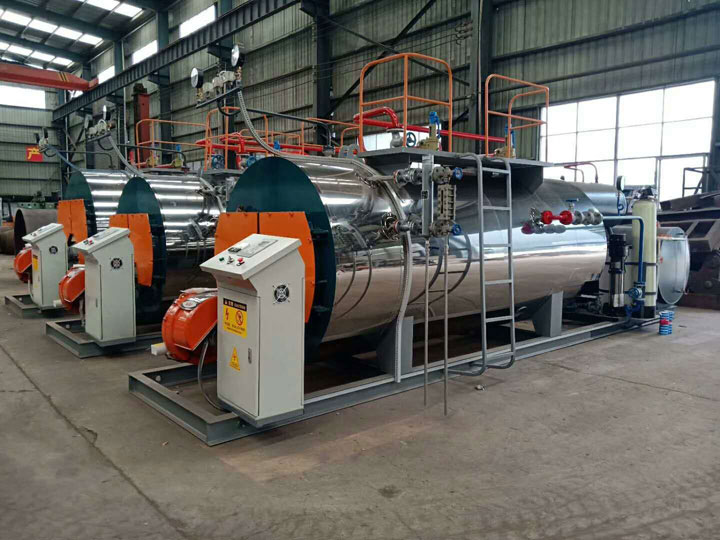
Excess air tuning is the cheapest efficiency work you can do on a gas-fired boiler, and it is also the easiest to get wrong. The goal is not the lowest possible O2 reading on the analyser. The goal is the lowest O2 that still holds a stable flame, keeps CO low across the whole firing range, and leaves margin for the fuel/air ratio control to drift between service visits. On most packaged gas boilers, a well-tuned unit runs around 3% O2 (approximately 15% excess air) at high fire and rises to 5–7% O2 at low fire, where burner turndown and air leakage through the register make tight control harder. This article explains how to set those targets by load, what CO limits to watch, and why a slightly rich mixture is far safer than a lean one.
What excess air actually costs you
Every percent of excess air above stoichiometric carries nitrogen and unused oxygen up the stack, and you pay to heat it. For natural gas (roughly 10.5 m³ of air per m³ of gas at stoichiometric, ~9.5 m³ air per m³ gas on a volume basis depending on gas composition), each 1% of excess air raises dry flue gas loss by roughly 0.02–0.03 percentage points at 150 °C stack temperature. That sounds small, but moving from 25% excess air to 10% excess air on a 10 MW boiler firing 8,000 hours a year is a real fuel line item. Use the capacity and cost guide to size the annual fuel exposure before you decide how much tuning effort is justified.
The counterweight is stack temperature. Excess air tuning only pays if the heat exchanger is clean and the stack temperature is reasonable. If your stack temperature is 40 °C above the design value, fix fouling first — tuning O2 on a dirty boiler just moves the loss around.
O2 targets by load
The table below gives practical O2 setpoints for a conventional packaged fire-tube or water-tube gas boiler with a modulating burner and mechanical linkage or electronic ratio control. Values are dry-basis O2 at the economiser outlet (or boiler outlet if no economiser), measured with a calibrated flue gas analyser, with the boiler at steady state for at least 10 minutes at each load point.
| Load (% of rated) | Target O2 (% dry) | Approx. excess air (%) | Acceptable band |
|---|---|---|---|
| 100 | 3.0 | ~15 | 2.5–4.0 |
| 75 | 3.5 | ~18 | 3.0–4.5 |
| 50 | 4.5 | ~24 | 3.5–5.5 |
| 25 | 5.5 | ~32 | 4.5–7.0 |
| Low fire (min.) | 6.0–7.0 | ~35–45 | 5.0–8.0 |
Assumptions: natural gas at ~35.8 MJ/m³ (HHV), ambient air 20 °C, no air preheater, analyser calibrated to dry basis. If you have an air preheater, O2 readings at the stack are unchanged but the cost of excess air rises because combustion air arrives hot. If you have flue gas recirculation for NOx control, expect the O2 setpoint to sit 0.5–1.0 points higher because FGR displaces air in the burner.
Note the shape of the curve: the low-fire band is wider on purpose. At low fire, the burner is more sensitive to register leakage, linkage hysteresis, and draft variation, so a tighter target buys little efficiency and costs stability.
CO limits and what they tell you
CO is the tuning signal that matters more than O2. A clean gas flame should run below 20 ppm CO at high fire and below 50 ppm at low fire, corrected to 3% O2. Readings above 100 ppm at any load point mean incomplete combustion — either the mixture is going lean locally, the flame is impinging on a cold surface, or the burner is dirty. Above 400 ppm, treat it as a fault, not a tuning preference.
Watch the CO curve as you reduce O2. There is a knee: CO stays flat as O2 falls, then rises sharply. Set your high-fire O2 target 0.5–1.0 points above the knee, not at it. That margin is what protects you when the gas calorific value shifts, the combustion air fan filter loads up, or the linkage wears.
Why too little air is worse than too much
Running lean (low excess air) looks attractive on the analyser but carries three risks that a slightly rich setting does not:
- CO and unburned hydrocarbons rise fast. The CO knee is steep. A 0.5-point O2 drop past the knee can take CO from 30 ppm to several hundred ppm, and unburned gas is a direct fuel loss plus an emissions problem.
- Flame instability and flame failure. Lean mixtures are closer to blow-off, especially at low fire and during load ramps. Nuisance lockouts and, worse, delayed ignition on relight are the practical outcomes.
- No margin for drift. Linkage wear, damper hysteresis, and gas pressure variation all move the actual air/fuel ratio. A setting with 2% margin has nowhere to go; a setting with 10% margin absorbs normal drift between services.
Too much air costs efficiency, but it is a known, measurable, linear cost. Too little air is a non-linear risk with safety and reliability consequences. Tune toward the rich side of the knee and accept the small stack loss.
Commissioning checklist
- Calibrate the flue gas analyser (O2, CO, and temperature) before the visit; record calibration date.
- Clean the burner, diffuser, and flame detector; confirm the combustion air fan and inlet filter are clear.
- Verify gas supply pressure at the train and at the burner head against the datasheet at high fire.
- Set high fire first, then 75%, 50%, 25%, and low fire; allow 10 minutes steady state at each point.
- Record O2, CO, CO2, stack temperature, and ambient temperature at every point.
- Check CO at each point against the limits above; if CO exceeds 100 ppm, stop and investigate before adjusting further.
- Confirm the O2 curve is monotonic from high fire to low fire; a dip or step indicates linkage or damper problems.
- Record the final curve and post it at the boiler; it is the baseline for the next service.
If your burner uses electronic ratio control, save the curve file and note the firmware version. If it uses a mechanical linkage, mark the linkage positions so the next technician can see whether anything has moved.
What to send us for a proposal
To scope a tuning or retrofit proposal, send: boiler rated capacity and design pressure; burner make, model, and turndown; current fuel consumption and operating hours; a recent flue gas analysis at high fire and low fire; stack temperature and whether an economiser or air preheater is fitted; any NOx limit you must meet; and a photo of the burner front and the ratio control. If you are also considering replacement, review our product range first so we can compare tuning against new equipment on the same duty. With those inputs we can tell you what the tuning is likely to recover and what hardware, if any, is needed.


