

6-100 t/h
SZS Water-Tube Gas/Oil Steam Boiler, 6-100 t/h
Membrane-wall water-tube steam boiler with staged combustion and FGR, 6-100 t/h at up to 2.5 MPa and 98% efficiency with heat reco...
View detailsCylinder drying, corrugator preheat and starch kitchen loads, with a 200 t/day board machine worked example and condensate recovery guidance.
A paper machine is a water-removal machine that happens to make paper. Stock arrives at the wet end at 40-45% dryness, leaves the dryer section at 92-95%, and the difference is evaporated with steam-heated cylinders. That evaporation, not the tonnage of paper, sets the boiler size, and it is why two machines of the same output can have very different steam demands if their furnish or their pressing is different.
Pressure levels follow the dryer section. Tissue and fine paper run at 0.4-0.8 MPa. Linerboard and fluting need more heat flux in the first dryer groups and run at 0.8-1.0 MPa. Corrugated plants are different again: the single facer, the preheaters and the double backer all run at 1.0-1.3 MPa, because the starch gel point and the board speed demand a high surface temperature at the roll.
Corrugators have a further characteristic: the steam load follows the order book, not the clock. A shift with long runs at 200 m/min looks nothing like a shift with six short orders, and the boiler must cope with both.
For a board or tissue mill up to 20 t/h, a packaged fire-tube boiler remains the practical choice; above that a water-tube SZS unit is more usual. The scope that matters is downstream: a deaerator above 4 t/h, a condensate return system with a flash vessel, and a blowdown heat recovery unit. Paper mills return 80-90% of their condensate, and that return is the single biggest efficiency asset in the plant.
Dryer sections need more than a header. Each group of cylinders has its own pressure control valve, a steam separator to remove entrained water, and a differential-pressure control across the group so that condensate leaves instead of accumulating. Where two pressure levels are needed, a thermocompressor can lift flash steam from the low-pressure group into the high-pressure main instead of venting it.
| Parameter | Value | Note |
|---|---|---|
| Steam capacity | 8 t/h at 1.25 MPa | 194 °C saturated |
| Board output | 200 t/day | recycled linerboard |
| Water evaporated | 4.26 t/h | 45% to 92% dryness |
| Specific steam demand | 1.35 kg/kg water | cylinder drying |
| Condensate return | 85% at 95 °C | flash vessel to deaerator |
| Design efficiency | 94% (LHV) | economiser fitted |
| Blowdown | 4% | softened make-up |
At 1 t of paper, 45% dryness means 0.45 t of fibre and 0.55 t of water. At 92% dryness the same fibre carries 0.039 t of water, so 0.511 t of water is evaporated per tonne of paper. At 200 t/day that is 102 t/day, or 4.26 t/h averaged over 24 hours.
Cylinder drying takes 1.3-1.4 kg of steam per kilogramme of water evaporated, so 4.26 × 1.35 = 5.75 t/h. Stock heating and the size press add about 0.5 t/h, and building heat and hot water 0.3 t/h. The header therefore needs 6.55 t/h, and an 8 t/h boiler at 1.25 MPa covers it with 22% margin for start-up and grade changes.
Fuel follows from the load. The published figure for an 8 t/h unit at rating is 631.5 Nm³/h of natural gas, so at 82% load the consumption is about 518 Nm³/h, or 12,400 Nm³/day. Over 7,000 hours a year that is roughly 3.6 million Nm³.
Now test the margin. If the mill adds a second machine or raises speed by 10%, the demand reaches 7.5 t/h and the 8 t/h boiler has no reserve. That is the moment to decide between a second small unit and a larger replacement, and it is cheaper to decide it at the enquiry stage than after the building is up.
Returning 85% of condensate at 95 °C instead of feeding cold make-up is worth about 9% of the fuel bill on this plant. The flash vessel adds to it: condensate at 1.25 MPa flashing to 0.3 MPa releases roughly 9% of its mass as low-pressure steam, which can feed the size press or the starch kitchen.
An economiser taking flue gas from 190 °C to 125 °C recovers about 3.5 points, worth roughly 130,000 Nm³ a year here. Blowdown at 4% instead of 6%, achieved by tightening softener control, is worth another 0.4 points. Dryer syphons and steam traps are maintenance items, but a failed trap on a 1.25 MPa group can waste more steam in a month than an economiser saves in a year.
On gas, 30 mg/Nm³ needs flue-gas recirculation; the same burner without it gives 60-80 mg/Nm³. Mills burning bark, rice husk or paper sludge need a different train: a chain grate or moving grate boiler, a multi-cyclone or bag filter for particulate, and a stack height set by the dispersion study.
Water discharge matters as much as air. Boiler blowdown, softener regeneration and stock preparation effluent all fall under the site permit, and a mill that switches to a lower-blowdown regime often finds the effluent load easier to meet as a side effect.
Send the evaporation figures and the pressure schedule and we will size the boiler against the dryer section rather than against the paper tonnage.
6-100 t/h
Membrane-wall water-tube steam boiler with staged combustion and FGR, 6-100 t/h at up to 2.5 MPa and 98% efficiency with heat reco...
View details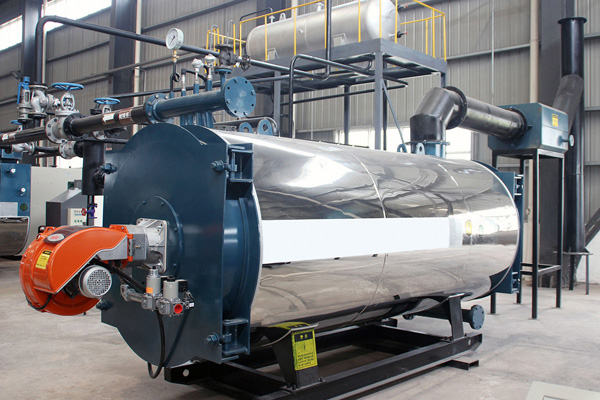
120-5,800 kW
Horizontal liquid-phase thermal oil heater, 120-5,800 kW, disc coil heating surface, 300-340 C at 0.8-1.0 MPa working pressure.
View details
1-20 t/h boiler equivalent
Finned tube economizers and tubular air preheaters for fire-tube, water-tube and thermal oil systems, with cold-end protection aga...
View detailsExternal links open the publisher’s website and are provided for background reading.
Because steam demand tracks the water removed, not the paper made. Two machines at 200 t/day can differ by 20% in steam demand if one presses to 48% dryness and the other to 42%, or if one makes heavy linerboard and the other light fluting.
Typically 1.0-1.3 MPa at the single facer and preheaters, because the starch needs a roll surface above its gel point at production speed. A 0.8 MPa supply often works at low speed and then fails when the line accelerates.
80-90% is normal, since the dryers use clean steam indirectly. The returns are hot, around 95-100 °C, so a flash vessel and a deaerator recover most of the value. Contaminated returns from the stock line are kept separate.
Yes, in a purpose-designed grate boiler with the right grate, furnace volume and flue-gas cleaning. The boiler then differs substantially from a gas-fired packaged unit, and the fuel analysis, ash chemistry and moisture content drive the design.
Industry solution
Sterilisation steam quality, laundry peaks and 60 °C hot water with Legionella control, sized on a 300-bed worked example.
View details
Industry solution
Plating baths, cleanroom humidity and lamination presses: why electronics plants heat indirectly, and how a two-shift load profile...
View details
Industry solution
Bitumen storage, tank coils and line tracing sized for a 320 t/h plant, with a 700 kW worked example and dryer heat demand cross-c...
View detailsWe appoint one or two partners per country to quote, deliver and service our boilers locally. Territory protection, factory pricing and commissioning support are part of the agreement.