

1-100 t/h (0.7-70 MW)
WNS Gas/Oil Steam Boiler, 1-100 t/h
Packaged three-pass wet-back fire-tube steam boiler for gas and oil, 1-100 t/h at 1.25 MPa, with matched modulating burner and ful...
View detailsSterilisation steam quality, laundry peaks and 60 °C hot water with Legionella control, sized on a 300-bed worked example.
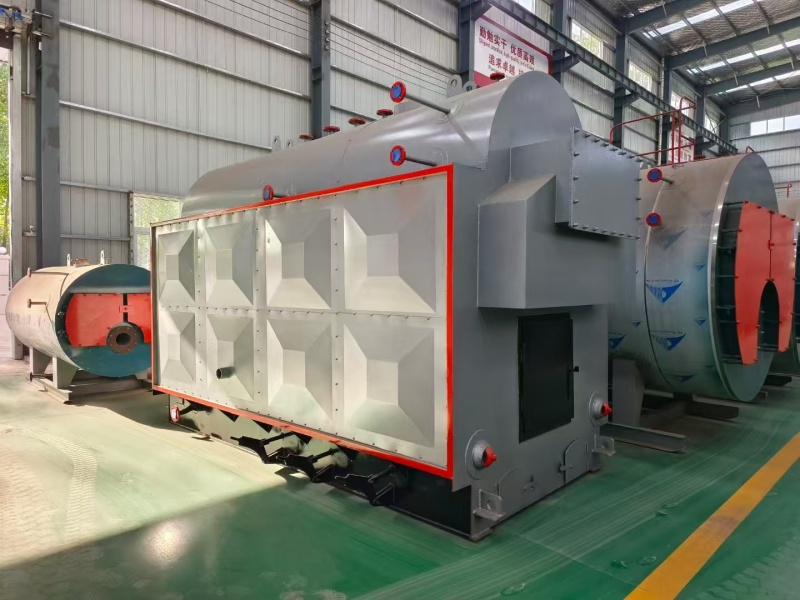
A hospital buys heat in two forms. Steam goes to sterilisation, laundry and the kitchen at high temperature in sharp bursts. Hot water goes to wards, theatres, showers and cleaning at 60 °C on a smooth daily curve. Sizing one boiler for both and trusting the diversity is the usual mistake: the steam peak is set by how many autoclaves start together, the water load by how many people wash before breakfast.
Scale is modest: 400 beds need 0.5-1.5 t/h of steam and 40-70 litres of hot water per bed per day. What makes it difficult is coincidence: laundry at 07:00, CSSD sterilising theatre sets at 07:30, domestic water peaking at 07:45.
A porous-load steriliser holds 134 °C for four minutes, which saturated steam reaches at 0.21 MPa. Come-up for a 600-litre double-door unit takes three to six minutes and draws 25-35 kg of steam; holding takes 8-12 kg/h. Three units starting a shift present about 100 kg/h for ten minutes — nothing over a day, but it is what the header must absorb.
Quality matters more than quantity, and manufacturers are specific: a dryness fraction of 0.95 or better, no more than about 3.5% non-condensable gas by volume, and no boiler treatment chemical. Wet steam delivers part of its mass as droplets, so a wrapped instrument set is wetted, heats more slowly, and the cycle either fails its air-removal test or leaves the pack damp. Air is worse: a film of non-condensable gas blocks condensation on the load and a 3% air fraction can double come-up time.
Treatment chemicals travel with moisture: amines, phosphate, oxygen scavenger and antifoam are all in the boiler water, and any of them reaching an instrument tray leaves a residue on a product meant to be sterile. Where steam contacts dressings, instruments or dialysis water, use a clean steam generator fed with reverse-osmosis water and run without volatile treatment — an enquiry-stage decision, not a commissioning surprise.
Sterilisers are specified at 0.4-0.8 MPa. At 0.4 MPa saturated steam is 151 °C, 17 K above the chamber and enough for the jacket. Raising the header to 1.0 MPa adds nothing: the drop across the chamber valve flashes harder, carryover rises with velocity, and every jacket sees a higher design pressure for no benefit. Where an ironer or kitchen range needs 0.8 MPa, one 0.8 MPa header serves the department; where the CSSD is the only user, 0.4-0.5 MPa is better.
Laundry demand is calculated from linen weight. A hospital generates 3-4 kg of linen per bed per day, a hotel 2.5-4 kg per room, and steam consumption is 0.8-1.2 kg per kg of linen in a plant with dryer exhaust heat recovery, nearer 1.3 kg without it.
Take 300 beds at 3.5 kg: 1,050 kg of linen a day and, at 1.0 kg/kg, about 1,050 kg of steam. Over an eight-hour shift that is 130 kg/h average, suggesting a very small boiler. The instantaneous load is different. Washers fill and heat in 20 minutes, dryers run 45-60 minute cycles, and a flatwork ironer with a one-metre roll adds 40-60 kg/h while it runs. A realistic peak is 1.6 times the shift average, 210-250 kg/h, with the ironer pushing toward 300 kg/h.
Combined with the CSSD peak at a diversity of 0.8, the steam plant for a 300-bed hospital comes out near 0.35 t/h. A 0.5 t/h unit with 5:1 turndown covers it, with margin for a second shift. It should not, however, share a 1.0 MPa header with a steriliser that wants 0.4 MPa: every user then pays for a pressure reduction it does not need.
Domestic hot water is stored and distributed at 60 °C, with the return not below 50 °C. These are not comfort figures: Legionella multiplies between 20 and 45 °C, survives at 50 °C and is killed within minutes at 60 °C, so a calorifier holding 55 °C to save standing loss is a culture vessel. Two schemes work: continuous storage at 60-65 °C with a plate heat exchanger sized for the morning peak, or storage at 60 °C with a weekly pasteurisation to 70 °C for an hour where long distribution and dead legs cannot be removed. Thermostatic mixing valves hold delivery at 41-43 °C so nobody is scalded. Storage of 45-60 litres per bed absorbs the morning peak; without it the hot water boiler must be three times larger.
| Load | Design figure | Peak, 300 beds | Supply |
|---|---|---|---|
| Sterilisation | 25-35 kg per cycle | 100 kg/h | 0.4-0.5 MPa, clean steam |
| Laundry | 3.5 kg linen per bed per day | 300 kg/h | 0.8 MPa |
| Kitchen | 0.10-0.15 kg per meal | 80 kg/h | 0.4 MPa |
| Domestic hot water | 50 L per bed per day at 60 °C | 4,000 L in 2 h | Hot water 60 °C |
Bed count and occupancy, linen kilograms per day and the shift pattern, steriliser count with cycle time and chamber volume, hot water litres per day with the morning peak, and the raw water analysis. With those five items steam and hot water can be sized separately rather than by one boiler carrying a duty never chosen for it.
1-100 t/h (0.7-70 MW)
Packaged three-pass wet-back fire-tube steam boiler for gas and oil, 1-100 t/h at 1.25 MPa, with matched modulating burner and ful...
View details
6-100 t/h
Membrane-wall water-tube steam boiler with staged combustion and FGR, 6-100 t/h at up to 2.5 MPa and 98% efficiency with heat reco...
View details
2-50 m³/h treated water
Softener and deaerator package for boiler make-up, holding hardness below 0.03 mmol/L and oxygen below 0.05 mg/L.
View detailsExternal links open the publisher’s website and are provided for background reading.
Most autoclaves are specified at 0.4-0.8 MPa. At 0.4 MPa saturated steam is 151 °C, which gives 17 K of margin over a 134 °C chamber. Higher header pressure adds nothing to the process and increases flashing across the chamber valve.
It can, if the header is set at the highest pressure any user needs and sterilisation steam comes from a clean steam generator rather than the boiler directly. Many hospitals run one 0.5-1 t/h boiler at 0.8 MPa for laundry and kitchen, with a small generator for the sterilisers.
A hospital generates 3-4 kg of linen per bed per day, and steam consumption is 0.8-1.2 kg per kg of linen. For 300 beds at 3.5 kg, that is about 1,050 kg of steam a day, with a laundry peak near 300 kg/h.
Industry solution
Domestic hot water, laundry and kitchen steam sized on occupancy and diversity, with a 300-room hotel worked example and storage s...
View details
Industry solution
Cylinder drying, corrugator preheat and starch kitchen loads, with a 200 t/day board machine worked example and condensate recover...
View details
Industry solution
Plant sizing and unit selection for 7-70 MW networks: design-week load, N+1 sequencing, 115/70 °C hydraulics and a 20.6 MW worked...
View detailsWe appoint one or two partners per country to quote, deliver and service our boilers locally. Territory protection, factory pricing and commissioning support are part of the agreement.