

0.5–10 t/h
Steam Boiler Package for Food Processing Plants
Steam boiler package for food processing: WNS gas or electric, 0.5-10 t/h at 0.7-1.25 MPa. Handles shift-based loads and sharp CIP...
View detailsThree-pass wet-back hot water boiler with a large furnace, FGR or surface premix burner and an internal condenser for 95/70 and 115/70 loops.
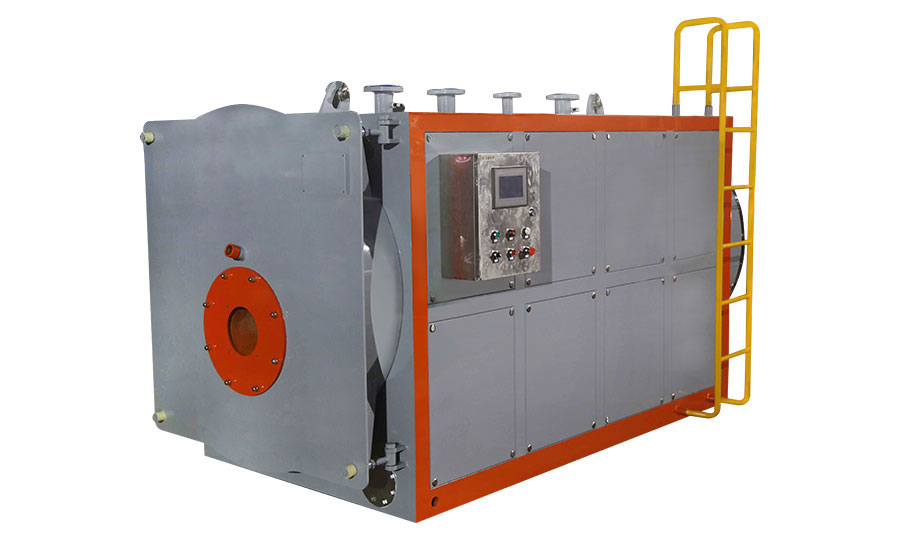
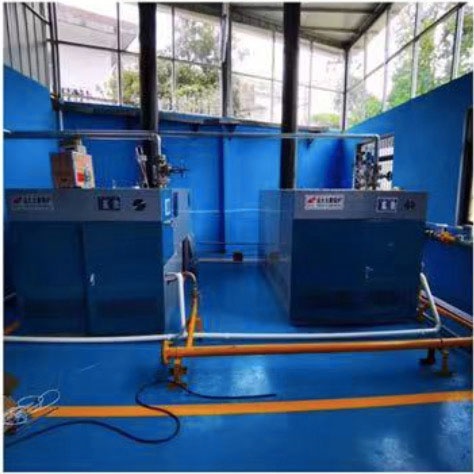
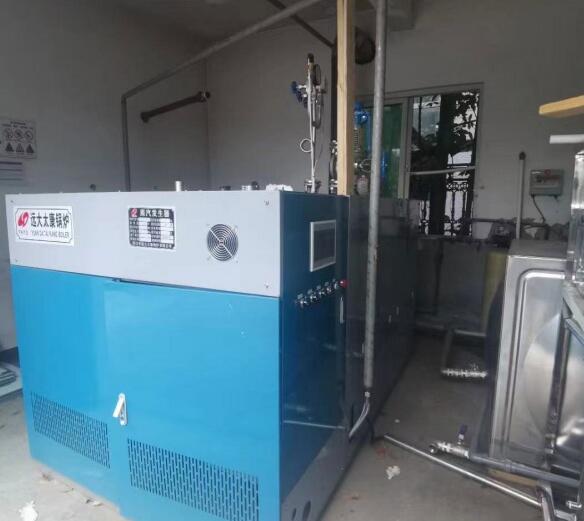
This boiler is a three-pass, fully wet-back shell, and the layout is dominated by the furnace. The combustion chamber is a large-diameter corrugated tube set low in the shell, sized so heat release per cubic metre stays modest and the flame has room to finish before it reaches the reversal chamber. A big furnace does three jobs at once: it lowers peak flame temperature, which is the first defence against thermal NOx; it gives the fuel time to burn out at low excess air; and it absorbs the thermal expansion of a long flame without impinging on the rear wall.
Gas turns in the water-backed chamber, crosses the second-pass bundle and returns through the third, then passes through a condenser built into the rear of the same shell. Putting the condenser inside rather than on a separate skid is a plant room decision as much as a thermal one: it costs no additional floor area, which matters in a basement where the boiler has to fit between columns.
The first route is flue-gas recirculation. Cooled gas is taken from the condenser outlet and blended into the combustion air, diluting oxygen in the flame zone and dropping the flame temperature. Recirculation rates of 10-20% are usual, set by a control valve interlocked with firing rate so the flame stays stable at low fire. The second route is a full-premix surface burner: gas and air are mixed before the burner head and burn on a metal fibre mat in a short, cool, blue flame with very uniform temperature. Premix reaches low NOx without recirculation, but it wants clean, stable gas pressure and a well-filtered air supply, and its turndown is narrower than a staged burner’s.
Both routes are designed against a 30 mg/Nm³ target at 3% oxygen. That is a design aim checked by a stack test on the installed unit, not a type certificate; the number that appears on a test sheet depends on the burner setting, the gas composition and the load at which the test is run.
The condenser occupies the coolest part of the gas path, where the tube wall can sit below the water dew point. It is built from spiral finned ND steel tubes: the fins multiply surface in a short duct, and the weathering steel tolerates the dilute acid film that forms when the vapour condenses. Carbon steel would be gone in a few seasons. The condensate, of the order of 1.5 kg per Nm³ of gas when fully condensed, drains through a trapped line to a neutralisation pit.
Because the condenser is in the shell, the gas leaving the boiler is at about 55 °C and the visible plume at the stack is much reduced, which is often the reason a city-centre site chooses this design at all.
A condensing boiler only earns its efficiency when the return water is cold enough. At 95/70 the return is 70 °C and the condenser runs dry, with the unit behaving like a 94-95% boiler. At 70/50, or with a pool or underfloor circuit returning at 40 °C, the condenser does real work and the efficiency moves towards 97%. Design the system for the lowest return that the emitters allow, and where a high-temperature circuit is unavoidable, use a return-temperature bypass or a separate low-temperature zone rather than accepting a permanently dry condenser.
Flow matters too. A 0.7 MW unit at a 25 K drop circulates 24 t/h; double the drop and the flow halves, along with the pump and pipe sizes. That is why 115/70 units are common on district mains and 95/70 on building plant.
Hotels, hospitals and pools with year-round hot water see a low return for much of the year and get the most from the condenser. District heating schemes benefit where the network can run at 70/50 for most of the season. Process plants wanting 115 °C water need the pressurized build and should still check the return temperature before the efficiency case is written. In all cases, size on the design-day load with a 10-15% margin and check that the minimum firing rate is below the summer load, or the boiler will cycle and lose the advantage it was bought for.
Premix gives the lowest NOx with the simplest gas train but needs clean gas and stable pressure, and has less turndown. FGR suits larger outputs, dirty or variable gas, and wide load swings, at the cost of fan power and a condensate drain on the recirculation line.
It removes a separate skid and its pipework, so the whole unit fits the footprint of a conventional boiler. The trade-off is that access for cleaning the fins is through the rear casing rather than from a walkway.
The stack gas is wet and cool, so the flue must be corrosion-resistant and drained at the base, and it must still meet the local minimum height, usually 8 m or the figure in the environmental approval. A plume is visible in cold weather even at 55 °C.
| Model | WNS0.7-1.0/95/70-Q | WNS1.4-1.0/95/70-Q | WNS2.8-1.0/95/70-Q | WNS4.2-1.0/95/70-Q | WNS7.0-1.0/95/70-Q | WNS10.5-1.25/115/70-Q |
|---|---|---|---|---|---|---|
| Rated heat output | 0.7 MW | 1.4 MW | 2.8 MW | 4.2 MW | 7.0 MW | 10.5 MW |
| Design pressure | 1.0 MPa | 1.0 MPa | 1.0 MPa | 1.0 MPa | 1.0 MPa | 1.25 MPa |
| Outlet / return temperature | 95/70 °C | 95/70 °C | 95/70 °C | 95/70 °C | 95/70 °C | 115/70 °C |
| Circulating water flow | 24 t/h | 48 t/h | 96 t/h | 144 t/h | 240 t/h | 360 t/h |
| Heating surface (body) | 28.6 m² | 57.63 m² | 107.16 m² | 197.61 m² | 291.33 m² | 427.15 m² |
| Flue-gas temperature with condenser | ≈55 °C | ≈55 °C | ≈55 °C | ≈55 °C | ≈55 °C | ≈55 °C |
0.5–10 t/h
Steam boiler package for food processing: WNS gas or electric, 0.5-10 t/h at 0.7-1.25 MPa. Handles shift-based loads and sharp CIP...
View details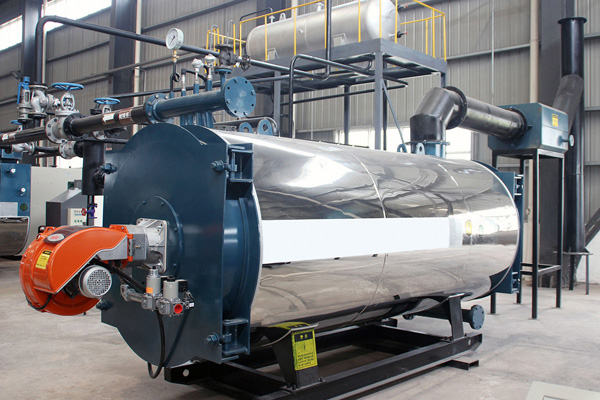
0.7-7 MW thermal oil; 1-6 t/h steam
Packaged thermal oil heaters and steam boilers for rubber and tire plants, sized for vulcanization presses, mixing and drying. The...
View details10 t/h
The WNS10-1.25-Q is a packaged three-pass wet-back fire-tube boiler delivering 10 t/h of steam at 1.25 MPa and 194 °C, firing natu...
View detailsExternal links open the publisher’s website and are provided for background reading.
Include the capacity (t/h or MW), fuel, working pressure and site country so the proposal matches your permit limits.
We appoint one or two partners per country to quote, deliver and service our boilers locally. Territory protection, factory pricing and commissioning support are part of the agreement.