
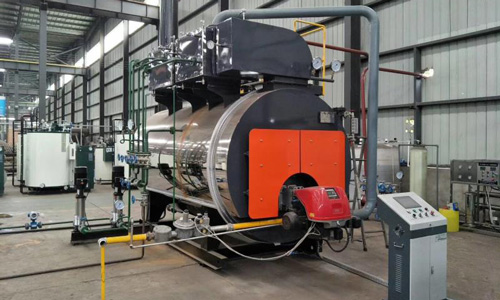
1-100 t/h
Low-NOx Condensing Gas Steam Boiler
Two-pass wet-back steam boiler with economiser and condensing tail, designed for 30 mg/Nm³ NOx and a stack temperature near 55 °C.
View detailsBottom-fired vertical fire-tube hot water boiler, 0.06-0.7 MW at atmospheric pressure, 85/65 C, for small heating and pool loads.
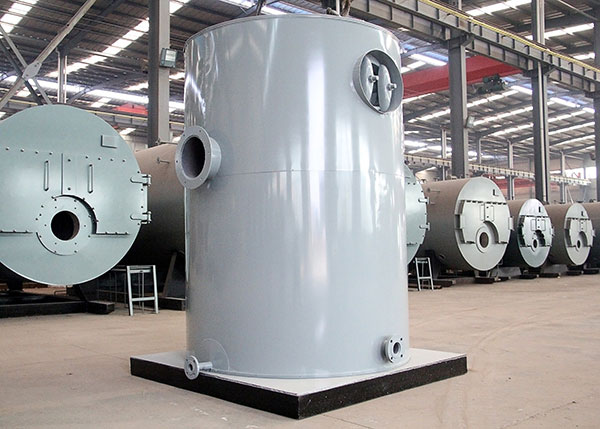
The CLHS is a bottom-fired vertical fire-tube boiler that supplies hot water at atmospheric pressure. Output runs from 0.06 MW to 0.7 MW, which covers a guesthouse, a clinic wing, a school block, a swimming pool or one production line that needs 85 °C water and has no use for steam. The burner is mounted at the base and fires upward into a straight vertical furnace; the gas turns at the top into the smoke-tube bundle, travels down the tubes and leaves through the upper smoke box to the chimney.
The proportions suit a plant room where floor area is scarce and headroom is not. A 0.06 MW unit measures 630 mm by 630 mm by 1,150 mm; the 0.7 MW unit measures 1,450 mm by 1,380 mm by 2,250 mm. Nothing has to be left clear at the rear for tube withdrawal, because the tubes come out upwards through the top box.
The furnace is a plain cylindrical shell rather than a corrugated one. On a vertical unit the furnace is short, so the pressure loss of a smooth bore is acceptable, and a plain wall keeps the flame envelope away from the tube plate. Furnace diameter is set by the burner flame, not by water volume. An undersized furnace quenches the flame, raises CO and unburnt hydrocarbon, and puts the peak heat flux right at the tube-to-tubeplate joint, which is where the first crack appears.
The convective bundle uses threaded smoke tubes. The spiral rib trips the boundary layer on every pitch, which lifts the convective coefficient by roughly a third against a smooth tube of the same bore, and it keeps the tube wall closer to the water temperature. Both effects show up as a lower exit gas temperature and a shorter bundle for the same duty. Brushing access is through the top smoke box.
The shell is vented to atmosphere, so the water surface sits at ambient pressure. The unit cannot build pressure in normal service, and the control philosophy is built around temperature rather than pressure: a safety temperature limiter, a low-water cut-out, a flow proving switch and a modulating or two-stage burner. In many jurisdictions an atmospheric unit falls outside the pressure-vessel inspection regime. Whether that applies to your site is a question for the local authority, and registration thresholds, water treatment duties and flue permissions should be settled before the order is placed.
Water volume is small: 95 L at 0.06 MW, 1,280 L at 0.7 MW. The boiler answers a load step quickly, but it has little thermal inertia, so a circuit with a generous primary volume, or a buffer tank on the pool or domestic hot water side, keeps burner cycling within reason.
Design conditions are 85 °C flow and 65 °C return. Keep the return above about 60 °C. A colder return drops the tube wall below the acid dew point of the flue gas, and the condensate that forms on the gas side of a non-condensing boiler is the usual cause of early tube failure in this class of unit. A three-port mixing valve, a recirculation loop or a primary-secondary arrangement with a plate exchanger all solve it, and any of them is cheaper than a re-tube.
Fuel options are natural gas, LPG, town gas and light oil, with a matched forced-draft burner carrying pre-purge, flame supervision and a gas train to local code. Thermal efficiency is 93 to 94% at nominal output. The package is delivered assembled, with the control panel wired and tested; site work is the flue, the water connections and the fuel line. Delivery is typically 25 to 45 days after drawing approval, and commissioning takes 5 to 10 days including water treatment set-up and burner adjustment.
Yes, through a plate heat exchanger or a storage calorifier. Do not draw potable water directly through the boiler shell, because the shell is not a sanitary vessel and the water will pick up iron and treatment chemicals.
Keep the return at 60 C or above. Below that, the gas-side tube wall falls under the flue gas acid dew point and wet corrosion starts at the cold end of the bundle.
That depends on the jurisdiction, not on the boiler. The shell is vented and cannot pressurise, but registration, emissions and electrical rules are set locally, so confirm the position with the authority before installation.
| Model | CLHS0.06-85/65-Y(Q) | CLHS0.12-85/65-Y(Q) | CLHS0.24-85/65-Y(Q) | CLHS0.35-85/65-Y(Q) | CLHS0.7-85/65-Y(Q) |
|---|---|---|---|---|---|
| Rated heat output | 0.06 MW | 0.12 MW | 0.24 MW | 0.35 MW | 0.7 MW |
| Water capacity | 95 L | 170 L | 342 L | 550 L | 1,280 L |
| Outlet / inlet connection | DN40 / DN40 | DN40 / DN40 | DN65 / DN65 | DN80 / DN80 | DN100 / DN100 |
| Thermal efficiency | 93-94% | 93-94% | 93-94% | 93-94% | 93-94% |
| Empty weight | 200 kg | 380 kg | 446 kg | 720 kg | 1,900 kg |
| Dimensions L x W x H | 630 x 630 x 1,150 mm | 750 x 750 x 1,380 mm | 950 x 880 x 1,700 mm | 1,110 x 1,040 x 1,850 mm | 1,450 x 1,380 x 2,250 mm |
1-100 t/h
Two-pass wet-back steam boiler with economiser and condensing tail, designed for 30 mg/Nm³ NOx and a stack temperature near 55 °C.
View details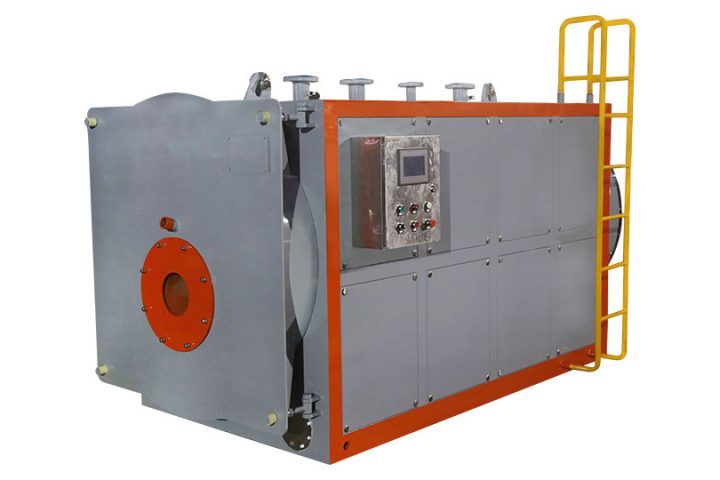
0.7-14 MW (larger on request)
Three-pass wet-back hot water boiler with a large furnace, FGR or surface premix burner and an internal condenser for 95/70 and 11...
View details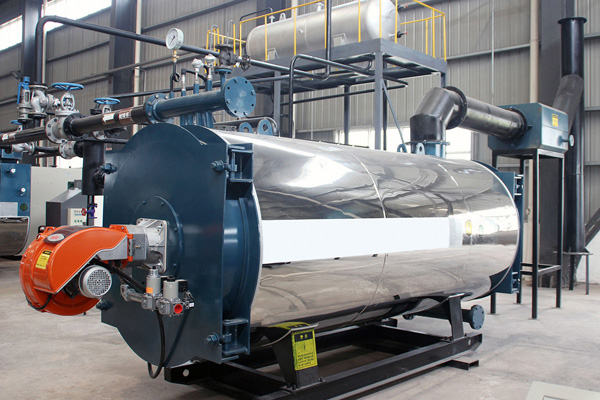
120-5,800 kW
Horizontal liquid-phase thermal oil heater, 120-5,800 kW, disc coil heating surface, 300-340 C at 0.8-1.0 MPa working pressure.
View detailsExternal links open the publisher’s website and are provided for background reading.
Include the capacity (t/h or MW), fuel, working pressure and site country so the proposal matches your permit limits.
We appoint one or two partners per country to quote, deliver and service our boilers locally. Territory protection, factory pricing and commissioning support are part of the agreement.