
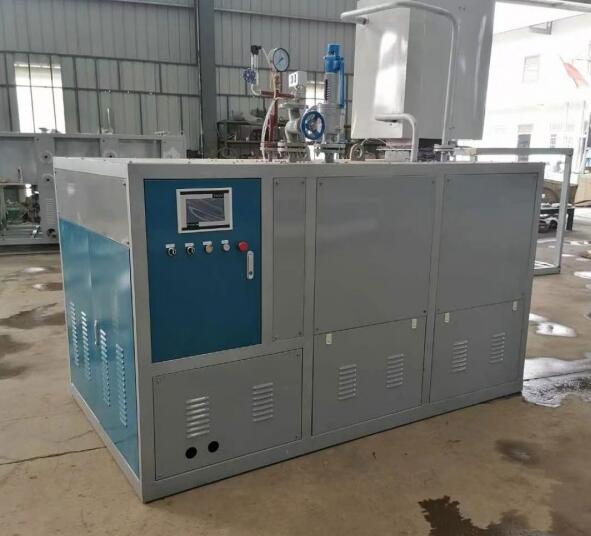
Two ways to boil water in a small plant
Below about 4 t/h, a plant chooses between two architectures that look similar on a datasheet and behave nothing alike in service. A fire-tube boiler is a pressure vessel full of water with a furnace tube running through it: the water is the working fluid and the heat sink at the same time. A coil once-through boiler is a few metres of small-bore tube wound into a helix, with a burner at one end and a pump at the other; water enters, is evaporated in a single pass, and leaves as steam, with perhaps twenty litres in the circuit at any moment.
The comparison is not about which is better. It is about which set of compromises suits the duty, and the four that decide it are water inventory, feedwater quality, load following and the cost of standing by.
Water inventory and what it changes
A 2 t/h fire-tube at 1.0 MPa holds 4,000-5,500 litres at the normal water level. A coil unit of the same rating holds 60-90 litres; a 1 t/h unit holds around 45 litres, which is why that size sits inside the D-class definition. The ratio is fifty to eighty times, and every other difference follows from it.
Start-up is the visible one. A fire-tube is brought up slowly because the shell is a thick pressure part with a temperature gradient across it: 30-45 minutes from cold to full pressure, with the burner held at low fire and the shell expansion checked. A coil unit reaches full pressure in three to five minutes, because there is almost no metal to heat relative to the output and the tube is thin-walled. For a plant that starts with the shift, that difference is worth more than a point of efficiency: the boiler can be cold overnight instead of being kept at pressure for nobody.
Standing loss follows. A fire-tube held at pressure radiates and convects from a large hot shell and draws a small amount of fuel through the stack; the loss is 1.5-3% of rating. A coil unit standing cold loses nothing, at the cost of a purge and a short warm-up on each start. Where steam is needed eight hours a day, five days a week, the coil saves several percent of the annual fuel bill on standby alone. Where steam is needed continuously, the calculation reverses, because the coil has no stored heat to ride through a burner trip and each start costs a purge cycle.
Feedwater quality: the real dividing line
A fire-tube can live with softened water. Hardness below 0.03 mmol/L, a conductivity of 3,000-4,000 µS/cm held by blowdown at 5-10%, and a monthly check are the normal regime. Scale forms on the furnace tube, but there is access to inspect it, and a water-side cleaning every few years is part of the maintenance budget.
A once-through coil cannot live with that. There is no blowdown, because there is no water body to blow down: everything dissolved in the feedwater either stays in the tube or leaves with the steam. That means near-demineralised water — hardness effectively zero, iron under 0.05 mg/L, silica under 0.2 mg/L, conductivity in the low tens of microsiemens, dissolved oxygen under 0.02 mg/L. A softener alone does not get there.
The consequence of getting it wrong is severe because the tube bore is small. Half a millimetre of scale on a 12 mm bore reduces the flow area by about 16% and, more importantly, raises the tube wall temperature by 60-100 K at the same heat flux, because the scale insulates the metal from the water. The tube then fails by overheating, usually within a year, and often at the hottest point in the first pass where nobody can see it. A fire-tube with the same scale layer runs hotter and less efficiently but does not fail in the same way, because the metal is thicker and the heat flux lower.
Load following and steam quality
The fire-tube’s water volume is a steam accumulator. A 20% step in demand dips the pressure by 0.05-0.08 MPa and the boiler recovers in three to five minutes without the burner doing anything dramatic. Batch users — a jacketed kettle, a retort, a group of sterilisers — are served by that stored energy, and the burner sees a smoothed load.
The coil has no such buffer. It responds within 30-60 seconds, which is faster than the fire-tube can, but the response must be coordinated: feedwater flow, fuel and air have to move together, or the outlet temperature and the steam quality swing. A sudden drop in load with the feed pump still running pushes wet steam out of the unit, and a sudden rise can starve the tube and cause a temperature excursion. Good controls handle this with feed-forward from the steam flow, and the minimum stable load is 20-25% of rating, below which the tube risk rises.
For a plant with a steady process load and a modest turndown requirement, the coil is well behaved. For a plant whose load is a series of batch steps, the fire-tube is more forgiving, and the difference in controls complexity is real.
Efficiency, space and service
A modern coil unit with an economiser reaches 94-95% on gas, and a condensing version 96-97%, because the counter-flow arrangement gives a close approach and the flue gas can be taken below its dew point in a corrosion-resistant tail. A three-pass fire-tube reaches 92-93% with an economiser and 86-88% without one. At part load the gap widens, because the fire-tube’s standing loss is a larger share of a smaller output.
The coil wins on space and weight: a 2 t/h unit is roughly 2 m by 1.2 m and 2.5 t, against 4.5 m by 2.3 m and 9-11 t for the fire-tube, which also needs a plinth and usually a crane for installation. The fire-tube wins on serviceability: both ends open, tubes can be inspected, brushed and replaced on site. A coil cannot be inspected internally without cutting it out, and a failed coil goes back to the works. That is not a defect, but it is a fact to plan for, and it argues for the water treatment being right rather than repairable.
| Characteristic | Fire-tube, 2 t/h | Coil once-through, 2 t/h |
|---|---|---|
| Water inventory | 4,000-5,500 L | 60-90 L |
| Cold start to full pressure | 30-45 minutes | 3-5 minutes |
| Standing loss at pressure | 1.5-3% of rating | Negligible when cold |
| Feedwater | Softened, 3,000-4,000 µS/cm | Demineralised, low tens of µS/cm |
| Blowdown | 5-10% | None |
| Load response | 3-5 minutes after a step | 30-60 seconds |
| Minimum stable load | 15-20% | 20-25% |
| Efficiency, gas, with economiser | 92-93% | 94-95% |
| Footprint, weight | 4.5 x 2.3 m, 9-11 t | 2.0 x 1.2 m, 2.5 t |
Where each one fits
The coil suits a plant that starts and stops, has good water available, needs steam quickly and has limited floor space: a laundry, a small food plant, a hotel with a separate steam demand, a modular plant room. The fire-tube suits continuous duty, variable water quality, batch loads that need storage, and any site that wants to inspect and repair its own pressure parts — including where the fuel is biomass or coal and the furnace is part of the boiler.
The decision should be made on the load duration curve, the water analysis and the shift pattern, not on the boiler house floor area alone. Two plants with the same 2 t/h peak can correctly choose opposite answers.


