
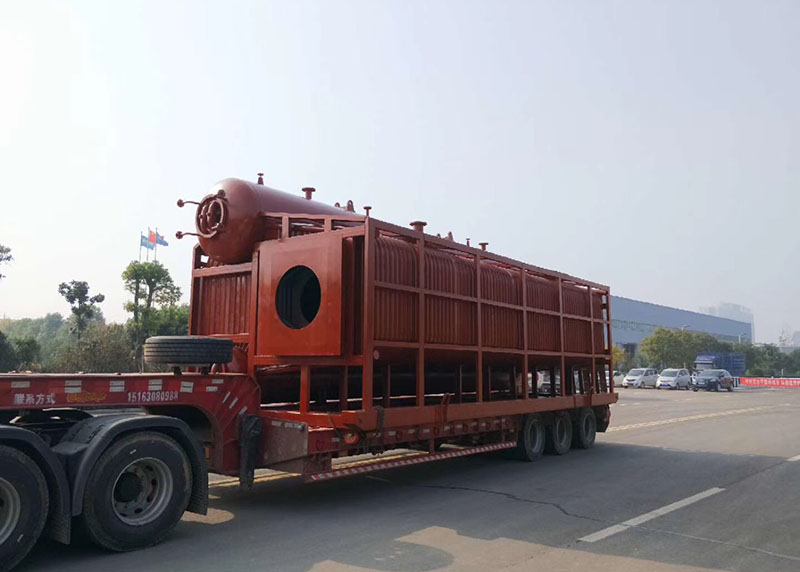
Two architectures, one duty
Both boiler families burn gas in a furnace and transfer heat to water, and both are offered from 6 t/h upward. The difference is where the water sits. In a WNS the furnace and the smoke tubes are inside a single large shell full of water, and hot gas passes through the water three times. In an SZS the furnace is a membrane-walled box, water runs inside tubes arranged around and above the flame, and the gas crosses the tube banks once or twice before the economiser.
That single difference drives almost every other property: pressure limit, water inventory, footprint, response to load, feedwater quality and maintenance. A buyer who compares only efficiency and price is comparing the two least decisive numbers.
Where the fire-tube boiler wins
A fire-tube boiler is a pressure vessel with a large water volume. At 4 t/h the shell holds about 9 t of water; at 6 t/h, 12 t. That inventory is a steam reservoir of roughly twenty minutes at rating, which absorbs step changes without moving the header pressure. For a plant with batch processes, a laundry, a hotel or a hospital, that behaviour is worth more than two points of efficiency.
It is also cheaper per tonne of capacity, arrives as a single packaged unit, needs a smaller boiler house and starts from cold in 20-30 minutes. Standard sizes run from 1 to 20 t/h and the catalogue extends to 100 t/h, but the practical economic range is 1-20 t/h at up to 1.6 MPa. Above that pressure the shell wall thickness grows with diameter, and the weight and cost of the pressure part rise faster than the capacity.
Water quality is the constraint. In a fire-tube boiler the water is on the outside of the tubes and the heat flux is moderate, so softened water with hardness below 0.03 mmol/L and a monthly blowdown routine is normally enough. Scale still costs: 1 mm on the tube surface is worth 2-3% of fuel.
Where the water-tube boiler wins
An SZS puts the pressure inside small-diameter tubes, so the same wall thickness contains a far higher pressure. That is why water-tube units are the standard choice above 1.6 MPa and are offered to 2.5 MPa and beyond in this range. Steam at 2.5 MPa and 225 °C is available from the catalogue, and superheaters can be added where the process needs dry steam.
The furnace is a membrane-walled box with a large volume relative to its output, which lowers peak flame temperature and makes 30 mg/Nm³ NOx achievable with flue gas recirculation and staged air rather than a bigger furnace. Efficiency is quoted at 98% on lower calorific value with an economiser and condenser, against 95-98% for a condensing fire-tube unit.
The price is water inventory. A 10 t/h SZS holds perhaps 8-10 t of water in the whole circuit, much of it in the tubes, and the drum is small. Load changes move pressure quickly, so a cyclic process needs a steam accumulator or a boiler sized with headroom. Feedwater must be demineralised, not merely softened, because evaporator tubes run at high heat flux and dissolved solids concentrate against the metal.
The comparison that matters
The table sets the two families side by side at the same 10 t/h rating. Figures are typical for gas firing at 1.25-1.6 MPa; specific models vary.
| Item | WNS fire-tube | SZS water-tube |
|---|---|---|
| Economic range | 1-20 t/h | 6-100 t/h |
| Maximum pressure | 1.6 MPa (2.5 on request) | 2.5 MPa and above |
| Water content at 10 t/h | About 16-24 t | About 8-10 t |
| Cold start to full pressure | 20-30 minutes | 35-50 minutes |
| Response to a step load | Buffered by water volume | Fast but needs accumulator |
| Quoted efficiency, LHV | 95-98% condensing | 98% with condenser |
| Feedwater | Softened | Demineralised |
| Footprint at 10 t/h | About 7.4 x 3.3 m | About 7.9 x 3.4 m plus stack |
| Site work | Single packaged unit | Two modules, more welding |
Efficiency claims and how to read them
A condensing fire-tube boiler at 97.5% and a water-tube at 98% are within measurement error of each other on the same gas. The gap that matters is at part load. A fire-tube boiler with a large water volume holds its efficiency down to 40-50% load; a water-tube unit at 30% load loses more to radiation and to the fan, and its economiser may drop below the acid dew point if the return water is cold.
Ask for the efficiency at three loads and for the flue gas temperature at each. A boiler that quotes 98% at full load and 62 °C stack will not hold 62 °C at half load unless the economiser has a bypass or the feedwater is warm enough. Condensation in the tail is the point of a condensing boiler, but it must happen in the condenser, not in the chimney.
Selection rules that hold up
Choose fire-tube when the load is cyclic, the pressure is 1.6 MPa or below, capacity is under 20 t/h, the plant has softened water and the boiler house is tight. Choose water-tube when the pressure is above 1.6 MPa, the load is continuous at 70-100% for most of the year, capacity is above 15-20 t/h, or the process needs superheated steam. Choose a water-tube unit with an accumulator when the load is both cyclical and above 20 t/h.
Two cases blur the rule. A 15 t/h plant running three shifts at steady load is usually better served by water-tube despite the lower capacity. A 25 t/h plant that starts and stops with the shift is usually better with two fire-tube units than one water-tube, because two shells give redundancy and storage together.
The final test is the load duration curve. If more than 60% of operating hours sit above 70% load, water-tube efficiency and lower maintenance will pay for the extra water treatment. If most hours sit between 30% and 60%, with peaks that arrive without warning, the fire-tube’s water volume is doing real work that no efficiency figure captures.


