

1-100 t/h (0.7-70 MW)
WNS Gas/Oil Steam Boiler, 1-100 t/h
Packaged three-pass wet-back fire-tube steam boiler for gas and oil, 1-100 t/h at 1.25 MPa, with matched modulating burner and ful...
View detailsA 2 t/h gas steam boiler supplies pasteurisation, CIP and whey drying at a dairy in Bishkek, with a stainless feedwater set and a low-NOx burner.
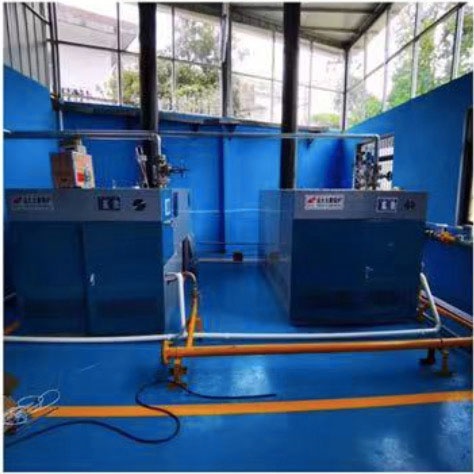
The dairy in Bishkek receives 60 t of milk a day and runs pasteurisers, a yoghurt line, a whey evaporator and a CIP set. Steam is used indirectly for pasteurisation and evaporation and directly for CIP heating, and the plant’s sanitation schedule means the load has sharp, predictable peaks at the end of each production run.
The boiler is a 2 t/h WNS fire-tube unit at 0.8 MPa and 175 °C. The pressure is deliberately modest: the pasteurisers need 0.5 MPa and the CIP set 0.4 MPa, and higher pressure would only add cost and standing losses.
Production draws about 1.0-1.2 t/h. The CIP set takes 1.6-1.8 t/h for 40 minutes when it heats 8 m3 of water from 20 to 80 °C, and that is the sizing case. The boiler’s 2 t/h rating covers it with a margin, and the steam accumulator-free design relies on a 5 m3 feedwater tank at 105 °C to ride through the first minutes of the peak.
At 2 t/h and 0.8 MPa the boiler absorbs about 1.35 MW. On natural gas at 34 MJ/Nm3 the full-load rate is about 155 Nm3/h, and the annual consumption reflects the plant’s two-shift pattern rather than continuous running.
| Item | Value |
|---|---|
| Rated evaporation | 2 t/h |
| Pressure / temperature | 0.8 MPa / 175 °C |
| Production load | 1.0-1.2 t/h |
| CIP peak | 1.6-1.8 t/h for 40 min |
| Full-load gas rate | about 155 Nm3/h |
| Feedwater | softened, deaerated, stainless |
The plant’s food-safety audit requires that steam used in direct contact with product be free of boiler chemicals. The boiler runs on softened water with a volatile oxygen scavenger, and the steam header has a separator and a 0.5 micron filter on the direct-contact line. Boiler water TDS is held at 2,000 ppm so carry-over stays low.
The feedwater tank and all piping after the deaerator are stainless. This is not a luxury in a dairy: carbon steel piping sheds iron oxide, and the plant’s first boiler had a recurring problem with rust spots in the yoghurt line’s steam injector.
The boiler replaced a 1.5 t/h unit that could not hold pressure during CIP. Installation took three weeks, including a new gas line and a stainless feedwater set. The plant now runs 1.1 t/h in production and 1.7 t/h during CIP without a pressure dip, and the whey evaporator, which used to lose vacuum at the end of the shift, holds steady.
Gas consumption in the first year was 8% lower per tonne of milk than the old boiler, mostly from the economizer and from not running a unit oversized for production just to meet CIP.
1-100 t/h (0.7-70 MW)
Packaged three-pass wet-back fire-tube steam boiler for gas and oil, 1-100 t/h at 1.25 MPa, with matched modulating burner and ful...
View details
6-100 t/h
Membrane-wall water-tube steam boiler with staged combustion and FGR, 6-100 t/h at up to 2.5 MPa and 98% efficiency with heat reco...
View details
2-50 m³/h treated water
Softener and deaerator package for boiler make-up, holding hardness below 0.03 mmol/L and oxygen below 0.05 mg/L.
View detailsExternal links open the publisher’s website and are provided for background reading.
The highest process requirement is 0.5 MPa. Running at 0.8 MPa gives margin without the standing losses and equipment cost of a higher pressure.
Only with a filtered, chemical-free direct-contact line. Most plants use indirect heating and keep a clean-steam skid for direct injection.
The boiler is sized on the CIP load, not the production load, and a 5 m3 deaerated feedwater tank covers the first minutes of the peak.
2025
Tema, Ghana
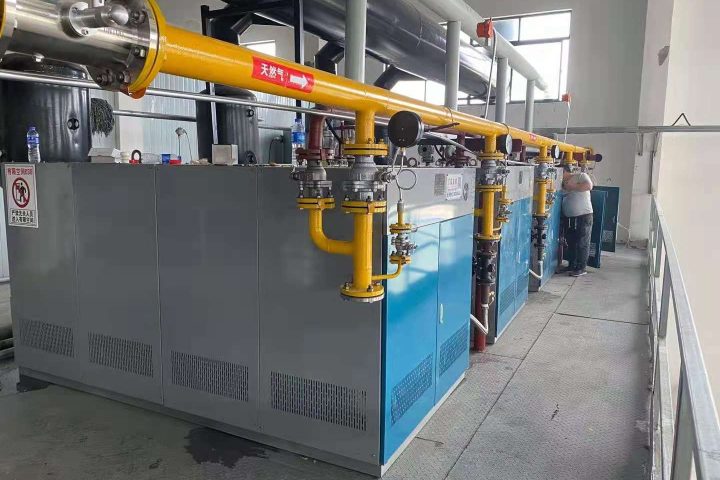
A 2.8 MW gas thermal oil heater holds 300 C for a resin and coatings plant in Tema, Ghana, replacing a high-pressure steam system...
View project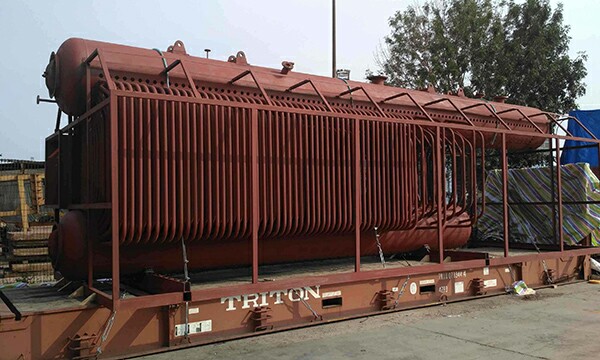
2023
Phnom Penh, Cambodia
3 t/h biomass steam boiler at 1.0 MPa on rubber wood, commissioned in 2023 in Phnom Penh, Cambodia: the factory shares a wall with...
View project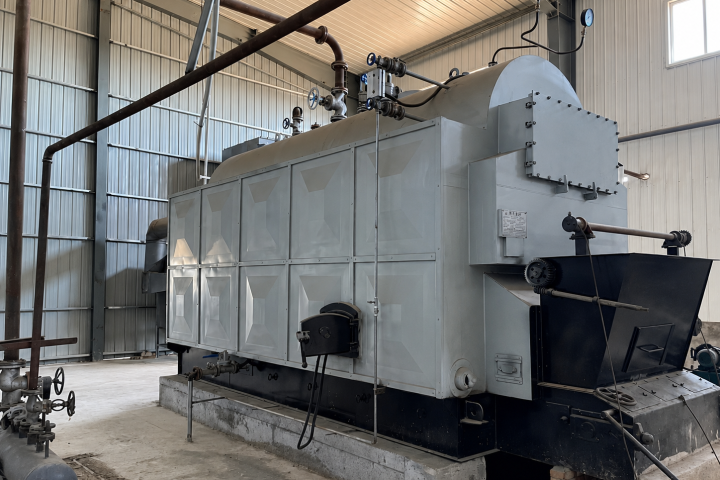
2016
Ho Chi Minh City, Vietnam
A steam boiler was supplied for a textile printing and dyeing plant in Ho Chi Minh City, Vietnam, supporting the wet processing st...
View projectWe appoint one or two partners per country to quote, deliver and service our boilers locally. Territory protection, factory pricing and commissioning support are part of the agreement.