
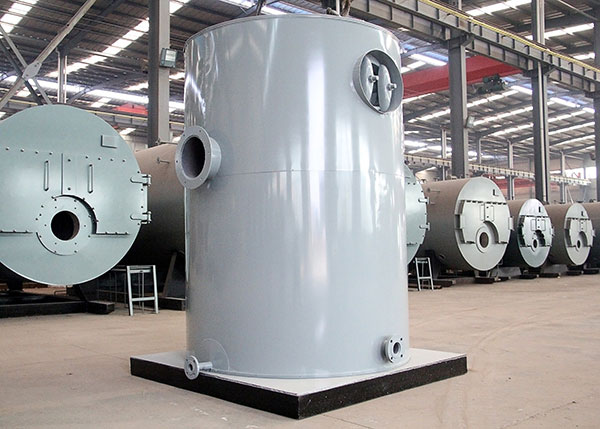
0.06-0.7 MW (10-90 ×10⁴ kcal/h)
CLHS Vertical Atmospheric Hot Water Boiler
Bottom-fired vertical fire-tube hot water boiler, 0.06-0.7 MW at atmospheric pressure, 85/65 C, for small heating and pool loads.
View detailsThe WNS2-1.25-Q is a packaged three-pass wet-back fire-tube steam boiler rated at 2 t/h and 1.25 MPa, delivering 194 °C steam at 95% efficiency (LHV basis) on natural gas, LPG, light diesel or heavy fuel oil.
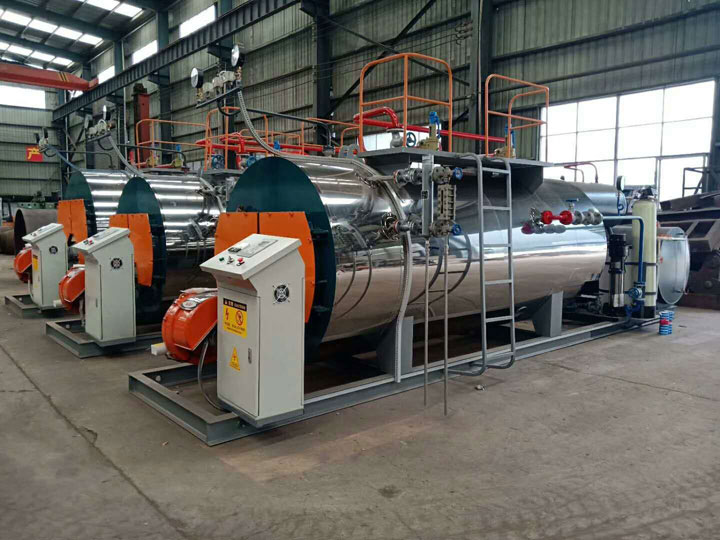
The WNS2-1.25-Q is a packaged, three-pass wet-back fire-tube steam boiler rated at 2 t/h with a design pressure of 1.25 MPa and a steam temperature of 194 °C. It fires natural gas, LPG, light diesel or heavy fuel oil through a low-NOx burner and is quoted at 95% efficiency on an LHV basis. The unit is factory-assembled as a package, so site work is limited to setting, connections and commissioning rather than shell-and-tube erection.
At 2 t/h the boiler matches process steam demand that is steady but modest: small food and beverage lines, laundries, textile finishing, greenhouses, small chemical or pharmaceutical batches, and district or campus heating plants that run one boiler as lead unit. It is also a common choice where steam is needed intermittently and where a larger boiler would spend most of its life cycling below its efficient band.
The published fuel consumption is 149 Nm³/h at rated output on natural gas at 95% efficiency. The figure follows from the rated steam output and the fuel’s lower heating value: the boiler must add the enthalpy to raise feedwater to 194 °C steam at 1.25 MPa, and the gas volume is that heat input divided by the LHV and the stated efficiency. Because the rating is on an LHV basis, the number is directly comparable with gas-supplier data. For LPG, light diesel or heavy fuel oil the volumetric and mass rates differ with the fuel’s own heating value and density; the natural gas figure should not be read across to liquid fuels.
A 2 t/h fire-tube boiler has a relatively large water volume for its output, which gives useful steam storage and smooths short demand swings. With a modulating low-NOx burner the unit can follow load across a wide turndown rather than cycling on and off; efficiency at part load depends on burner turndown, excess air and flue-gas temperature, and the 95% figure applies at rated output. Where demand regularly falls below the burner’s minimum stable firing rate, the boiler will cycle, and a smaller unit or added storage may be the better match.
The WNS2-1.25-Q is a horizontal packaged unit: shell, furnace, tube passes, burner and controls arrive as one assembly, with connections for feedwater, steam, blowdown, fuel and flue. Planning should allow for the burner swing space and front access for servicing, rear access to the wet-back turnaround, side clearance for tube inspection, and headroom for the flue and valves. Foundation, flue route and fuel supply are project-specific; no dimensions or weights are stated here and should be taken from the model drawing.
Fire-tube boilers at this pressure require consistent feedwater and boiler water chemistry: softened or demineralised make-up to control hardness, controlled alkalinity and dissolved oxygen, and regular blowdown to limit dissolved solids. Scale and carryover are the main threats to efficiency and steam quality at 2 t/h, so treatment and monitoring should be designed before commissioning, not after.
The packaged control set covers burner management, flame supervision, modulating firing on pressure, feedwater control and the usual safety interlocks for low water, high pressure and flame failure. The low-NOx burner is matched to the fuel selected at order; gas and liquid fuel trains differ, and dual-fuel arrangements should be specified up front.
Choosing 2 t/h rather than the next size down avoids running a smaller boiler flat out with no margin for peak draws or fouling. Choosing it rather than the next size up avoids a unit that spends most of its time at low fire or cycling, which costs efficiency and burner life. The 2 t/h rating sits where a single packaged boiler can carry a modest plant with useful turndown and storage.
| Parameter | Value |
|---|---|
| Model | WNS2-1.25-Q |
| Capacity | 2 t/h |
| Pressure | 1.25 MPa |
| Steam temperature | 194 °C |
| Feedwater temperature | Not stated in brief |
| Fuel | Natural gas, LPG, light diesel, heavy fuel oil |
| Fuel consumption at rated output | 149 Nm³/h (natural gas, 95% efficiency) |
| Efficiency | 95% (LHV basis) |
| Burner/control | Low-NOx burner, packaged three-pass wet-back fire-tube |
| Application | Process steam, heating, laundry, small industrial plants |
It is rated at 2 t/h of steam at 1.25 MPa and 194 °C. Continuous output above that rating is outside the brief; short peaks are buffered by the boiler's water volume, but sustained demand should be matched by the rated capacity.
149 Nm³/h of natural gas at rated output, based on 95% efficiency on an LHV basis. LPG, light diesel and heavy fuel oil have different heating values and densities, so their rates differ and are not given by this figure.
If your peak demand sits close to 2 t/h with little margin, this rating gives headroom a smaller unit would not. If demand is usually well below the burner's minimum firing rate, a smaller unit or added steam storage may suit better than stepping up to the next size.
| Model | WNS2-1.25-Q |
|---|---|
| Capacity | 2 t/h |
| Pressure | 1.25 MPa |
| Steam temperature | 194 °C |
| Feedwater temperature | 20 °C (105 °C with deaerator) |
| Fuel | Natural gas, LPG, light diesel, heavy fuel oil |
| Fuel consumption at rated output | 149 Nm³/h (natural gas, 95% efficiency) |
| Efficiency | 95% (LHV basis) |
| Burner/control | Low-NOx burner; packaged three-pass wet-back fire-tube |
| Application | Process steam, heating, laundry, small industrial plants |
0.06-0.7 MW (10-90 ×10⁴ kcal/h)
Bottom-fired vertical fire-tube hot water boiler, 0.06-0.7 MW at atmospheric pressure, 85/65 C, for small heating and pool loads.
View details
1-20 t/h
Gas-fired steam boiler package for textile and dyeing plants. SZS or WNS boilers deliver 1-20 t/h at 1.0-1.6 MPa, handling batch d...
View details3 t/h
The WNS3-1.25-Q is a packaged three-pass wet-back fire-tube steam boiler rated at 3 t/h and 1.25 MPa, producing 194 °C steam on na...
View detailsExternal links open the publisher’s website and are provided for background reading.
Include the capacity (t/h or MW), fuel, working pressure and site country so the proposal matches your permit limits.
We appoint one or two partners per country to quote, deliver and service our boilers locally. Territory protection, factory pricing and commissioning support are part of the agreement.