
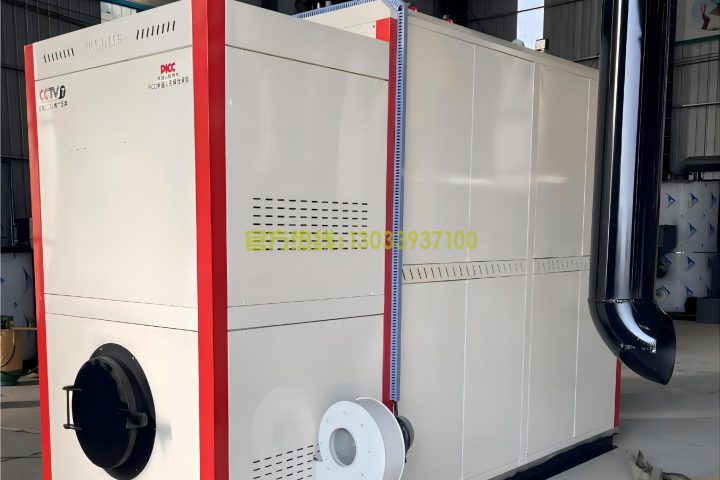
0.3-2 t/h
Integrated Steam Heat Source Unit, 0.3-2 t/h
Skid-mounted steam package combining boiler, burner, feedwater module, softener and controls in one enclosure, 0.3-2 t/h at 0.7-1....
View detailsCoil-type once-through steam boiler, 0.3-4 t/h at 0.7-1.6 MPa, no drum, 20-60 litres of water and a five to ten minute cold start.
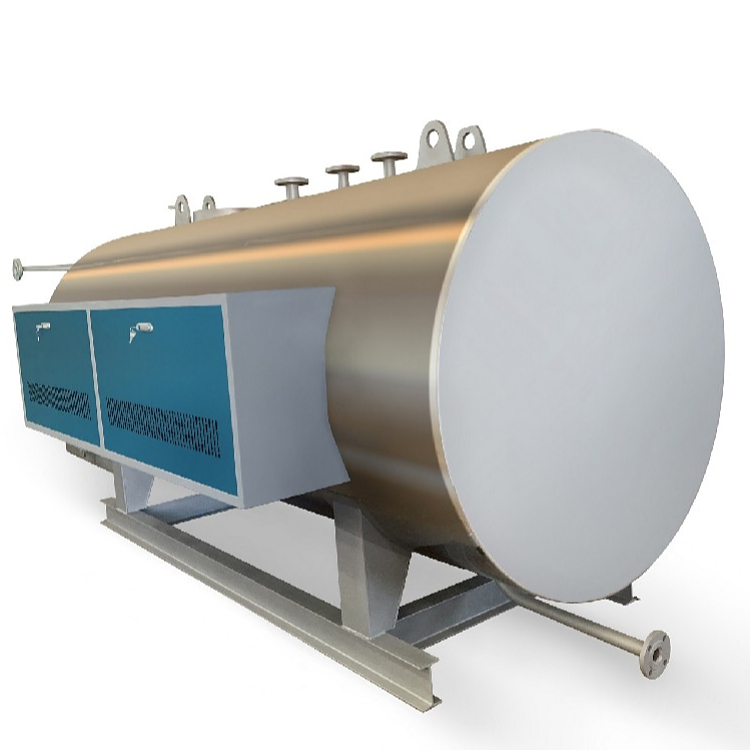
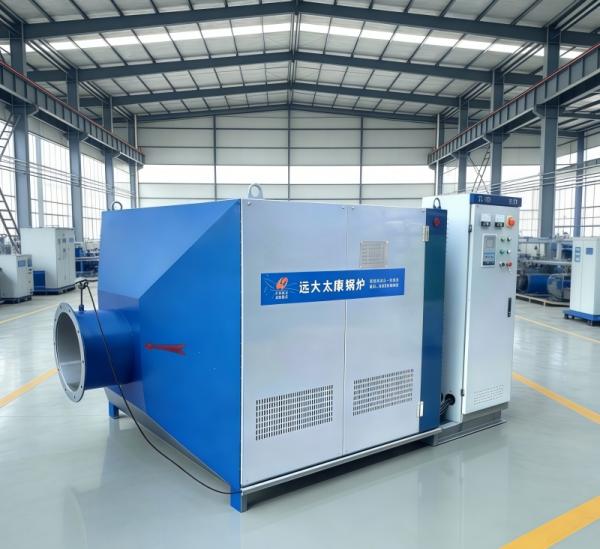
A once-through boiler evaporates water in a single pass through a coil and delivers steam at the outlet, with no drum and no recirculation. Feedwater enters one end at pump pressure and leaves the other as saturated steam at 0.7 to 1.6 MPa, 0.3 to 4 t/h, five to ten minutes from cold. Water inventory is 20 to 60 litres, under 1 per cent of a fire-tube of the same output.
A shell boiler holds four to six tonnes of water at saturation, roughly 4 GJ of stored heat. That reserve absorbs a sudden draw, and it is also why the boiler takes 40 to 90 minutes to raise pressure from cold. A once-through unit holds 20 to 60 litres, some 30 MJ, and follows the load instead of buffering it.
Load following is therefore excellent and load shocks are not. A 300 kg step on a 2 t/h unit is 15 per cent of capacity, and with 45 litres of water the pressure falls within seconds unless the feed pump and firing rate move together. Keep any single user below a third of rating, or add a small accumulator.
Blowdown disappears, and that has the longest reach. A shell boiler blows down 3 to 5 per cent of its feedwater to hold dissolved solids at a set point; a once-through coil has no blowdown connection, so every gram of dissolved solid either leaves with the steam or stays on the tube wall. Feedwater quality must be better by the same factor: hardness near 0.01 mmol/L, conductivity under 5 µS/cm on demineralised feed, silica controlled.
The heating surface is a helical coil of 32 to 51 mm tube, three to six passes deep, with the burner firing into the centre. Heat flux is 100 to 200 kW/m² against 60 to 80 in a fire-tube boiler, and the wall is thin because it transfers heat rather than carrying a drum’s weight. A 1 mm scale layer on a 4 mm wall at that flux lifts the metal temperature 150 to 250 K, past the creep limit. On this design scale is a tube failure with a date on it.
Softening alone is often not enough. A softener exchanges calcium and magnesium for sodium, which is acceptable in a drum boiler that blows down, but in a once-through unit the sodium salts have no exit except the steam. Demineralisation by reverse osmosis or mixed bed is the usual specification; below that, a softener plus a conductivity trip on the feed line is the minimum.
With no drum there is no water level to trip on, so protection is built from flow and temperature. A minimum-flow orifice or recirculation line keeps at least 30 per cent of design flow through the coil; a flow switch trips the burner within two to three seconds of losing feedwater; a thermocouple on the last pass trips on over-temperature; and the feed pump runs on a variable-speed drive slaved to outlet temperature, not to a level probe.
The classic failure is a blocked strainer or a closed valve downstream, which stops flow while the burner keeps firing. The coil dries out in under a minute, the last pass glows and the tube ruptures. Nothing in a drum boiler fails that fast, which is why the interlock logic is built around flow.
At design load the coil exit is dry saturated steam with 1 to 2 per cent moisture, separated in a small centrifugal separator at the outlet. Below about 25 to 30 per cent load the last pass does not fully evaporate, the outlet becomes a wet mixture, and the separator handles slugs of water that reach the header as water hammer. Most units specify a minimum stable load of 25 per cent; below that, cycling is kinder than continuous running.
Against a fire-tube boiler of the same rating, a once-through unit takes 40 to 60 per cent of the floor area, weighs about a third as much, starts in five to ten minutes and has no drum to inspect. It suits a packaged plant on a mezzanine, a plant that starts and stops with the shift, and a retrofit into a room where a shell will not fit.
It does not suit a plant with hard water and no treatment budget, a load with large single draws, or an operator who expects to blow down and forget. Both types reach 90 to 93 per cent on gas; the choice is what the plant can afford to put into the water and how fast it needs steam.
Because there is no blowdown. A shell boiler removes dissolved solids by blowing down 3 to 5 per cent of its feed; a once-through coil cannot, so solids either leave with the steam or deposit on the tube. Hardness near 0.01 mmol/L and low conductivity are the price of the design.
The burner trips within two to three seconds on a flow switch, because the coil would otherwise dry out and rupture in under a minute. A minimum-flow recirculation line and an over-temperature trip on the last pass are the second and third lines of defence.
No better than its water inventory allows. Keep any single user below a third of rating; for a press or a steriliser that opens a large valve, add a small steam accumulator rather than a bigger coil.
| Size class | 0.3 t/h | 0.5 t/h | 1 t/h | 2 t/h | 3 t/h | 4 t/h |
|---|---|---|---|---|---|---|
| Rated pressure | 0.7 MPa | 1.0 MPa | 1.0 MPa | 1.25 MPa | 1.6 MPa | 1.6 MPa |
| Steam temperature | 170 °C | 184 °C | 184 °C | 194 °C | 204 °C | 204 °C |
| Water inventory | 20 L | 25 L | 35 L | 45 L | 55 L | 60 L |
| Cold start to pressure | 5 min | 5 min | 6 min | 8 min | 9 min | 10 min |
| Gas burn at 91% | 25 Nm³/h | 42 Nm³/h | 84 Nm³/h | 166 Nm³/h | 249 Nm³/h | 332 Nm³/h |
0.3-2 t/h
Skid-mounted steam package combining boiler, burner, feedwater module, softener and controls in one enclosure, 0.3-2 t/h at 0.7-1....
View details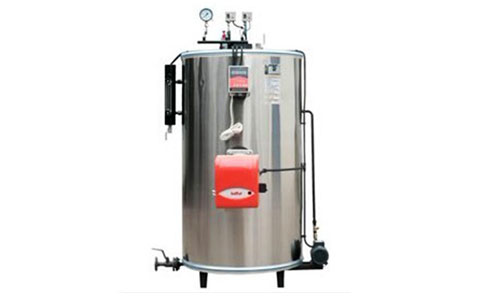
0.1-1 t/h
Vertical three-pass packaged steam boiler for small loads, 0.1-1 t/h at 0.7-1.0 MPa, with a 1.3 m square footprint and fast cold s...
View details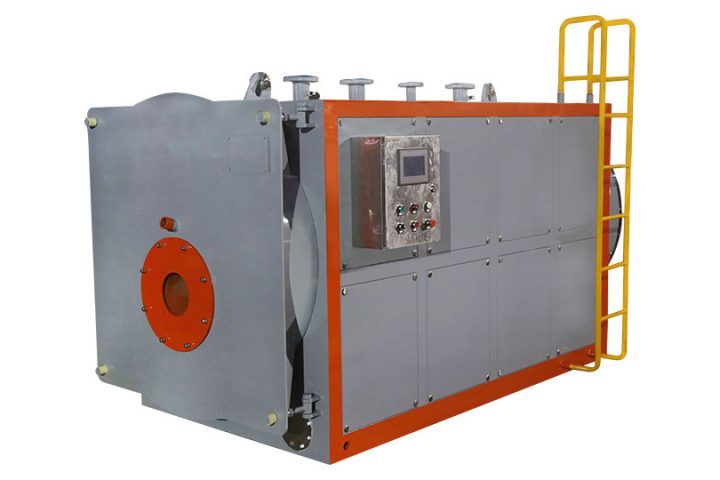
0.7-14 MW (larger on request)
Three-pass wet-back hot water boiler with a large furnace, FGR or surface premix burner and an internal condenser for 95/70 and 11...
View detailsExternal links open the publisher’s website and are provided for background reading.
Include the capacity (t/h or MW), fuel, working pressure and site country so the proposal matches your permit limits.
We appoint one or two partners per country to quote, deliver and service our boilers locally. Territory protection, factory pricing and commissioning support are part of the agreement.