

1-100 t/h (0.7-70 MW)
WNS Gas/Oil Steam Boiler, 1-100 t/h
Packaged three-pass wet-back fire-tube steam boiler for gas and oil, 1-100 t/h at 1.25 MPa, with matched modulating burner and ful...
View detailsThe WNS3-1.25-Q is a packaged three-pass wet-back fire-tube steam boiler rated at 3 t/h and 1.25 MPa, producing 194 °C steam on natural gas, LPG, light diesel or heavy fuel oil at 95% efficiency (LHV basis).
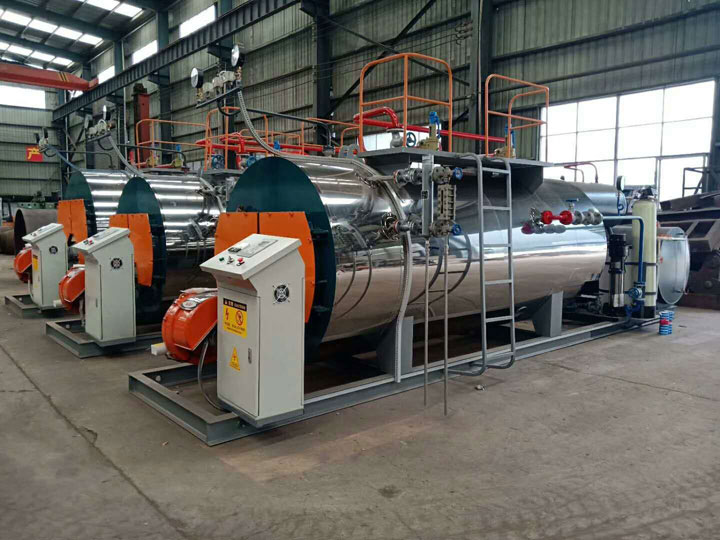
The WNS3-1.25-Q is a 3 t/h unit from the WNS Gas/Oil Steam Boiler series. It is a three-pass wet-back fire-tube boiler supplied as a packaged assembly with a low-NOx burner. Rated steam pressure is 1.25 MPa at a steam temperature of 194 °C. The boiler fires natural gas, LPG, light diesel or heavy fuel oil, and is rated at 95% efficiency on an LHV basis.
At 3 t/h, this unit sits in the small-to-mid industrial range. It suits plants whose steam demand is steady but modest: process heating, food and beverage operations, laundries, small district or campus steam systems, and facilities that run one boiler as the working unit with a second for standby. The 1.25 MPa / 194 °C rating covers saturated-steam process loads and heating duties that do not require higher-pressure steam.
The published fuel consumption is 223 Nm³/h at rated output, stated for natural gas at 95% efficiency. The figure follows from the rated steam output and the heat input needed to raise feedwater to 194 °C saturated steam, divided by the LHV-basis efficiency. It is a rated-output value: at lower firing rates the fuel flow falls roughly in proportion, and it will differ for LPG, light diesel or heavy fuel oil because those fuels have different heating values and densities. Use 223 Nm³/h as the natural-gas design point for gas supply and metering sizing, not as a figure for the other fuels.
A 3 t/h fire-tube boiler has a relatively large water volume for its output, which gives useful steam storage and smooths short load swings. With a modulating low-NOx burner, firing rate tracks steam pressure across the turn-down range, so the unit can hold pressure at part load without frequent cycling. Efficiency at part load depends on burner turn-down and on flue-gas losses; the 95% figure is the rated point. Where demand regularly falls well below 3 t/h, confirm the burner’s minimum firing rate against the actual load profile.
The packaged format means the pressure vessel, burner and controls arrive as one factory-assembled unit, reducing site erection work to setting, connections and commissioning. Plan the boiler room around the unit’s footprint plus clearances for burner service, tube access, and flue and pipe connections. Allow space for feedwater and water-treatment equipment, the flue route, and fuel supply or gas train. Final layout should follow the project drawings; no dimensions are stated here.
Fire-tube boilers at this pressure require consistent feedwater and boiler-water quality control to protect tubes and shell from scale and corrosion. Provide softening or demineralisation as the water analysis dictates, plus chemical dosing and blowdown control. Water treatment is not optional at 3 t/h: scale on the fire-tube surfaces directly reduces efficiency and can lead to tube overheating.
The unit is supplied with a low-NOx burner and packaged control system. Controls handle modulating firing to match steam pressure, flame supervision and safety interlocks, and integrate with feedwater control and level protection. Confirm the control scope and interface requirements against your plant’s automation and safety architecture during project engineering.
Choose 3 t/h when peak steam demand sits comfortably within the rating and a single packaged unit keeps the plant simple. The next size down leaves little margin for load growth or standby; the next size up adds capacity and footprint you may not need, and can run at low firing rates if demand stays small. Matching the boiler to the real load profile, rather than to a round number, is the practical basis for the decision.
| Parameter | Value |
|---|---|
| Model | WNS3-1.25-Q |
| Capacity | 3 t/h |
| Pressure | 1.25 MPa |
| Steam temperature | 194 °C |
| Fuel | Natural gas, LPG, light diesel, heavy fuel oil |
| Fuel consumption at rated output | 223 Nm³/h (natural gas, 95% efficiency) |
| Efficiency | 95% (LHV basis) |
| Burner/control | Low-NOx burner, packaged control system |
It is rated at 3 t/h of steam at 1.25 MPa and 194 °C. Continuous output should be planned within that rating, with the burner's turn-down range checked against your load profile.
At rated output on natural gas at 95% efficiency, fuel consumption is 223 Nm³/h. Consumption falls roughly in proportion at lower firing rates and differs for LPG, light diesel or heavy fuel oil.
Feedwater and boiler water must be controlled to protect the fire-tube surfaces from scale and corrosion. Softening or demineralisation, chemical dosing and blowdown control should be set according to your water analysis.
| Model | WNS3-1.25-Q |
|---|---|
| Capacity | 3 t/h |
| Pressure | 1.25 MPa |
| Steam temperature | 194 °C |
| Fuel | Natural gas, LPG, light diesel, heavy fuel oil |
| Fuel consumption at rated output | 223 Nm³/h (natural gas, 95% efficiency) |
| Efficiency | 95% (LHV basis) |
| Burner/control | Low-NOx burner, packaged control system |
| Application | Process heating, food and beverage, laundries, small district/campus steam systems |
1-100 t/h (0.7-70 MW)
Packaged three-pass wet-back fire-tube steam boiler for gas and oil, 1-100 t/h at 1.25 MPa, with matched modulating burner and ful...
View details
0.5-4 t/h
Trailer-mounted packaged steam boiler, 0.5-4 t/h at 1.0-1.25 MPa, with burner, feed pump, water tank, control panel and stack on o...
View details
1-100 t/h
Two-pass wet-back steam boiler with economiser and condensing tail, designed for 30 mg/Nm³ NOx and a stack temperature near 55 °C.
View detailsExternal links open the publisher’s website and are provided for background reading.
Include the capacity (t/h or MW), fuel, working pressure and site country so the proposal matches your permit limits.
We appoint one or two partners per country to quote, deliver and service our boilers locally. Territory protection, factory pricing and commissioning support are part of the agreement.