
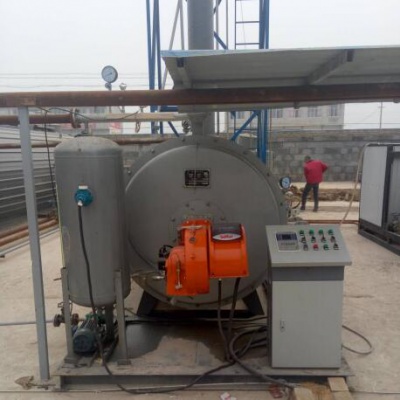
Feedwater treatment is the cheapest reliability measure on any steam plant, and the most commonly under-specified. Scale of 1 mm on a fire-tube boiler’s heating surface can raise fuel consumption by roughly 2–3% and push tube metal temperatures up; oxygen pitting measured in tenths of a millimetre can perforate a tube wall in months. This article covers the four treatment steps that matter most for industrial boilers — softening, deaeration, oxygen scavenging and conductivity control — and gives reference values by pressure band. It is a starting point for specification, not a substitute for a water-treatment programme designed against your actual raw-water analysis. For equipment options, see our product range.
1. Why treatment is sequenced, not optional
Each treatment step protects the next. Softening removes hardness (calcium and magnesium) that would otherwise precipitate as scale at the heat-transfer surface. Deaeration removes the bulk of dissolved oxygen before it reaches the boiler. Chemical scavenging mops up the residual oxygen that the deaerator cannot remove. Conductivity control limits dissolved solids so that carryover and foaming stay within bounds. Skip a step and the downstream equipment pays: an undersized softener loads the deaerator with hardness carryover, and a deaerator without a working vent cannot be compensated for by doubling the scavenger dose.
2. Softening: remove hardness before it becomes scale
Sodium-cycle ion exchange is the standard for industrial boilers up to medium pressure. Resin exchanges calcium and magnesium for sodium; hardness is typically reduced from whatever the raw water contains to below 1–2 mg/L as CaCO₃ at the softener outlet. Two practical points drive cost and reliability:
- Regeneration frequency and salt use scale with raw-water hardness and flow. A softener sized on average flow rather than peak flow will slip hardness during morning draw-off.
- Hardness monitoring should be continuous or at least daily at the softener outlet. A hardness slip of a few mg/L is invisible until scale appears.
Where raw-water alkalinity is high, simple softening may not be enough; demineralisation or reverse osmosis may be needed at higher pressures. That decision is driven by the boiler pressure band and the raw-water analysis, not by preference.
3. Deaeration: the bulk oxygen removal step
A properly operating deaerator reduces dissolved oxygen to around 0.005–0.015 mg/L (5–15 µg/L) at the outlet, with feedwater heated to within a few degrees of saturation temperature. Performance depends on three things: steam supply adequate for the load, venting that actually removes the released gases, and internals (trays or spray nozzles) that are clean and correctly installed. A deaerator that is short of steam or has a blocked vent will pass oxygen through regardless of chemical dose.
Deaerator sizing is tied to peak steam demand, not average. If you are sizing a new plant or expanding, the capacity and cost guide explains how feedwater and deaerator capacity track boiler rating.
4. Oxygen scavenging: the residual protection
After deaeration, a chemical scavenger removes the remaining oxygen and passivates metal surfaces. Sodium sulphite is common on lower-pressure boilers; it adds dissolved solids and is not suitable where steam is used in food processing or where high pressure makes solids control tight. Hydrazine and its replacements (carbohydrazide, DEHA, erythorbate) are used at higher pressures. Dose is set by residual measurement, not by rule of thumb: target a measurable residual at the boiler feedwater inlet and adjust from there. Overdosing wastes chemical and, in the case of sulphite, adds conductivity.
5. Conductivity limits by pressure band
The table below gives indicative feedwater and boiler water limits for industrial shell and water-tube boilers. Values are typical guidance for drum boilers with good quality make-up; they are not a substitute for the boiler manufacturer’s limits or your treatment supplier’s programme. Assumptions: softened or demineralised make-up, continuous blowdown available, conductivity measured at 25 °C and corrected for temperature.
| Parameter | Low pressure (up to ~10 bar) | Medium pressure (~10–25 bar) | Higher pressure (~25–40 bar) |
|---|---|---|---|
| Feedwater hardness (mg/L as CaCO₃) | < 2 | < 1 | < 0.5 |
| Deaerator outlet O₂ (mg/L) | ≤ 0.015 | ≤ 0.010 | ≤ 0.005 |
| Feedwater conductivity (µS/cm at 25 °C) | < 1500 | < 500 | < 200 |
| Boiler water conductivity (µS/cm at 25 °C) | < 6000 | < 3500 | < 2000 |
| Boiler water pH | 10.5–12.0 | 10.5–11.8 | 9.5–11.0 |
Treat these as bands to design against, not pass/fail limits. Actual limits depend on boiler design, steam purity requirements and whether the steam contacts product. Conductivity control is achieved through blowdown rate and make-up quality; if you are consistently at the top of the band, the fix is usually make-up quality or blowdown control, not more chemical.
6. Checklist: what to verify before changing the programme
- ☐ Raw-water analysis on file, including hardness, alkalinity, chloride and silica.
- ☐ Softener outlet hardness logged daily; regeneration cycle matched to actual water use.
- ☐ Deaerator steam supply and vent verified under peak load, not just at idle.
- ☐ Dissolved oxygen measured at deaerator outlet and at feedwater inlet.
- ☐ Scavenger residual measured and dose adjusted to residual, not to a fixed setting.
- ☐ Conductivity and pH logged for feedwater and boiler water; blowdown rate reviewed.
- ☐ Boiler manufacturer’s water limits compared against the current programme.
What to send us for a proposal
To size treatment equipment or a feedwater package, send: boiler rating and design pressure; steam demand profile (average and peak); raw-water analysis; current make-up quality and treatment scheme; deaerator and softener details if existing; and any steam purity constraints (food contact, turbine, process). Cost is driven mainly by flow rate, pressure rating, materials of construction, level of automation, and whether the package includes softening, deaeration and chemical dosing as an integrated skid. Send these details and we will respond with a specification and a scope-based cost breakdown.


