
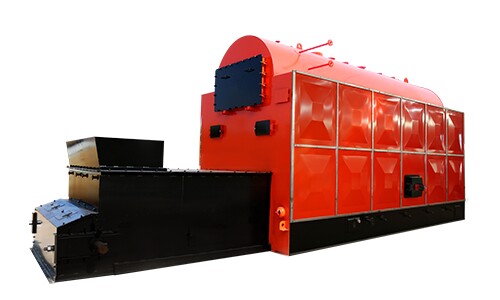
Industrial boiler price is not a single number attached to a tonnage. It is the sum of a pressure-vessel design, a combustion package, heat-recovery equipment, a control system, a set of auxiliaries, and the logistics and site work needed to put it into service. Two boilers rated at the same steam output can differ substantially in cost because one is built for 10 bar and the other for 25 bar, one burns natural gas through a modulating low-NOx burner and the other fires heavy fuel oil, and one is supplied as a bare pressure vessel while the other arrives as a skid-mounted package with feedwater, blowdown and stack components. The sections below explain the engineering drivers in the order they typically affect a quotation, so you can see where scope changes cost. For the equipment families involved, see our product range; for sizing logic, see the capacity and cost guide.
1. Capacity: steam output sets the size of everything
Capacity, expressed in tonnes of steam per hour (t/h) or in kW/MW thermal, is the first multiplier. It sets furnace volume, heating surface, drum diameter, tube count and the size of every downstream component. As a rule of thumb, a fire-tube boiler needs roughly 1.2–1.5 m³ of furnace volume per tonne per hour of steam output to keep heat release rates within reasonable limits, and water-tube designs scale differently but follow the same principle: more output means more surface and more steel.
Cost does not scale linearly with capacity. A 2 t/h unit and a 20 t/h unit do not differ by a factor of ten, because fixed costs — burner controls, instrumentation, documentation, pressure-part testing — are spread over a larger machine. In practice, cost per tonne of steam falls as capacity rises, then flattens and can rise again above roughly 30–40 t/h where water-tube construction, site erection and larger auxiliaries take over from packaged fire-tube designs. Specify capacity at the actual maximum continuous rating you need, not a round number, because oversizing raises cost across every line item.
2. Design pressure and temperature: steel thickness and code scope
Design pressure drives shell and tube wall thickness, and therefore steel mass. For a given diameter, required thickness rises roughly in proportion to pressure, so a boiler designed for 25 bar carries noticeably more steel than one designed for 10 bar at the same capacity. Higher pressure also raises the cost of fittings, valves, flanges and weld procedures, and it may push the design from a simple fire-tube layout into a water-tube layout.
Superheated steam adds a superheater, higher-grade tube material and more complex headers. Feedwater temperature matters too: a boiler specified with 105 °C feedwater needs a different economiser duty than one at 20 °C. State design pressure, design temperature and feedwater temperature explicitly — a supplier quoting 10 bar when you need 16 bar will look cheaper for a reason.
3. Burner and fuel: the combustion package
The burner is often the single largest bought-in item after the pressure vessel. Selection depends on fuel, turndown, excess-air targets and emissions limits. A modulating gas burner with a 5:1 turndown and low-NOx head costs more than a simple on/off unit. Dual-fuel burners with a separate oil train, pump set, heater and changeover logic add further cost. Heavy fuel oil requires heating, filtration and atomisation equipment that gas firing does not.
Fuel also changes the boiler itself: flue-gas volume, furnace size and convective surface differ between natural gas and coal or biomass. Ask for the burner’s rated output at your site’s gas calorific value and supply pressure, and confirm the boiler is matched to that burner — a mismatched combination costs efficiency, not just money.
4. Economiser and heat recovery
An economiser recovers heat from flue gas to preheat feedwater. Typical flue gas leaves a boiler at 180–250 °C; an economiser can cool it to 120–150 °C, improving overall efficiency by roughly 3–6 percentage points depending on load and feedwater temperature. That is a real operating saving, but it adds a pressure part, a bypass, drain and additional controls to the quotation.
Air preheaters, condensate recovery and blowdown heat recovery follow the same logic: each adds capital cost and each reduces fuel consumption. Decide which are justified by your annual running hours — a boiler at 8,000 h/year justifies more heat recovery than one at 2,000 h/year.
5. Controls and instrumentation
Control scope ranges from a basic burner management system with flame safeguard and pressure switch control to a PLC-based system with O2 trim, feedwater modulation, remote monitoring and integration with plant SCADA. Each added loop means sensors, actuators, wiring and engineering time. Safety-related controls — flame detection, low-water cutout, high-pressure interlocks — are not optional and should be included in every comparison; if one quote omits them, it is not comparable.
6. Auxiliaries, freight and installation scope
A boiler is rarely supplied alone. Feedwater pumps, water treatment, deaerator, blowdown vessel, stack, valves, insulation and steelwork can add substantially to the package. Freight depends on size and route: a packaged 10 t/h fire-tube unit may ship as one section, while a larger water-tube boiler ships in parts and is erected on site. Installation scope — foundations, rigging, piping, electrical, commissioning — is often quoted separately and can rival the equipment value if the site is constrained.
| Parameter | Typical range | Effect on cost |
|---|---|---|
| Capacity | 1–40 t/h steam | Cost per t/h falls with size up to ~30 t/h, then flattens |
| Design pressure | 10–25 bar(g) | Steel mass rises roughly with pressure; fittings and weld scope increase |
| Feedwater temperature | 20–105 °C | Higher feedwater reduces economiser duty but requires deaeration |
| Flue gas exit temperature | 180–250 °C without economiser; 120–150 °C with | Economiser adds capital, improves efficiency ~3–6 points |
| Burner turndown | 3:1 to 5:1 modulating | Higher turndown and low-NOx heads add cost |
| Excess air (gas firing) | ~10–15% (O2 ~2–3%) | O2 trim controls add instrumentation, save fuel |
Assumptions: values are indicative for packaged industrial steam boilers firing natural gas; actual figures depend on design, fuel and site conditions.
Checklist: what to define before requesting a quotation
- Maximum continuous steam output (t/h) and design pressure (bar(g))
- Steam condition: saturated or superheated, temperature
- Feedwater temperature and water treatment approach
- Fuel type, calorific value, supply pressure, and whether dual fuel is needed
- Emissions limits and any low-NOx requirement
- Annual running hours, to judge economiser and heat recovery payback
- Control philosophy: stand-alone, PLC, or plant SCADA integration
- Auxiliary scope: pumps, deaerator, blowdown, stack, insulation
- Delivery point and site access constraints
- Installation and commissioning scope: who does what
What to send us for a proposal
To prepare a comparable proposal, send: required steam output and design pressure; steam temperature and feedwater temperature; fuel type and supply data; emissions limits; annual operating hours; the auxiliary and control scope you expect; delivery location and site access notes; and the boundary of installation work you want included. With those inputs we can define the boiler, burner, economiser and auxiliaries as one matched package and show clearly what is included and what is excluded. Start with our product range and the capacity and cost guide, then send your data sheet.


