
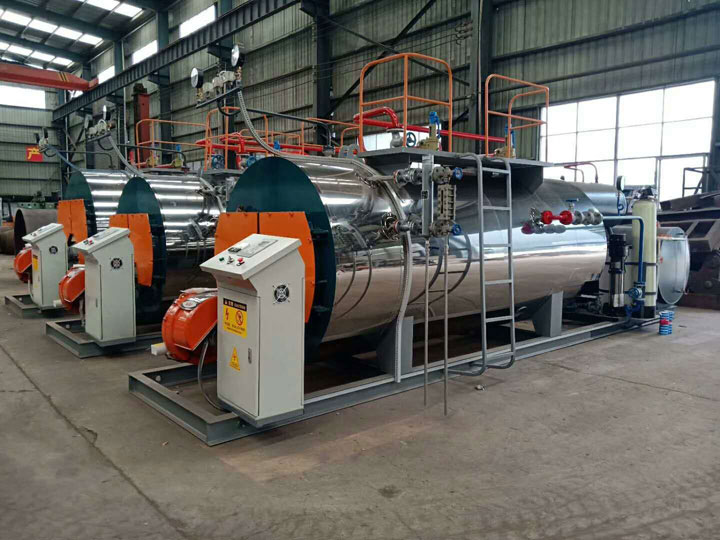
Two boiler quotes can both claim “95% efficiency” and still describe very different machines. The gap usually comes down to which calorific value the supplier used, and which losses were counted. This article explains lower heating value (LHV) versus higher heating value (HHV), walks through the main loss streams — stack, radiation and blowdown — and gives you a practical way to compare offers on equal terms. If you are sizing a unit at the same time, the capacity and cost guide covers the load side of the calculation.
LHV vs HHV: the same fuel, two numbers
Every fuel has two calorific values. HHV (also called gross calorific value) counts all the heat released when the fuel burns and the water vapour in the products condenses back to liquid. LHV (net calorific value) excludes that latent heat, because in a real boiler the flue gas leaves above the water dew point and the vapour never condenses.
For natural gas, HHV is roughly 10% higher than LHV. Typical figures: HHV about 38.0 MJ/Nm³ and LHV about 34.3 MJ/Nm³ at 0 °C, 101.3 kPa, depending on composition. For light fuel oil, HHV is around 45.5 MJ/kg and LHV around 42.7 MJ/kg. Because efficiency is useful heat divided by fuel energy input, using the smaller LHV denominator produces a larger percentage. A boiler at 92% on LHV is roughly 83% on HHV for natural gas. Neither number is wrong — but they are not interchangeable.
The loss streams that make up the difference
Efficiency is best understood as 100% minus the losses. For a gas-fired fire-tube boiler the picture typically looks like this:
- Stack (flue gas) loss — usually the largest item. It scales with flue gas temperature and excess air. A 10 °C rise in flue gas temperature costs roughly 0.5 percentage points of efficiency; every 1% of excess O₂ above the ideal adds a small but real penalty.
- Radiation and convection loss — heat escaping through the casing and insulation. It is roughly proportional to surface area, so it matters more on small boilers. A 1 t/h unit may lose 1.5–2.5% this way; a 20 t/h unit may lose under 0.5%.
- Blowdown loss — heat carried out with water drained to control dissolved solids. At 5% blowdown from a boiler at 10 bar, the energy penalty is on the order of 1–1.5% of fuel input. Heat recovery from blowdown can recover much of it.
- Unburned loss and moisture — small in well-tuned gas firing, larger with heavy oil or poor atomisation.
Worked example: where the percentages go
The table below shows a representative heat balance for a natural-gas fire-tube boiler at 10 bar, with 15% excess air and 180 °C flue gas temperature at the outlet. Values are indicative engineering estimates, not test results from a specific unit.
| Item | Value | Basis / assumption |
|---|---|---|
| Fuel input (LHV) | 100% | Natural gas, LHV ≈ 34.3 MJ/Nm³ |
| Stack loss | 7.5% | 180 °C flue gas, 15% excess air, 20 °C ambient |
| Radiation & convection | 1.2% | Insulated casing, mid-size unit |
| Blowdown loss | 1.0% | 5% blowdown at 10 bar |
| Unburned / other | 0.3% | Well-tuned gas burner |
| Useful heat (LHV basis) | 90.0% | 100% minus losses |
| Equivalent on HHV basis | ≈ 81% | Multiply by LHV/HHV ≈ 0.90 |
Note how a modest stack loss dominates. Drop the flue gas temperature to 120 °C with an economiser and stack loss can fall toward 4–5%, lifting LHV efficiency into the mid-90s. That is the mechanism behind condensing and near-condensing designs — and it is also why the return-water temperature matters so much.
Why LHV efficiency looks higher — and when it is legitimate
LHV efficiency is the standard reference in most of Europe and in much of Asia for combustion equipment, so it is a fair basis for comparison as long as everyone uses it. It becomes misleading when a condensing boiler is quoted on LHV and the latent heat is actually recovered: efficiencies above 100% on LHV are possible because the denominator excludes heat the boiler genuinely captures. On HHV the same unit will read below 100%. Neither figure is a trick, but mixing bases across quotes is.
Practical rule: if a quote states efficiency, ask for the calorific value basis, the flue gas temperature at rated output, the excess air or O₂ level, and the return water temperature assumed. Without those four, the number cannot be checked.
Checklist for comparing boiler quotes
- Confirm whether efficiency is on LHV or HHV, and convert both quotes to the same basis.
- Check the flue gas temperature at rated and at part load — part-load behaviour often differs.
- Ask what return water temperature the figure assumes; condensing gains depend on it.
- Confirm whether blowdown heat recovery and economiser are included or optional.
- Check the stated excess air or O₂ trim; fixed-air burners lose efficiency at low fire.
- Compare radiation loss on the same capacity class — small units lose proportionally more.
- Ask for the load profile used; a boiler optimised for 100% load may be poor at 30%.
- Confirm the fuel specification (HHV, LHV, density, sulphur) matches your supply.
Cost differences between quotes usually trace back to these items: heat recovery surface, burner turndown and controls, insulation quality, and whether blowdown recovery is included. Our product range lists the configurations available so you can see which of these are standard.
What to send us for a proposal
To size and quote accurately we need: required steam or hot water output and pressure/temperature; expected load profile (average and peak, hours per day); fuel type with HHV/LHV and supply pressure; feedwater or return water temperature; blowdown or water treatment constraints; available footprint and flue route; and any efficiency or emissions targets with the basis stated. Send these and we will return a proposal with the efficiency basis, flue gas temperature and assumed operating conditions written down explicitly, so it can be compared line by line with other offers.


