

20 t/h
20 t/h Water-Tube Gas/Oil Steam Boiler SZS20-1.6-Q
The SZS20-1.6-Q is a 20 t/h D-type double-drum water-tube boiler producing steam at 1.6 MPa and 204 °C. It achieves 95% efficiency...
View detailsTrailer-mounted packaged steam boiler, 0.5-4 t/h at 1.0-1.25 MPa, with burner, feed pump, water tank, control panel and stack on one road-legal chassis.
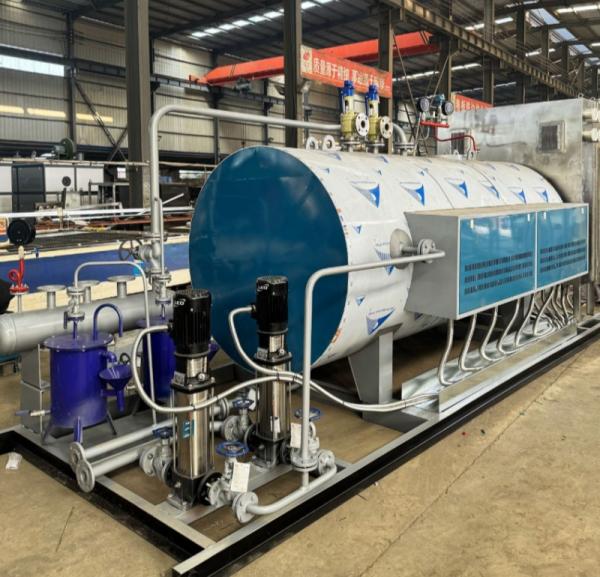
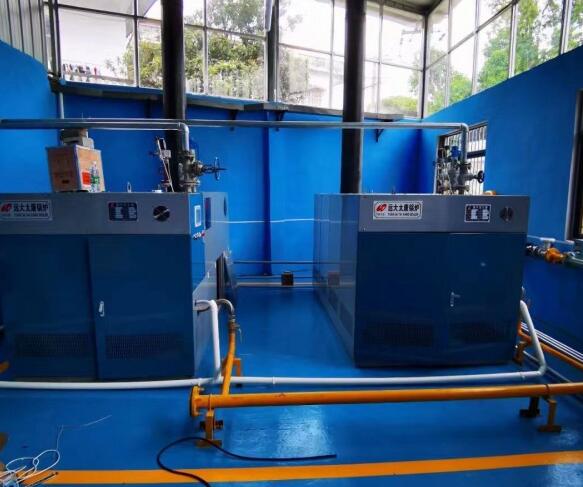
The unit is a three-pass wet-back boiler, 0.5 to 4 t/h, on a braked trailer chassis with the burner, feedwater pump, feed tank, fuel tank, control panel and exhaust stack carried on the same frame. It arrives towed, is levelled on its jacks, connected to fuel, water and power, and steams the same day. Nothing is built, no foundation cast, and when the job ends it leaves on the same drawbar.
The demand is usually temporary or moving: site camps needing hot water and process steam for six to twenty-four months, seasonal plants such as vegetable precooking or produce drying, temporary heat while a boiler house is refurbished, and emergency replacement after a flood or tube failure. The alternative is a permanent building, or a rented unit without its auxiliaries.
Road legality is decided by gross weight, not rating. A 2 t/h unit weighs about 6 t dry, holds about 6 t of water, and sits on a trailer of about 2.8 t with 1000 L of diesel: roughly 15.6 t over two axles, or 7.8 t per axle, inside the 8 t most export markets allow on a braked two-axle trailer. A 4 t/h unit approaches 20 t wet and needs three axles.
| Size class | Diesel at full load | Gross weight, wet | Axles | Installed power |
|---|---|---|---|---|
| 0.5 t/h | 42 L/h | 7.5 t | 2 | 8 kW |
| 1 t/h | 85 L/h | 11.5 t | 2 | 15 kW |
| 2 t/h | 170 L/h | 15.6 t | 2 | 25 kW |
| 4 t/h | 340 L/h | 23.5 t | 3 | 45 kW |
Water is the variable: moving the unit wet adds 6 to 9 t, so it travels drained, shell vented and tank empty. Four lashing points are welded to the chassis at the corners of the boiler cradle, positioned so chains run within 30 degrees of the deck, and the body is fixed to the cradle with shear plates, because a shell that shifts under braking is a pressure-part failure and a traffic accident. The fuel tank is double-skinned with a bund of 110 per cent of its volume and the fill point inside the bund; a trailer parked where there is no drainage will eventually be refuelled carelessly.
On diesel the unit burns about 85 L per tonne of steam at 90 per cent efficiency, so a 2 t/h unit at full fire takes 170 L/h and a 1000 L tank gives roughly five hours: a shift, not a week. On natural gas the supply is regulated to 2 to 8 kPa at the burner train, sized for about 80 Nm³ per tonne of steam; on LPG the same duty needs a vaporiser in cold weather, the most commonly forgotten item on winter sites.
Feedwater is the harder constraint. The unit carries a 1 to 3 m³ feed tank and a pump but no softener by default, and hard site water will scale a fire-tube boiler within weeks. Above about 3 mmol/L total hardness the softener goes on the trailer too. Blowdown goes to a chassis tank and then to a safe point, never to the ground.
A unit left with water in the shell, feed line and pump casing will split a tube or a casing on the first hard frost. Drain the shell, tank, pump and lines whenever it stands idle below about 4 °C, or keep it firing on low fire; trace heating and a panel thermostat are worth specifying wherever it stays north of the frost line through winter.
Commissioning takes one to three days: level the trailer, connect fuel, water and power, fill and prove the low-water cut-off, set the burner to the local fuel, prove flame failure and over-pressure trips, and run up with the safety valve lifting at its set point. The stack travels in sections and is erected to 4 to 6 m above the deck; a stack ending at the trailer roof recirculates flue gas into the burner intake whenever the wind is wrong, giving an unstable flame and high carbon monoxide. The inspector signs it off against the site’s pressure-equipment rules, so the paperwork travelling with it, in the local language, matters as much as the machinery.
A trailer unit is not a permanent boiler house. Insulation is thinner, the flue is short, and there is no economiser unless one is added on the deck: expect 88 to 91 per cent on gas against 94 to 95 per cent for a fixed unit of the same rating. It stops at 1.25 MPa and is not for unattended operation. What it does is deliver steam where it is needed, this month, without a building.
Yes, with a braked trailer, lights and a gross weight within the towing vehicle's rating; registration and periodic inspection follow the destination country's trailer rules. The boiler travels drained and vented, with the stack stowed in sections on the deck.
One to three days. The trailer is levelled, fuel, water and power are connected, the safety trips are proved and the burner is set to the local fuel. A unit arriving with its fuel and water supplies already on site can be steaming within a day.
About 1.1 m³ of softened water per tonne of steam, so 1 to 4.5 m³/h at full load. A softener is essential on hard site water; without one, scale forms in the fire tubes within weeks and efficiency falls before any visible symptom appears.
| Size class | 0.5 t/h | 1 t/h | 2 t/h | 4 t/h |
|---|---|---|---|---|
| Rated evaporation | 0.5 t/h | 1 t/h | 2 t/h | 4 t/h |
| Rated pressure | 1.0 MPa | 1.0 MPa | 1.25 MPa | 1.25 MPa |
| Diesel burn at full load | 42 L/h | 85 L/h | 170 L/h | 340 L/h |
| Installed electrical | 8 kW | 15 kW | 25 kW | 45 kW |
| Gross trailer weight, wet | 7.5 t | 11.5 t | 15.6 t | 23.5 t |
| Axles | 2 | 2 | 2 | 3 |
20 t/h
The SZS20-1.6-Q is a 20 t/h D-type double-drum water-tube boiler producing steam at 1.6 MPa and 204 °C. It achieves 95% efficiency...
View details
1-100 t/h (0.7-70 MW)
Packaged three-pass wet-back fire-tube steam boiler for gas and oil, 1-100 t/h at 1.25 MPa, with matched modulating burner and ful...
View details15 t/h
The WNS15-1.25-Q is a packaged three-pass wet-back fire-tube boiler delivering 15 t/h of steam at 1.25 MPa and 194 °C, firing natu...
View detailsExternal links open the publisher’s website and are provided for background reading.
Include the capacity (t/h or MW), fuel, working pressure and site country so the proposal matches your permit limits.
We appoint one or two partners per country to quote, deliver and service our boilers locally. Territory protection, factory pricing and commissioning support are part of the agreement.