
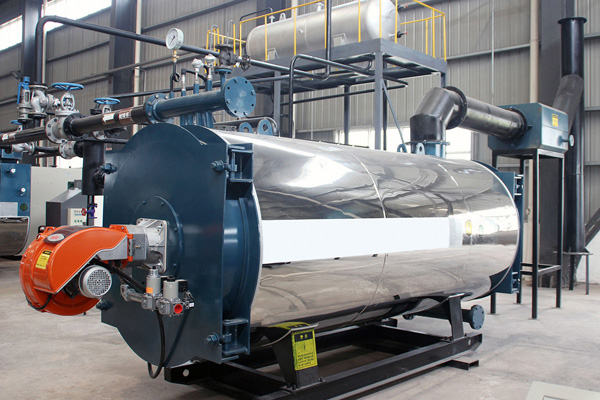
When specifying a high-temperature process heating system, the choice between thermal oil and steam often comes down to pressure, complexity, and operating cost. Steam systems require high pressure to achieve temperatures above 200°C, leading to thicker vessels, more elaborate controls, and higher maintenance. Thermal oil systems, by contrast, can reach 300–400°C at near-atmospheric pressure, simplifying design and reducing regulatory burden. This article compares the two technologies on pressure-temperature relation, system complexity, heat transfer, and maintenance, and explains what drives cost so you can make an informed decision.
Pressure-Temperature Relation
The fundamental difference lies in the pressure-temperature relationship. Saturated steam at 200°C requires about 1.6 MPa (16 bar), while at 300°C it needs roughly 8.6 MPa (86 bar). Thermal oils, with boiling points above 350°C at atmospheric pressure, operate at low pressure (typically 0.3–0.8 MPa) even at 300°C. This means thermal oil systems avoid the need for high-pressure piping, heavy-duty flanges, and certified pressure vessels, reducing capital cost and simplifying installation. For processes requiring temperatures above 250°C, thermal oil is often the more practical choice.
System Complexity
Steam systems are more complex due to the need for water treatment, blowdown, condensate return, and steam traps. They also require careful sizing of flash vessels and deaerators. Thermal oil systems are simpler: a closed loop with a circulation pump, expansion tank, and heat user. No water treatment or blowdown is needed, and the absence of phase change eliminates steam traps and condensate losses. However, thermal oil systems require careful design of the expansion tank and nitrogen blanketing to prevent oil degradation. Overall, thermal oil systems have fewer auxiliary components, leading to lower installation and operational complexity.
Heat Transfer
Steam provides high heat transfer coefficients through condensation, making it efficient for processes with high heat flux requirements. Thermal oils have lower heat transfer coefficients (typically 200–500 W/m²K for organic oils vs. 5000–10000 W/m²K for condensing steam), requiring larger heat exchanger surfaces. However, thermal oil systems can use smaller diameter piping due to lower pressure drops and higher flow velocities. The table below compares key parameters for a typical 300°C process.
| Parameter | Steam (saturated) | Thermal Oil (mineral) |
|---|---|---|
| Operating temperature | 300°C | 300°C |
| Operating pressure | 8.6 MPa (86 bar) | 0.5 MPa (5 bar) |
| Heat transfer coefficient (film) | 5000–10000 W/m²K | 200–500 W/m²K |
| Specific heat capacity | 2.1 kJ/kgK (liquid) | 2.5 kJ/kgK |
| Density at operating temp. | ~30 kg/m³ (steam) | ~800 kg/m³ |
| Piping material | Heavy-wall alloy steel | Standard carbon steel |
Assumptions: Saturated steam properties from IAPWS-IF97; thermal oil properties typical for mineral oil at 300°C. Heat transfer coefficients are indicative for film coefficients in turbulent flow.
Maintenance
Steam systems require regular water treatment, blowdown, and inspection of steam traps and condensate pumps. Corrosion and scale are ongoing concerns, particularly in high-pressure systems. Thermal oil systems have different maintenance needs: oil analysis is critical to monitor degradation (oxidation, thermal cracking), and periodic oil replacement is necessary (typically every 5–10 years depending on operating temperature). Pumps and valves require less frequent maintenance due to lower pressures. However, leaks in thermal oil systems can be hazardous due to fire risk, so proper design and monitoring are essential. Overall, thermal oil systems have lower routine maintenance but require oil quality management.
Cost Drivers
Capital cost for steam systems is higher due to pressure vessel codes, heavy piping, and water treatment equipment. Thermal oil systems have lower capital cost for the same temperature, but the heat transfer fluid itself is a recurring cost. Operating costs depend on fuel efficiency: steam systems can recover condensate heat, while thermal oil systems have no phase change but can incorporate economizers. Maintenance costs are generally lower for thermal oil. The total cost of ownership favors thermal oil for temperatures above 250°C, while steam may be more economical for lower temperatures and where direct steam injection is needed. For a detailed breakdown, see our capacity and cost guide.
Checklist: Choosing Between Thermal Oil and Steam
- Determine the maximum process temperature required. Above 250°C, thermal oil often has lower total cost.
- Assess pressure limitations at the point of use. High-pressure steam may require special permits and thicker piping.
- Evaluate heat transfer area constraints. Steam’s higher coefficients may reduce exchanger size.
- Consider maintenance capabilities. Thermal oil requires oil analysis; steam requires water treatment.
- Check for direct steam injection needs. If steam is injected into the process, a steam system is necessary.
- Review safety and fire protection requirements for thermal oil leaks.
- Compare fuel options and efficiency. Both systems can use gas, oil, or biomass.
- Explore our product range for both thermal oil heaters and steam boilers.
What to send us for a proposal
To prepare a tailored proposal, please provide: required process temperature and heat load (kW or kcal/h), operating hours per year, fuel type and availability, space constraints, any pressure limitations, and whether direct steam injection is needed. Also include details on the heat user (e.g., reactor, dryer, heat exchanger) and any specific safety or environmental requirements. With this information, we can recommend the most suitable system and outline the key cost drivers.


