
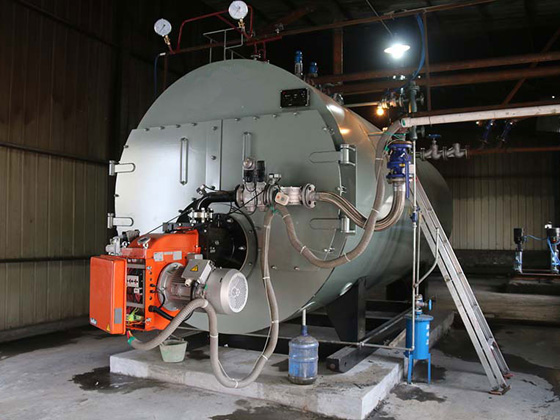
0.35-14 MW
WNS Pressurized Hot Water Boiler, 0.35-14 MW
Closed-loop pressurized hot water boiler for 95/70 and 115/70 systems, 0.35-14 MW, three-pass wet-back shell with modulating burne...
View detailsPlant sizing and unit selection for 7-70 MW networks: design-week load, N+1 sequencing, 115/70 °C hydraulics and a 20.6 MW worked example.
A district heating plant is sized by the coldest week of the year, financed over twenty years and judged on the other fifty-one. The design load comes from the connected building area, the heat load index at design outdoor temperature, the domestic hot water share and the network loss. For a northern Chinese or European city, 45-60 W/m² of connected floor area at design conditions is a working figure for a residential and commercial mix, with domestic hot water adding 10-20% and network losses 5-8%.
Below design conditions the plant runs at part load for most of the season, and that is where the money is made or lost. A plant of three equal units that runs one unit at 90% for 60% of the winter is efficient. The same plant running three units at 30% each is not, because fixed losses, purge losses and pump energy do not scale down with load.
The hydraulic design is fixed at the same time as the load. A 115/70 °C network with a 45 K design drop carries a given heat flow at just over half the volume of a 25 K network, and pipe size, pump energy and the number of boiler units all follow from that choice.
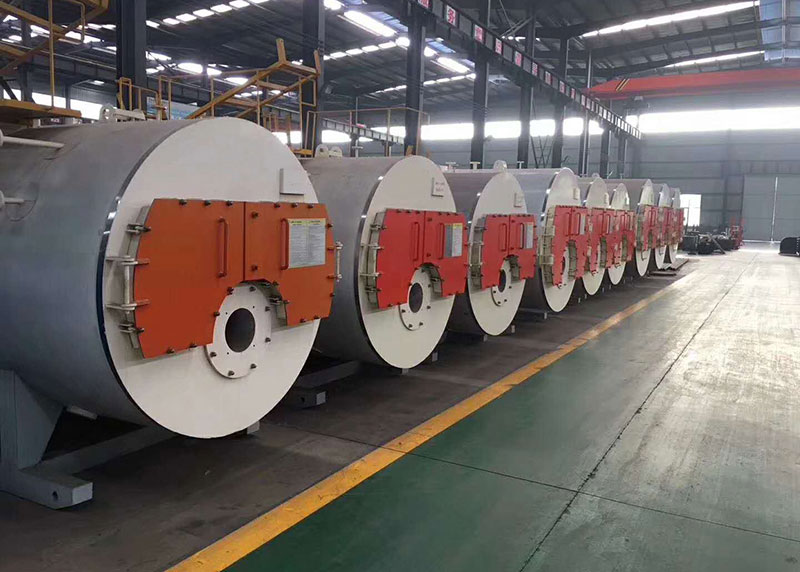
For plants in the 7-70 MW range, the practical building block is the packaged hot water boiler: the WNS series from 0.35 to 14 MW, delivered on one frame with burner, controls and safety valves. A 20-30 MW plant is therefore two to four units rather than one large field-erected boiler, which also gives the N+1 redundancy that a municipal network needs.
Around the boilers sit the network pumps, the pressurisation and make-up set, water treatment, and the flue-gas economiser or condenser. Sequencing control matters as much as the hardware: units should be brought on at 80-85% of the lead unit’s capacity, and the lead unit should rotate weekly so running hours stay even.
| Parameter | Value | Note |
|---|---|---|
| Installed capacity | 3 × 10.5 MW | two duty, one standby |
| Flow / return | 115 / 70 °C | 45 K design drop |
| Working pressure | 1.25 MPa | WNS10.5-1.25/115/70 |
| Circulation per unit | 360 t/h at 25 K | published model data |
| Gas consumption | 1,094.5 Nm³/h per unit | at rated output |
| Design efficiency | 93.5% (LHV) | economiser fitted |
| Network loss | 5% of connected load | design allowance |
Take 330,000 m² of connected floor area at 51 W/m²: 16.83 MW for space heating. Domestic hot water adds 2.8 MW at design, and network loss is taken at 5% of the sum. The design load is therefore (16.83 + 2.8) × 1.05 = 20.6 MW.
Three 10.5 MW units give 31.5 MW installed, with two units carrying 21.0 MW at design and the third on standby. That is true N+1: with any one unit out, the remaining two still meet the design load with 2% to spare. Two 14 MW units would give 28 MW but no redundancy, and a single 21 MW unit would fail the network on its first maintenance outage.
Check the flow. At a 45 K drop, 20,600 kW needs 20,600 / (4.19 × 45) = 109 kg/s, which is 393 m³/h. Each 10.5 MW unit at the same drop passes 200 m³/h, so two units run well inside their nozzles.
The published circulation of 360 t/h per unit looks larger, and it is: it corresponds to a 25 K drop, 10,500 / (4.19 × 25) = 100 kg/s. That is the right figure for a low-temperature network and the wrong one for a 45 K design, which is why the flow basis must be stated in the enquiry.
Fuel: at design, two units at 98% of rating consume 2 × 1,094.5 × 0.98 = 2,145 Nm³/h. Over a season of 2,300 equivalent full-load hours, annual heat is 47.4 GWh and fuel about 5.1 million Nm³.
Return temperature is the dominant variable. A network returning at 70 °C cannot condense flue gas; one returning at 45-50 °C can, and a flue-gas condenser then recovers 5-7 points. Lowering return temperature also increases the heat a given pipe can carry, which can defer a pipe upgrade for years.
Sequencing is the second lever. Three units at 30% load each burn more gas than one at 90%, because each carries its own radiation and convection losses and its own purge cycles. A lead-lag scheme with a 10% overlap and weekly rotation typically saves 2-3% of seasonal fuel.
Each point of efficiency on this plant is worth about 55,000 Nm³ a year. That is the figure to put against an economiser, a flue-gas condenser or a variable-speed network pump.
Municipal plants in urban areas usually face 30 mg/Nm³ NOx and continuous monitoring. Stack height is set by dispersion modelling, often 40-80 m for a plant of this size, and the boiler house noise limit applies at the nearest dwelling, not at the fence.
Water treatment and make-up metering are permit items as well as efficiency items: a network losing 2% of its water a day through leaks is losing treated water, heat and chemical. District heating also falls under pressure-equipment and periodic-inspection rules that vary by jurisdiction, and the plant layout should leave room for inspection openings.
Send the load and the network temperatures and we will return a unit selection, a sequencing scheme and the flow rates at both design and part load.
0.35-14 MW
Closed-loop pressurized hot water boiler for 95/70 and 115/70 systems, 0.35-14 MW, three-pass wet-back shell with modulating burne...
View details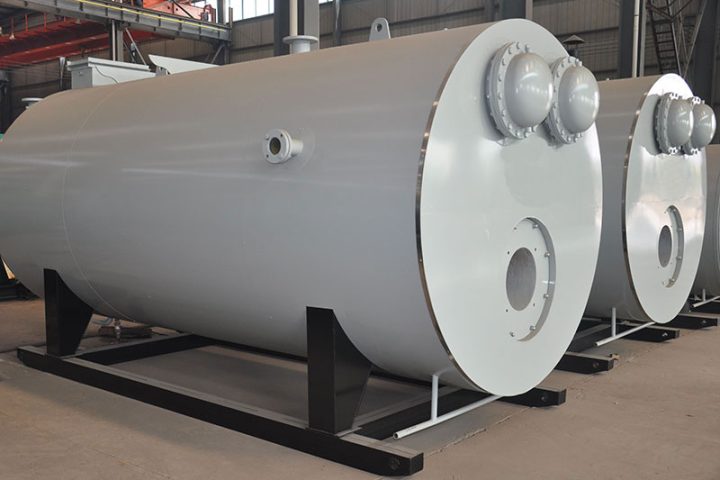
0.7-14 MW
Sealed vacuum hot water boiler, 0.7-14 MW, 85/60 C, heat medium water boiling under negative pressure and condensing on a stainles...
View details
6-100 t/h
Membrane-wall water-tube steam boiler with staged combustion and FGR, 6-100 t/h at up to 2.5 MPa and 98% efficiency with heat reco...
View detailsExternal links open the publisher’s website and are provided for background reading.
At least three equal units for a network above 15 MW, so that one can be out of service and the design load still met. Two units of 50% give no redundancy, and a single unit of 100% is only acceptable where a mobile boiler can be connected.
It sets whether the flue gas can be condensed, how much heat each pipe can carry, and how much pump energy the network uses. Dropping the return from 70 °C to 50 °C can add 5-7 points of boiler efficiency and raise network capacity by a third at the same flow.
The published circulation of 360 t/h for a 10.5 MW unit corresponds to a 25 K drop. At a 45 K design drop the same unit passes about 200 m³/h. Both are correct; the temperature basis has to be stated.
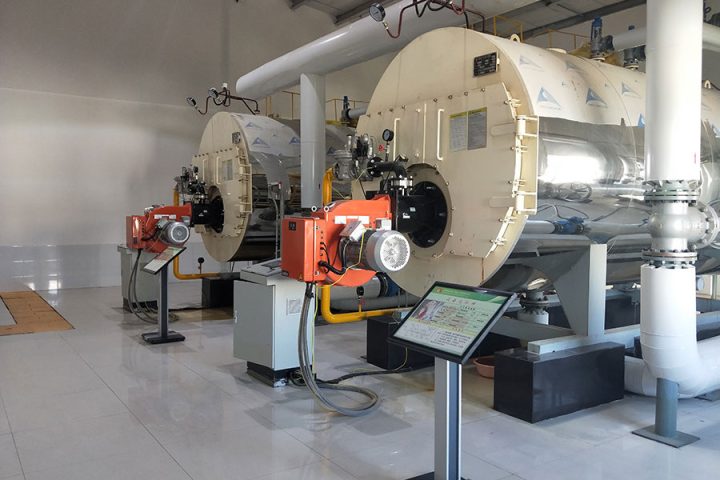
Yes, as multiple units. The WNS hot water range runs to 14 MW per shell, so a 20-30 MW plant is two to four packaged units with a common header, which is also how redundancy is achieved.
Industry solution
Sizing steam plant for pasteurisers, retorts, CIP and kettles, with a worked 6 t/h example, accumulator logic and fuel-saving leve...
View details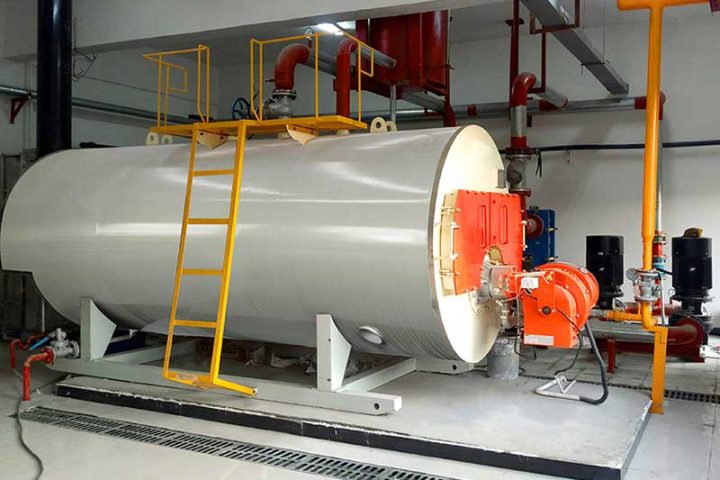
Industry solution
Matching steam pressure and thermal oil to reactor, reboiler and dryer duty, with a worked 6 t/h distillation and evaporation exam...
View details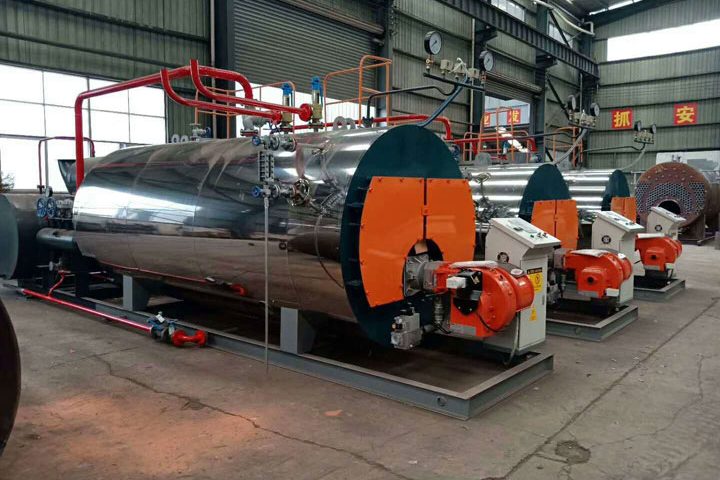
Industry solution
Batch dyeing steam, stenter heat and cylinder drying in one plant: coincidence factors, a 3.4 MW peak calculation and thermal oil...
View detailsWe appoint one or two partners per country to quote, deliver and service our boilers locally. Territory protection, factory pricing and commissioning support are part of the agreement.