

1-100 t/h (0.7-70 MW)
WNS Gas/Oil Steam Boiler, 1-100 t/h
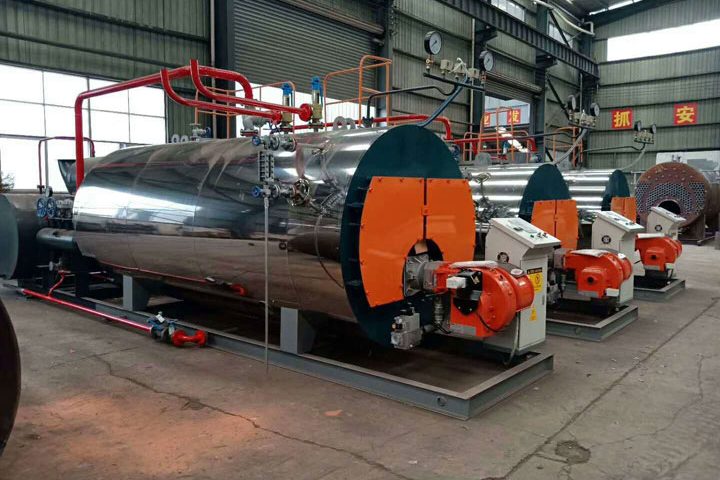
Packaged three-pass wet-back fire-tube steam boiler for gas and oil, 1-100 t/h at 1.25 MPa, with matched modulating burner and ful...
View detailsSizing steam plant for pasteurisers, retorts, CIP and kettles, with a worked 6 t/h example, accumulator logic and fuel-saving levers.
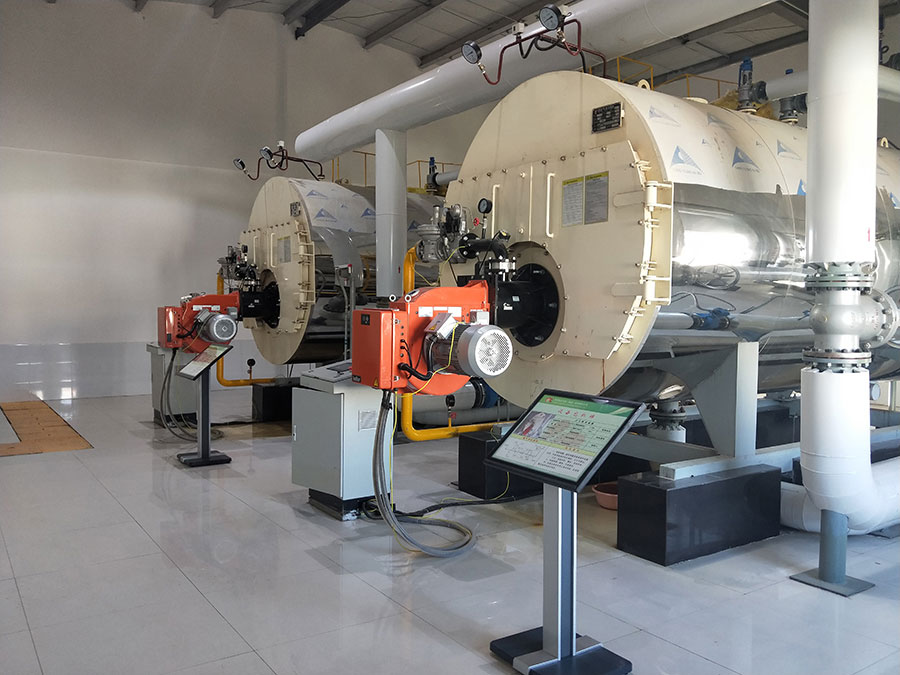
A food factory does not have one steam load. It has a base load from continuous plant — pasteurisers, blanchers, CIP sets, jacketed kettles — and batch peaks from retorts, fryers and washdown that swing demand by a factor of two within a quarter of an hour, every shift.
Temperature levels are set by the process. Pasteurisation and clean-in-place run at 0.3-0.4 MPa, where saturated steam is 143-151 °C; kettles and blanchers at 0.4-0.6 MPa; retorts at 0.7-1.0 MPa so the vessel reaches 121 °C with a usable jacket approach temperature. Supplying everything at 1.25 MPa and throttling down is common and not free: the reducing valve wastes available energy, and the steam reaching a jacketed kettle is hotter than its gaskets want.
The other half of the demand is hot water at 60-85 °C for washdown, tray washing and bottle rinsing. Serving it from an atmospheric hot water boiler or an economiser is usually cheaper than spending high-pressure steam through a heat exchanger.
For a plant up to 20 t/h the standard train is a packaged three-pass fire-tube boiler, a matched low-NOx burner, a softener and — above roughly 4 t/h — a thermal deaerator. Cold softened make-up carries about 8 mg/L of dissolved oxygen; after deaeration at 105 °C it carries 0.03 mg/L, and that difference is the life of the furnace tube and rear tubesheet.
Where retorts or fryers create short peaks, a steam accumulator between boiler and header is often cheaper than the next boiler size up. A 15 m³ accumulator at 1.0 MPa releases roughly 0.75 t of flash steam as the pressure falls to 0.5 MPa, which covers a 2.6 t/h excess for the fifteen minutes a retort cycle lasts, and the boiler runs at a steady 75-80% instead of chasing the header.
Most food steam is used indirectly and the condensate is clean. Returning 70% of it at 90 °C rather than feeding 20 °C make-up saves about 6% of fuel and most of the treatment chemical cost. Product-contaminated returns must be segregated, never blended into the hotwell.
| Parameter | Value | Note |
|---|---|---|
| Peak steam demand | 6.0 t/h | retort cycle coincident with CIP |
| Average steam demand | 3.4 t/h | two shifts, 16 h |
| Header pressure | 1.0 MPa | 179.9 °C saturated |
| Feedwater temperature | 105 °C | thermal deaerator outlet |
| Condensate return | 70% at 90 °C | clean returns only |
| Design efficiency | 94% (LHV) | economiser fitted |
| Fuel | Natural gas, 35.6 MJ/Nm³ | lower calorific value |
| Blowdown rate | 5% | softened make-up |
The plant has a 6.0 t/h peak made up of retorts at 2.8 t/h, continuous cooking and blanchers at 1.9 t/h, CIP at 0.8 t/h and tray washing at 0.5 t/h. Saturated steam at 1.0 MPa has an enthalpy of 2,778 kJ/kg; feedwater from the deaerator at 105 °C carries 440 kJ/kg. Each kilogramme of steam therefore delivers 2,338 kJ to the process.
6,000 kg/h × 2,338 kJ/kg = 14.03 GJ/h, which is 3,897 kW. At 94% efficiency on LHV the fuel input is 3,897 / 0.94 = 4,146 kW, and at 35.6 MJ/Nm³ that is 419 Nm³/h of natural gas. A WNS6-1.25-Q operated at 1.0 MPa sits comfortably inside its rating at that output.
Now check the boiler against the day rather than the hour. If the plant raises 78 t of steam in a 16-hour day, that is 13 full-load hours, so gas consumption is 13 × 419 = 5,450 Nm³/day, or about 1.68 million Nm³ over 4,000 operating hours a year.
Because the peak is 76% above the average, a single 6 t/h boiler sized on the peak would spend most of its life near 57% load, where a fire-tube boiler loses around 1.5 points of efficiency to standing losses and purging. Two arrangements compete: a 4 t/h base unit with a 2 t/h peak unit, or one 6 t/h unit with an accumulator. The second usually wins on capital, floor space and operating attention.
Three levers dominate. Stack temperature is the largest: an economiser taking flue gas from 200 °C down to 130 °C recovers about 3.5 points of efficiency and cuts the annual gas figure above from 1.68 to 1.62 million Nm³. Excess air is the second: trimming from 6% O2 to 3% O2 saves roughly 1% of fuel and lowers flame temperature, which helps NOx. Blowdown is the third: at 5% blowdown and 1.0 MPa, continuous blowdown heat recovery into the make-up line returns about 0.4 points.
Each point of efficiency is worth roughly 17,800 Nm³ a year here, so an economiser worth 3.5 points clears its cost inside two years on most industrial gas tariffs.
Gas firing with flue-gas recirculation holds NOx at 30 mg/Nm³, the limit now applied in many urban districts; the same burner without recirculation typically gives 60-80 mg/Nm³. Where heavy oil or solid fuel is burned, particulate and sulphur dioxide become the binding constraints and the train changes: multi-cyclone or bag filter, taller stack, and a stack temperature kept above the acid dew point.
Food plants carry one requirement that other industries do not. Steam that touches product — direct injection into kettles, or steam into a retort — should come from a clean steam generator fed with softened and reverse-osmosis water, because boiler treatment chemicals must never reach the food. That is a specification decision made at enquiry stage, not a detail to settle on site.
Send those six items and we will return a sized unit, a burner selection and a recommended auxiliary scope, not a brochure page.
1-100 t/h (0.7-70 MW)
Packaged three-pass wet-back fire-tube steam boiler for gas and oil, 1-100 t/h at 1.25 MPa, with matched modulating burner and ful...
View details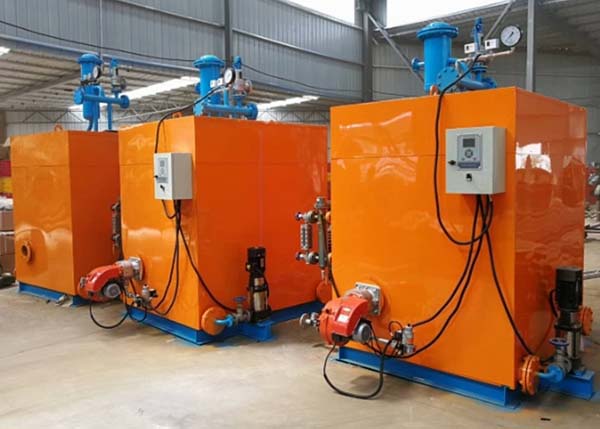
0.1-2 t/h
Multi-pass packaged steam generator, 0.1-2 t/h at 0.4-0.7 MPa, small water content and fast start for pressing, food and sterilizi...
View details
2-50 m³/h treated water
Softener and deaerator package for boiler make-up, holding hardness below 0.03 mmol/L and oxygen below 0.05 mg/L.
View details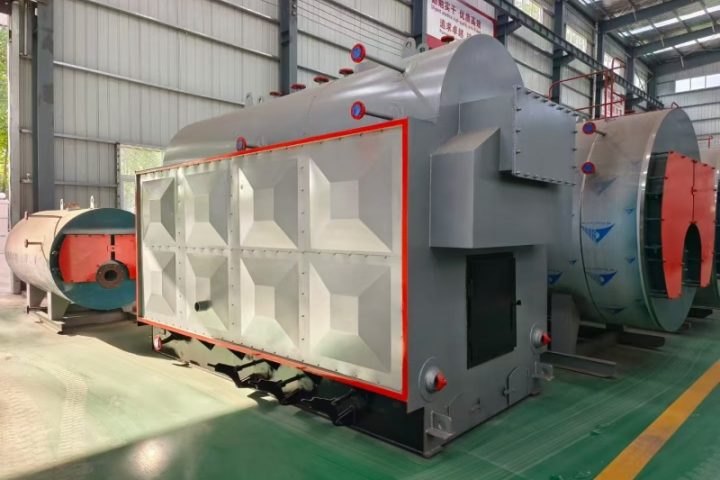
1-20 t/h boiler equivalent
Finned tube economizers and tubular air preheaters for fire-tube, water-tube and thermal oil systems, with cold-end protection aga...
View detailsExternal links open the publisher’s website and are provided for background reading.
Most food processes are satisfied at 0.4-1.0 MPa. Pasteurisers and CIP run at 0.3-0.4 MPa, kettles at 0.4-0.6 MPa, and retorts at 0.7-1.0 MPa so that 121 °C can be held with a workable jacket approach temperature. Supplying a single 1.0 MPa header and reducing at each user is common and simpler to operate.
Above roughly 4 t/h of continuous evaporation, yes. Feedwater at 105 °C after deaeration holds about 0.03 mg/L of oxygen against 8 mg/L in cold make-up, and the difference shows up as pitting in the furnace tube and rear tubesheet within a few years.
Often, yes. A steam accumulator of 8-12 m³ at header pressure releases the flash steam a retort cycle needs while the boiler stays at a steady load. Where the peak lasts longer than twenty minutes, a second smaller unit is the better answer.
It is the usual choice where steam contacts product. The generator is fed with softened or reverse-osmosis water and uses no amine or oxygen scavenger, so the steam carries no treatment chemical into the food. Indirect heating through a jacket or exchanger does not need it.
Industry solution
Batch dyeing steam, stenter heat and cylinder drying in one plant: coincidence factors, a 3.4 MW peak calculation and thermal oil...
View details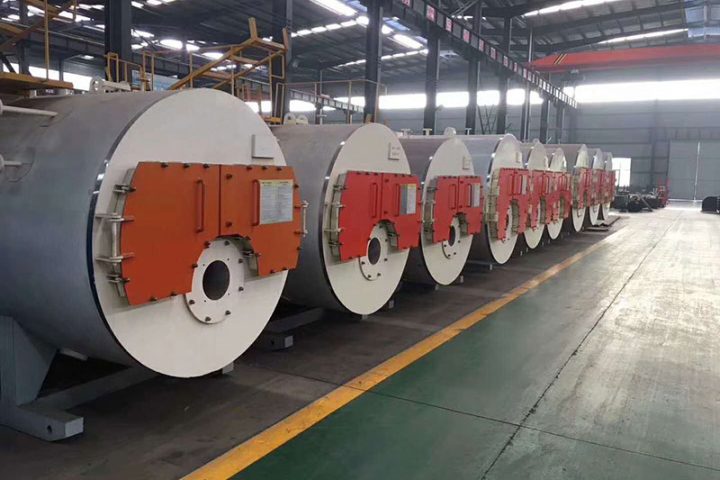
Industry solution
Plant sizing and unit selection for 7-70 MW networks: design-week load, N+1 sequencing, 115/70 °C hydraulics and a 20.6 MW worked...
View details
Industry solution
Dust, SO2 and NOx retrofits compared on efficiency and footprint, the real ceiling for a chain-grate boiler, and how to phase the...
View detailsWe appoint one or two partners per country to quote, deliver and service our boilers locally. Territory protection, factory pricing and commissioning support are part of the agreement.