

1-100 t/h (0.7-70 MW)
WNS Gas/Oil Steam Boiler, 1-100 t/h
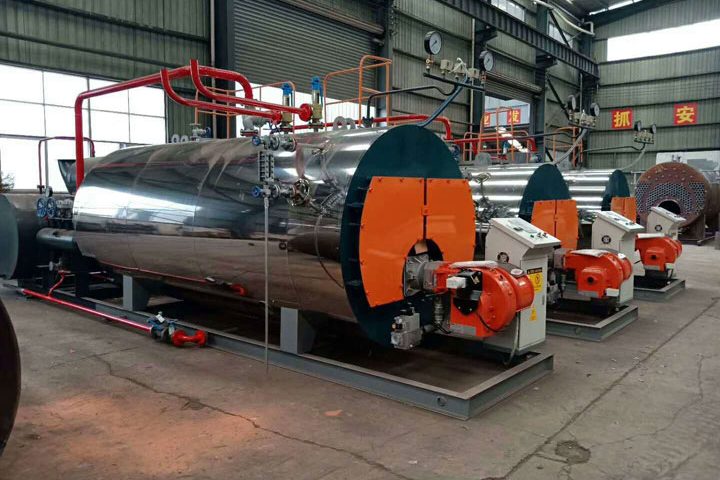
Packaged three-pass wet-back fire-tube steam boiler for gas and oil, 1-100 t/h at 1.25 MPa, with matched modulating burner and ful...
View detailsPlating baths, cleanroom humidity and lamination presses: why electronics plants heat indirectly, and how a two-shift load profile changes the boiler choice.

An electronics factory is not a heavy steam user. Sputtering, reflow, wave soldering and test are electric. The heat that comes from a boiler goes to the wet processes and to the building: plating and cleaning baths held at 45-90 °C, DI water heating, drying ovens, lamination presses, and the humidity control that keeps a cleanroom at 45% relative humidity in winter. A large site might total 1-2 t/h of steam equivalent. What makes the plant awkward is the shape of the day, and the fact that almost none of the heat may touch the product.
Defect densities in the parts-per-million range do not tolerate combustion products. A gas flame firing directly into a drying oven puts nitrogen oxides, sulphur oxides, carbon monoxide and unburnt hydrocarbons into the air that passes over solder mask, gold fingers and connectors. The residues are thin, invisible and conductive enough to fail a cleanliness test, and they are almost impossible to remove once baked on.
So the boiler sits in a separate plant room and the heat crosses a surface: steam or hot water through a shell-and-tube or plate exchanger into the process air, or a thermal oil circuit into a press platen. The flue gas leaves by its own stack. The separation is also a safety argument: a fuel leak in a plant room is a manageable event, the same leak inside a cleanroom is an evacuation.
Bath temperatures cluster in two bands. Acid copper, tin and most rinse tanks run at 25-35 °C, sometimes needing cooling rather than heat because the plating reaction and the pumps add energy. Nickel sulphamate, electroless nickel, hot degreasers and some etch stages run at 50-90 °C, and these are the real heating load. Electroless nickel is the most demanding: 85-90 °C held within 2 K for hours, because the deposition rate and the phosphorus content in the coating both move with temperature.
Heating is by immersion coil or by an external exchanger. Titanium or PTFE coils suit aggressive baths; stainless is adequate for alkaline cleaners. The coil must be electrically isolated and bonded to the tank earth, because a stray current through metal in a plating bath plates the coil and changes the bath chemistry.
Above roughly 120 °C water stops being useful at atmospheric pressure, and some processes — solder levelling preheat, polyimide cure, lamination — want 180-250 °C. That is thermal oil territory: a coil heater with a circulating pump, an expansion tank and a nitrogen blanket if the oil is to last more than a few years.
Winter humidification is often the largest steam load on site, and the one most often specified wrongly. A 20,000 m³/h air handling unit with 30% fresh air, holding 22 °C and 45% relative humidity against an outside condition of -8 °C and 2 g/kg, needs about 40 kg/h of steam. Three units and the load is 120 kg/h before any process demand.
Plant steam carries volatile amines dosed for condensate pH control, plus any carryover of boiler water solids. Injected into a cleanroom air stream, those amines end up on wafers, optics, bond pads and precision assemblies, and can form ammonium sulphate deposits on cooled surfaces. The fix is a clean steam humidifier fed with reverse-osmosis water, generating steam in a dedicated vessel or an electrode cylinder, with no treatment chemical in the circuit. It must also deliver dry steam: droplets carry dissolved solids, and a droplet that lands on a product leaves a spot that no cleanroom wipe will remove.
The profile is set by the shift pattern, not by production. On a two-shift week the plant runs at 0.8-1.0 t/h from 06:00, when baths are brought up and humidifiers go to full output, falls to 0.3-0.4 t/h through the day, and drops to 0.10-0.15 t/h at night for standby, cleaning and domestic hot water. The annual load factor lands between 35 and 45%.
Sizing for the morning peak and accepting night cycling is what produces most of the maintenance cost on these sites. Two smaller units sequenced on load, or one unit with 5:1 turndown, keeps the boiler out of the condensing and short-cycling regime that shortens the life of a fire-tube. Where the site has a gas supply and a demand above 1 t/h, a small condensing unit recovers the latent heat at part load and suits this profile better than a conventional shell.
| Load | Temperature | Medium | Peak demand |
|---|---|---|---|
| Plating and cleaning baths | 50-90 °C | Hot water or 0.4 MPa steam | 350 kW |
| Cleanroom humidification | 100 °C steam | Clean steam | 120 kg/h |
| Drying ovens | 80-140 °C air | Steam coil | 200 kW |
| Lamination presses | 180-200 °C | Thermal oil | 250 kW |
| DI water and rinse heating | 25-60 °C | Hot water | 100 kW |
Bath list with volume, hold temperature and heat-up time; cleanroom air volumes and winter design condition; press platen size and ramp rate; the shift pattern; and whether the site has gas, or must use electricity or oil. Those five items decide whether the answer is a steam boiler with a clean steam generator, a hot water boiler, a thermal oil heater, or all three in one plant room.
1-100 t/h (0.7-70 MW)
Packaged three-pass wet-back fire-tube steam boiler for gas and oil, 1-100 t/h at 1.25 MPa, with matched modulating burner and ful...
View details
6-100 t/h
Membrane-wall water-tube steam boiler with staged combustion and FGR, 6-100 t/h at up to 2.5 MPa and 98% efficiency with heat reco...
View details2-50 m³/h treated water
Softener and deaerator package for boiler make-up, holding hardness below 0.03 mmol/L and oxygen below 0.05 mg/L.
View detailsExternal links open the publisher’s website and are provided for background reading.
Direct firing puts nitrogen oxides, sulphur oxides, carbon monoxide and unburnt hydrocarbons into the air that passes over the product. The residues are thin, conductive and very hard to remove, so electronics drying and curing ovens are heated through a steam coil or an exchanger instead.
Not where the product is sensitive. Plant steam carries amines dosed for condensate pH control and any boiler water carryover, which deposit on wafers, optics and bond pads. Use a clean steam humidifier fed with reverse-osmosis water and no treatment chemical.
PCB lamination platens typically run at 180-200 °C, and polyimide cure stages go to 250 °C. Saturated steam cannot reach those temperatures at usable pressure, so the press circuit is thermal oil with a coil heater and a circulating pump.
Industry solution
Batch dyeing steam, stenter heat and cylinder drying in one plant: coincidence factors, a 3.4 MW peak calculation and thermal oil...
View details
Industry solution
Matching steam pressure and thermal oil to reactor, reboiler and dryer duty, with a worked 6 t/h distillation and evaporation exam...
View details
Industry solution
Cylinder drying, corrugator preheat and starch kitchen loads, with a 200 t/day board machine worked example and condensate recover...
View detailsWe appoint one or two partners per country to quote, deliver and service our boilers locally. Territory protection, factory pricing and commissioning support are part of the agreement.