
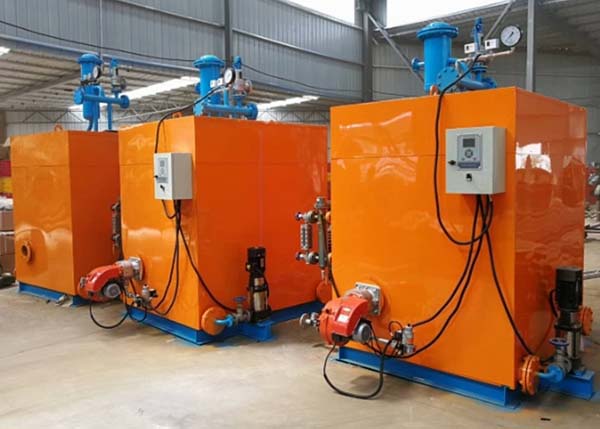
0.1-2 t/h
Packaged Steam Generator, 0.1-2 t/h
Multi-pass packaged steam generator, 0.1-2 t/h at 0.4-0.7 MPa, small water content and fast start for pressing, food and sterilizi...
View detailsThe WNS10-1.25-Q is a packaged three-pass wet-back fire-tube boiler delivering 10 t/h of steam at 1.25 MPa and 194 °C, firing natural gas, LPG, light diesel or heavy fuel oil at 95% efficiency (LHV basis).
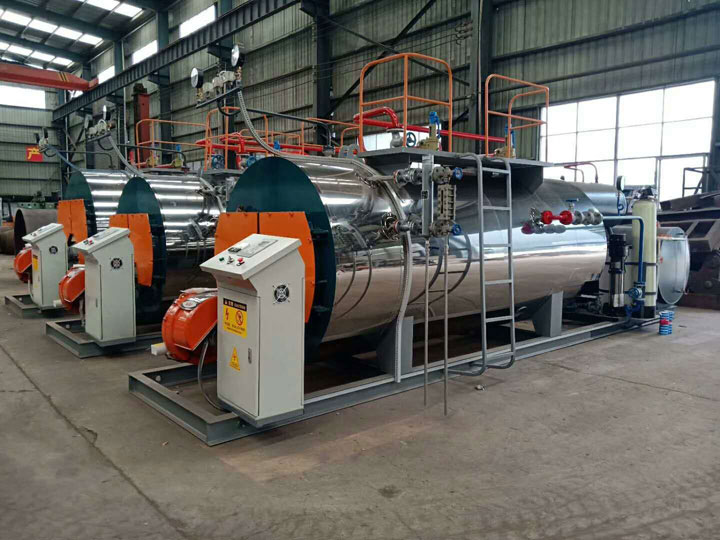
The WNS10-1.25-Q is the 10 t/h model in the WNS gas/oil steam boiler series. It is a three-pass wet-back fire-tube unit, factory-packaged with a low-NOx burner. Rated steam output is 10 t/h at a working pressure of 1.25 MPa and a steam temperature of 194 °C. The boiler fires natural gas, LPG, light diesel or heavy fuel oil, and is rated at 95% efficiency on an LHV basis.
At 10 t/h, this unit sits in the mid-range of packaged fire-tube practice. It suits plants with a steady process steam demand that is large enough to justify a single dedicated boiler but not large enough to require a field-erected water-tube unit. Typical duties include process heating in food, textile, chemical and paper operations, plus central steam supply for facilities that run continuously through the working week. Where demand is seasonal or highly variable, the 10 t/h rating gives useful headroom above average load without the part-load penalties of a much larger boiler.
The published fuel rate is 743 Nm³/h at rated output, based on natural gas firing at 95% efficiency. The figure follows from the rated steam output and the heat required to raise feedwater to steam at the stated pressure and temperature, divided by the boiler efficiency on an LHV basis. It is a rated-output value: at lower firing rates the instantaneous fuel flow falls broadly in proportion to output, subject to the efficiency curve of the unit. For LPG, light diesel or heavy fuel oil, the volumetric and mass rates differ from the natural gas figure because the calorific values and densities of those fuels differ; the 743 Nm³/h value applies to natural gas only.
Packaged fire-tube boilers of this capacity generally hold efficiency well across a broad modulation range, with the low-NOx burner matching firing rate to steam demand. At this size the furnace and convection surfaces are large enough that part-load operation does not sharply degrade heat transfer, and the wet-back reversal chamber helps maintain gas-side performance at reduced firing. Short cycling is the main part-load risk; it is managed by sizing the burner modulation range to the actual load profile and by setting the pressure band appropriately for the steam system volume.
The unit is packaged for delivery as a single assembly, which simplifies site work compared with field-erected boilers. Planning should account for: a level foundation capable of carrying the operating weight; clearance for the burner and its air intake at the front; access for tube cleaning and inspection at the rear and through the shell openings; flue connection to the stack; and space for feedwater, fuel-train and control equipment adjacent to the boiler. Confirm the specific footprint, weights and clearances against the model drawing before finalising civil works.
Fire-tube boilers at 1.25 MPa depend on consistent feedwater and boiler water quality to protect the tube sheets, furnace and tube bundle from scale and corrosion. A treatment programme covering softening or demineralisation, oxygen removal, and control of alkalinity, dissolved solids and silica is expected. Blowdown practice should follow the treatment supplier’s recommendations, and water quality should be monitored continuously rather than periodically, since scale on the furnace crown is the principal cause of tube failure in this boiler type.
The packaged low-NOx burner is supplied with a matching control package covering firing-rate modulation, flame supervision, fuel-train safety interlocks and pressure-based demand control. The control system should be configured for the fuel in use and integrated with the plant’s steam header pressure signal so that firing rate tracks demand smoothly. Operator interfaces, alarm logging and remote monitoring options are specified per project.
Choosing this model rather than the next size down reflects the need for capacity margin at peak demand and for a modulation range that keeps the burner out of short cycling. Choosing it rather than the next size up reflects the fact that a larger unit would run at low firing for most of the year, with poorer part-load efficiency and a larger installation envelope. The 10 t/h rating is the point at which a single packaged fire-tube boiler still covers the load without over-sizing the plant.
| Parameter | Value |
|---|---|
| Model | WNS10-1.25-Q |
| Capacity | 10 t/h |
| Pressure | 1.25 MPa |
| Steam temperature | 194 °C |
| Feedwater temperature | To be confirmed per project |
| Fuel | Natural gas, LPG, light diesel, heavy fuel oil |
| Fuel consumption at rated output | 743 Nm³/h (natural gas, 95% efficiency) |
| Efficiency | 95% (LHV basis) |
| Burner/control | Packaged low-NOx burner with matching control package |
| Application | Process and central steam supply |
The burner modulates to match demand, and the packaged fire-tube design holds efficiency across a broad part-load range at this capacity. The practical minimum stable firing rate and modulation range depend on the burner selected for the project; confirm these against the burner data sheet so the unit is not short cycling on your load profile.
It is the rated-output natural gas consumption derived from the heat needed to produce 10 t/h of steam at 1.25 MPa and 194 °C, divided by the 95% efficiency on an LHV basis. It applies to natural gas only; LPG, light diesel and heavy fuel oil have different calorific values and therefore different consumption rates.
Feedwater and boiler water quality must be controlled to prevent scale and corrosion on the furnace, tube sheets and tube bundle. A programme typically covers softening or demineralisation, deaeration and control of alkalinity, dissolved solids and silica, with blowdown set by the treatment supplier and water quality monitored continuously.
| Model | WNS10-1.25-Q |
|---|---|
| Capacity | 10 t/h |
| Pressure | 1.25 MPa |
| Steam temperature | 194 °C |
| Feedwater temperature | To be confirmed per project |
| Fuel | Natural gas, LPG, light diesel, heavy fuel oil |
| Fuel consumption at rated output | 743 Nm³/h (natural gas, 95% efficiency) |
| Efficiency | 95% (LHV basis) |
| Burner/control | Packaged low-NOx burner with matching control package |
| Application | Process and central steam supply |
0.1-2 t/h
Multi-pass packaged steam generator, 0.1-2 t/h at 0.4-0.7 MPa, small water content and fast start for pressing, food and sterilizi...
View details
3 t/h
The WNS3-1.25-Q is a packaged three-pass wet-back fire-tube steam boiler rated at 3 t/h and 1.25 MPa, producing 194 °C steam on na...
View details0.5–10 t/h
Steam boiler package for food processing: WNS gas or electric, 0.5-10 t/h at 0.7-1.25 MPa. Handles shift-based loads and sharp CIP...
View detailsExternal links open the publisher’s website and are provided for background reading.
Include the capacity (t/h or MW), fuel, working pressure and site country so the proposal matches your permit limits.
We appoint one or two partners per country to quote, deliver and service our boilers locally. Territory protection, factory pricing and commissioning support are part of the agreement.