Yuanda Boiler has built industrial boilers in Taikang, Henan since 1965. This technical library is published on yuandaboiler.com.
Overview
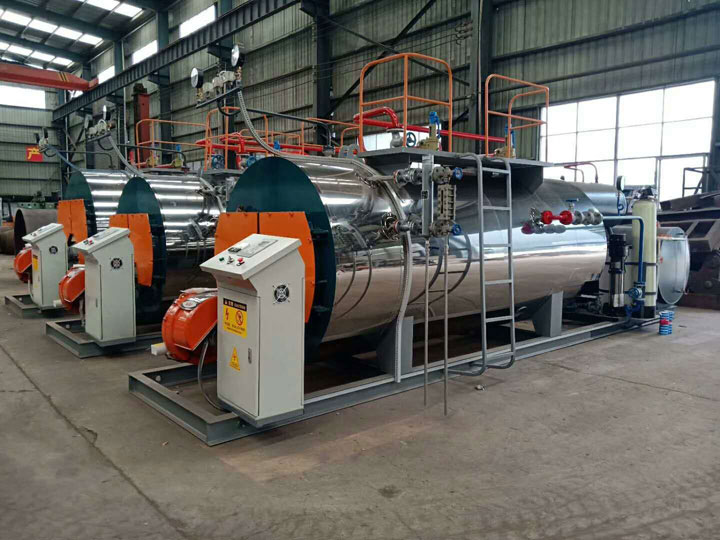
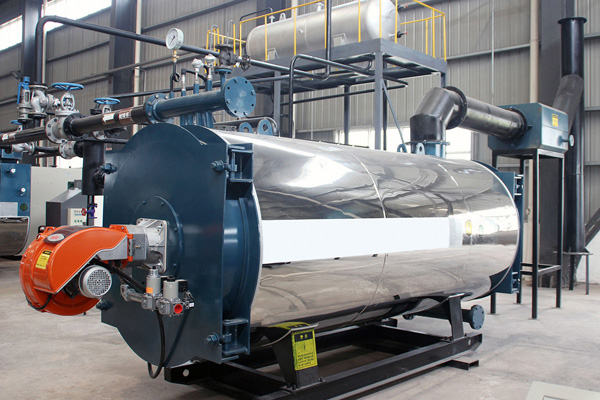
The WNS20-1.25-Q is a 20 t/h unit from the WNS Gas/Oil Steam Boiler series. It is a packaged, three-pass wet-back fire-tube boiler rated at 1.25 MPa with a steam temperature of 194 °C. The burner is a low-NOx design and the boiler accepts natural gas, LPG, light diesel and heavy fuel oil. Thermal efficiency is 95% on an LHV basis.
What this capacity suits
At 20 t/h, this model sits in the mid-to-large packaged range. It suits plants with a steady process steam demand that is large enough to justify a single dedicated boiler but not large enough to require a field-erected water-tube unit. Typical duty profiles include continuous process heating, large laundry and textile operations, food processing with significant cooking or sterilisation loads, and district or campus steam headers where one boiler carries base load. The packaged format means the unit is assembled and tested as a single shop-built body before shipment, which simplifies site work compared with field-erected boilers.
Fuel figure and how it is derived
The published fuel consumption is 1486 Nm³/h at rated output, based on natural gas firing at 95% efficiency. The figure follows from the rated steam output and the enthalpy rise from feedwater to steam at 1.25 MPa and 194 °C, divided by the fuel energy input at the stated efficiency. Because the number is tied to natural gas and to LHV efficiency, it should be recalculated when firing LPG, light diesel or heavy fuel oil, each of which has a different calorific value and combustion air requirement. The 1486 Nm³/h value is the reference point for gas supply sizing, meter selection and burner turndown setting at full load.
Part-load behaviour at this size
Large packaged fire-tube boilers are sensitive to part-load operation because the furnace and tube bundle are sized for full output. With a low-NOx burner, stable combustion is maintained across the normal modulating range, but sustained operation well below rated capacity increases relative heat loss and can reduce effective efficiency below the 95% full-load figure. For plants with wide load swings, the 20 t/h unit is best applied as a base-load boiler with a smaller unit or accumulator covering peaks, rather than as a single boiler cycling across the full range.
Installation envelope
The boiler is delivered as a packaged assembly, so the installation envelope is governed by the boiler body, the burner and its air intake, the flue outlet, and the space needed for tube access at the front and rear. General requirements include a level foundation, clearance for burner removal and tube cleaning, a flue path sized for the firing rate, and fuel supply and water connections at the designated points. Site-specific layout should be confirmed against the general arrangement drawing for the model.
Water treatment
Fire-tube boilers at this capacity depend on consistent feedwater quality. Scale and oxygen control protect the furnace and tube bundle, and the wet-back reversal chamber is particularly sensitive to thermal stress from deposits. A treatment programme matched to the site water analysis, with routine blowdown and monitoring of dissolved oxygen, hardness and conductivity, is part of normal operation.
Controls
The unit is supplied with burner management and boiler control covering flame supervision, modulation against steam pressure, low-water protection and interlocked shutdowns. The low-NOx burner is matched to the control package so that firing rate and air/fuel ratio are managed together across the load range.
Why this size
The 20 t/h model is chosen when demand is too large for a 15–16 t/h packaged unit to carry comfortably with margin, but below the point where a larger field-erected boiler becomes the practical choice. It keeps the packaged format and its simpler installation while providing capacity headroom for process growth.
| Parameter |
Value |
| Model |
WNS20-1.25-Q |
| Capacity |
20 t/h |
| Pressure |
1.25 MPa |
| Steam temperature |
194 °C |
| Fuel |
Natural gas, LPG, light diesel, heavy fuel oil |
| Fuel consumption at rated output |
1486 Nm³/h (natural gas, 95% efficiency) |
| Efficiency |
95% (LHV basis) |