
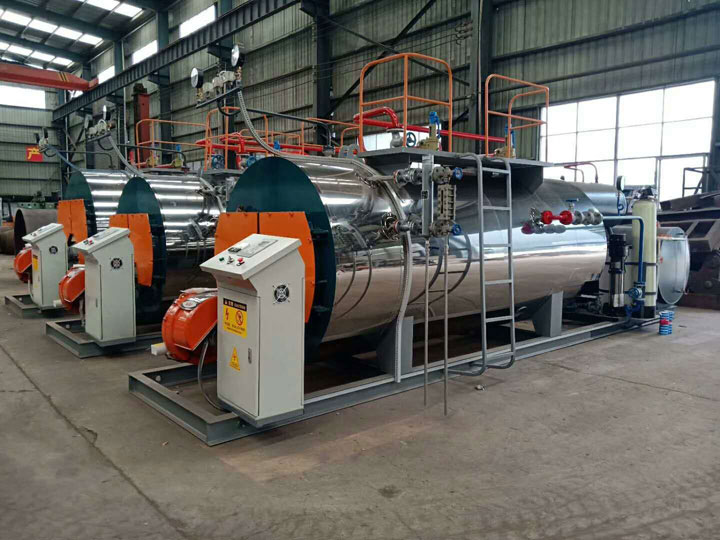
Fire-tube and water-tube boilers differ in where the water sits relative to the flame, and that single geometric fact drives almost every selection decision: how many gas passes you can fit, how large the unit can get, how tolerant it is of feedwater chemistry, and how fast it responds to load changes. This article sets out the rules we apply when matching a boiler type to a duty, using typical engineering values and stating the assumptions behind them. For the wider range of configurations, see our product range, and for sizing economics see the capacity and cost guide.
Pass arrangement: what it means for heat transfer and footprint
In a fire-tube boiler the hot gases travel through tubes surrounded by water. A two-pass unit sends combustion gases from the furnace through a reversal chamber and back through a second tube bundle; a three-pass unit adds a third bundle; a four-pass unit adds a fourth. Each additional pass extracts more heat from the flue gas, lowering stack temperature. As a rule of thumb, a well-designed three-pass fire-tube boiler on natural gas reaches stack temperatures around 180–220 °C without an economiser, and a four-pass unit can be 20–40 °C lower for the same duty. Adding an economiser typically recovers another 5–7 % of fuel input by cooling flue gas to roughly 100–130 °C, provided the feedwater temperature allows it.
Water-tube boilers reverse the arrangement: water flows inside tubes and hot gas passes across the outside. Because the pressure envelope is a set of small-diameter tubes rather than a large shell, the design can use a furnace plus convective tube banks and, in larger units, multiple gas passes through economiser and air heater sections. The practical consequence is that heat transfer surface per unit of floor area is higher, which is why water-tube units dominate above a certain size.
Capacity ceiling: where each type stops being sensible
Fire-tube boilers are generally economic from about 0.5 t/h up to roughly 20–25 t/h of saturated steam, with shell diameters and transport limits setting the upper bound. Above that, shell thickness at higher pressures and the difficulty of shipping a large pressure vessel make water-tube designs preferable. Water-tube boilers scale from small packaged units up to very large field-erected boilers; for industrial duty, packaged water-tube units are commonly offered from around 10 t/h upward, and the type becomes the default above roughly 25–30 t/h or when steam pressure exceeds about 20–25 bar.
| Parameter | Fire-tube (typical) | Water-tube (typical) | Assumption |
|---|---|---|---|
| Steam capacity range | 0.5–25 t/h | 10 t/h and above | Saturated steam, packaged units |
| Design pressure | up to ~20–25 bar | 25 bar and above | Standard industrial construction |
| Gas passes | 2, 3 or 4 | Furnace + convective bank, economiser | Natural gas firing |
| Stack temperature, no economiser | 180–220 °C (3-pass) | 150–200 °C | Full load, 15 °C ambient air |
| Water volume | Large (shell full of water) | Small (tubes only) | Same steam output |
| Cold start to full load | 30–60 min | 10–20 min | Warm dry start, operator attended |
| Load ramp rate | 3–5 %/min of rated output | 10–20 %/min | Stable feedwater supply |
Values are indicative for natural-gas-fired packaged boilers and will shift with fuel, excess air, feedwater temperature and economiser fitment. Treat them as selection guidance, not guarantees.
Water quality sensitivity
The fire-tube boiler holds a large volume of water in a shell, so dissolved solids concentrate slowly and the unit tolerates short excursions in feedwater quality better than a water-tube design. That tolerance is not a licence to skip treatment: scale on the fire-side tubes of a fire-tube boiler reduces heat transfer and can cause tube overheating and failure. Typical targets are hardness below about 0.5 °dH (roughly 0.09 mmol/L) for feedwater to packaged steam boilers, with conductivity controlled by blowdown to the boiler manufacturer’s limits, often in the 3,000–6,000 µS/cm range for shell boilers depending on pressure and design.
Water-tube boilers circulate water through small tubes at high velocity. They are less tolerant of suspended solids and hardness because deposits concentrate in tube bends and risers, and tube failure follows quickly. Feedwater for water-tube units is normally demineralised or softened with tighter limits, and continuous blowdown plus conductivity control is standard. If your water treatment plant is basic, that is a strong argument for a fire-tube unit within its capacity range.
Response speed and load following
Response speed follows water volume. A fire-tube boiler with a large shell inventory absorbs load swings and recovers slowly; a water-tube boiler with a small inventory responds quickly but is less forgiving of sudden demand spikes without feedwater control. For processes with steady baseload and slow changes, the fire-tube characteristic is an advantage. For processes with frequent step changes, such as batch reactors or certain drying lines, the water-tube unit’s faster ramp rate (see table) reduces pressure sag. In both cases, modulating burners, feedwater control and deaerator sizing determine the real-world response more than the boiler type alone.
Selection checklist
- Steam or hot water duty, and required capacity in t/h or kW.
- Design pressure and temperature, including any future upgrade margin.
- Load profile: baseload, cycling frequency, expected ramp rate.
- Feedwater quality available on site and planned treatment.
- Fuel type and expected flue gas composition.
- Footprint, headroom and access route for installation.
- Stack temperature target and whether an economiser is justified.
- Redundancy requirement: N+1 units or single unit with standby.
What drives cost
Cost is driven by pressure rating, capacity, materials, burner and controls package, economiser fitment, water treatment scope, and installation complexity including foundations and flue routing. A water-tube unit at the same capacity generally carries a higher capital cost per t/h but can be more economical at higher pressure and larger size. Operating cost is dominated by fuel, so stack temperature and excess air matter more than the purchase price over the life of the unit. We do not quote prices in this article; the capacity and cost guide explains the drivers in more detail.
What to send us for a proposal
To prepare a proposal we need: required capacity and duty (steam or hot water), design pressure and temperature, fuel type and supply pressure, feedwater analysis or planned treatment, load profile with expected cycling, site altitude and ambient conditions, available footprint and access dimensions, flue route and stack height limits, and any redundancy or standby requirement. Send these and we will confirm the boiler type, pass arrangement and auxiliary scope for your duty. Browse the product range for the configurations available.


