
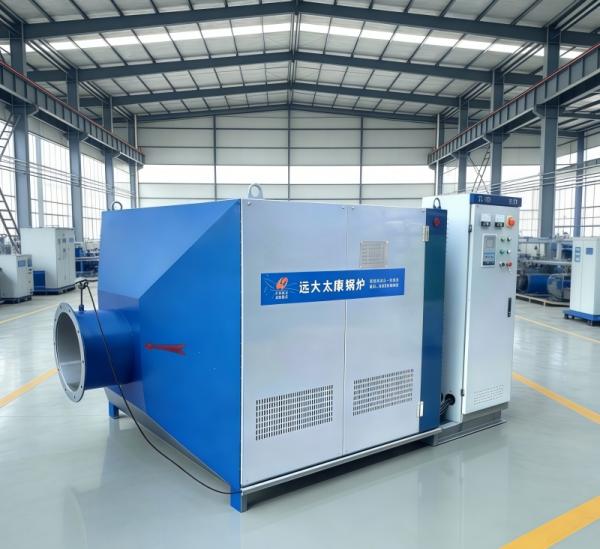
The same heat, two different sinks
A boiler leaves 15-25% of its fuel energy in the flue gas, and the tail-end heat recovery device exists to take some of it back. Two devices do the work: an economiser heats feedwater, and an air preheater heats combustion air. They draw from the same gas stream and they compete for the same temperature difference, so a plant usually fits one or the other, and sometimes both in series.
The choice is decided by what cold fluid is available, how cold it can be, and what the cold end of the device will do when the gas cools. Those three questions are more important than the quoted efficiency gain, because a device that corrodes or that has no heat sink saves nothing at all.
What the heat sink looks like
An economiser needs feedwater below the gas temperature, and the colder the better. A boiler with 20 °C make-up and no deaerator has an excellent sink; a boiler with 105 °C deaerated feed and high condensate return has almost none. The feedwater flow is also fixed by the boiler output, so the economiser’s duty is capped by the water: 4 t/h of water heated by 40 K absorbs 186 kW, and no amount of extra surface will absorb more unless the flow rises.
An air preheater needs combustion air, which is always available at ambient temperature and always colder than the feedwater. Its flow is set by the burner, about 10.5 Nm³ per Nm³ of gas, and its temperature rise is limited by the gas temperature and by the air-side pressure drop the fan can afford. In winter the air is colder and the preheater recovers more; in summer it recovers less, which is the opposite of the economiser’s behaviour with cold make-up.
Where the plant has a deaerator and returns most condensate, the air preheater is often the only device with a real sink. Where the plant runs on cold make-up with little condensate return, the economiser is the better choice, and it also reduces the oxygen load on the deaerator by warming the water first.
Cold end, dew point and corrosion
Both devices cool the gas, and both can push the cold end below the acid dew point. The difference is where the cold end sits. In an economiser it is the water inlet face, where the feedwater is coldest; in an air preheater it is the air inlet face, where the air is coldest. The air is usually colder than the feedwater, so the air preheater’s cold end is at greater risk, and its tubes are often the first to fail.
The countermeasure is the same in principle: keep the cold-end metal above the acid dew point with a margin, by bypassing part of the fluid, by recirculating, or by using a corrosion-resistant material at the cold end. ND steel or enamel-coated tubes are common in air preheaters; stainless or ND steel in economisers. The bypass must be controlled on metal temperature, not on a fixed position, because the risk changes with load and with ambient temperature.
For natural gas there is no acid dew point, and the constraint becomes the water dew point at 55-60 °C. A gas-fired boiler can run its economiser down to 60-70 °C without corrosion, and a condensing economiser below that with the right material and a drain. For oil, coal and biomass, the acid dew point at 120-160 °C governs, and the recovery is limited to cooling the gas to about 150-170 °C unless the cold end is protected.
Pressure drop, fan power and footprint
An economiser adds 250-350 Pa of gas-side resistance; an air preheater adds 150-300 Pa on the gas side and a similar figure on the air side, which the burner fan must overcome. The gas-side resistance is paid by the induced draught fan, and if that fan is already at its limit, the retrofit needs a new fan or a larger impeller, which can consume a third of the saving.
Footprint favours the economiser in a tight boiler house: it sits in the flue duct downstream of the boiler, with water connections and a drain. A tubular air preheater is bulkier, with two gas passes and two air passes, and it needs ductwork to and from the burner. Where space is short, the economiser wins before efficiency is even discussed.
There is also a combustion benefit to the air preheater that the economiser does not have. Warm combustion air stabilises the flame at low load, reduces the risk of a cold, smoky start, and can slightly improve burner turndown. On a boiler that cycles or runs at low load for long periods, that is worth as much as a point of efficiency.
Choosing, and combining
Where both a cold feedwater sink and space exist, fit the economiser first in the gas path and the air preheater after it. The water side takes the high-grade heat, the air heater works against the cooler gas, and the combination extracts more than either alone. This is the arrangement used on larger packaged boilers, and it is the reason a well-specified unit reaches 94-95% without condensing.
Where the feedwater is already hot, fit the air preheater alone. Where the flue gas is wet and the acid dew point is high, fit the economiser with a protected cold end and skip the air preheater, whose cold end would be colder still. Where the plant needs condensing gain, fit a condensing economiser against cold make-up and accept that the air preheater adds little at that point.
| Factor | Economiser | Air preheater |
|---|---|---|
| Heat sink | Feedwater, 20-104 °C | Combustion air, ambient |
| Duty limited by | Feedwater flow and temperature | Air flow and fan pressure |
| Cold-end risk | Water inlet face | Air inlet face, colder |
| Gas-side resistance | 250-350 Pa | 150-300 Pa plus air side |
| Footprint | Compact, in the duct | Larger, needs ductwork |
| Extra benefit | Feedwater warming, less deaeration | Flame stability at low load |
The payback calculation that decides
The saving is the heat recovered multiplied by the annual operating hours and the fuel price. For a 4 t/h gas boiler at 3.2 MW input with a 200 °C stack, cooling the gas to 150 °C recovers about 90 kW, or 2.8% of input. At 4,000 hours a year that is 360 MWh of gas, and the payback on a packaged economiser is usually one to two years. The air preheater recovers a similar amount but adds fan power, so its net saving is lower unless the fan is already sized with margin.
The calculation should include the cost of the fan upgrade, the ductwork, the bypass, the drain and the corrosion protection, not just the device. A retrofit that looks like an 18-month payback on the device alone can be a four-year payback installed, and that changes the decision. It should also include the maintenance: an economiser with fins needs cleaning, and a fouled economiser loses more than it saved.
The final choice is usually obvious once the heat sink is measured. If the feedwater is cold and the space is tight, the economiser is right. If the feedwater is hot and the burner would benefit from warm air, the air preheater is right. If both are true, fit both, in that order, and size the fans for the extra resistance from the start.


