

1-100 t/h (0.7-70 MW)
WNS Gas/Oil Steam Boiler, 1-100 t/h
Packaged three-pass wet-back fire-tube steam boiler for gas and oil, 1-100 t/h at 1.25 MPa, with matched modulating burner and ful...
View detailsA 3 t/h biomass boiler on coconut shell and wood waste supplies cooking and sterilising steam at a food plant in Metro Manila, with a bag filter for tight emissions limits.
The plant makes canned and retort foods in Metro Manila, where the air-quality permit is stricter than in the provinces. Steam is used for retorts, cooking kettles, a blancher and CIP, and the load is 1.8-2.4 t/h with a 2.8 t/h peak at retort start-up.
The boiler is a 3 t/h DZL chain-grate unit at 1.0 MPa, firing coconut shell with wood waste. The emissions train is the part the plant spent the most time on: a multi-cyclone followed by a pulse-jet bag filter, with continuous opacity monitoring and a 30 m stack.
Each retort takes a hard steam draw for 15-20 minutes, then holds. With four retorts the plant can see pressure sag if the boiler is small, so the 3 t/h unit is backed by a 3 m3 steam accumulator that releases flash steam during retort start-up. The accumulator lets the boiler stay at a steady 2 t/h while the retorts take their peaks.
At 3 t/h and 1.0 MPa the boiler absorbs about 2.1 MW. On coconut shell at 17 MJ/kg the fuel rate is about 470 kg/h, and the shell is bought from a copra processor two hours away.
| Item | Value |
|---|---|
| Rated evaporation | 3 t/h |
| Pressure | 1.0 MPa |
| Fuel | coconut shell, wood waste |
| Steam accumulator | 3 m3 |
| Dust control | multi-cyclone plus bag filter |
| Stack height | 30 m |
The plant’s water is municipal and softened to 0.03 mmol/L. Steam for retorts is indirect, but the plant still keeps TDS at 2,000 ppm and uses a food-grade oxygen scavenger. The steam header has a separator and the retort lines have their own traps and strainers.
The bag filter is the maintenance focus: differential pressure is logged daily, and a torn bag is replaced immediately because the opacity monitor will alarm. The plant keeps a full spare set of bags on site.
Installation took six weeks and commissioning eight days. The accumulator was commissioned with the boiler and proved its worth in the first week, when four retorts started together and header pressure fell only 0.03 MPa instead of the 0.15 MPa the old boiler allowed.
The plant’s steam cost is about 40% below the oil-fired baseline, and the boiler has passed two emissions inspections. The ash goes to a cement plant as a pozzolanic addition.
1-100 t/h (0.7-70 MW)
Packaged three-pass wet-back fire-tube steam boiler for gas and oil, 1-100 t/h at 1.25 MPa, with matched modulating burner and ful...
View details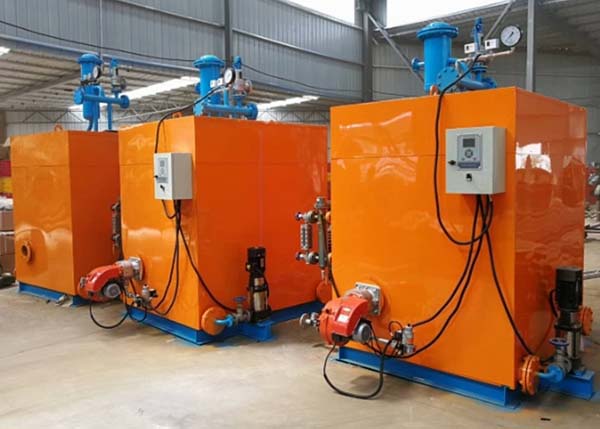
0.1-2 t/h
Multi-pass packaged steam generator, 0.1-2 t/h at 0.4-0.7 MPa, small water content and fast start for pressing, food and sterilizi...
View details
2-50 m³/h treated water
Softener and deaerator package for boiler make-up, holding hardness below 0.03 mmol/L and oxygen below 0.05 mg/L.
View details
1-20 t/h boiler equivalent
Finned tube economizers and tubular air preheaters for fire-tube, water-tube and thermal oil systems, with cold-end protection aga...
View detailsExternal links open the publisher’s website and are provided for background reading.
It stores hot water at saturation pressure and releases flash steam when retorts start, so the boiler sees a steady load instead of a spike.
The air-quality permit requires low particulate and visible emissions. A cyclone alone would not meet the opacity limit near housing.
Yes, it is mostly silica and is used as a cement additive or brick material, which offsets part of the disposal cost.
2024
Lahore, Pakistan
A 6 t/h chain-grate boiler burning coal and paper waste supplies drying steam at a paper mill in Lahore, with a bag filter and an...
View project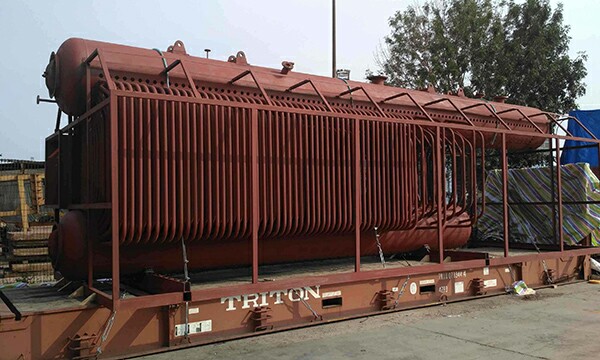
2023
Phnom Penh, Cambodia
3 t/h biomass steam boiler at 1.0 MPa on rubber wood, commissioned in 2023 in Phnom Penh, Cambodia: the factory shares a wall with...
View project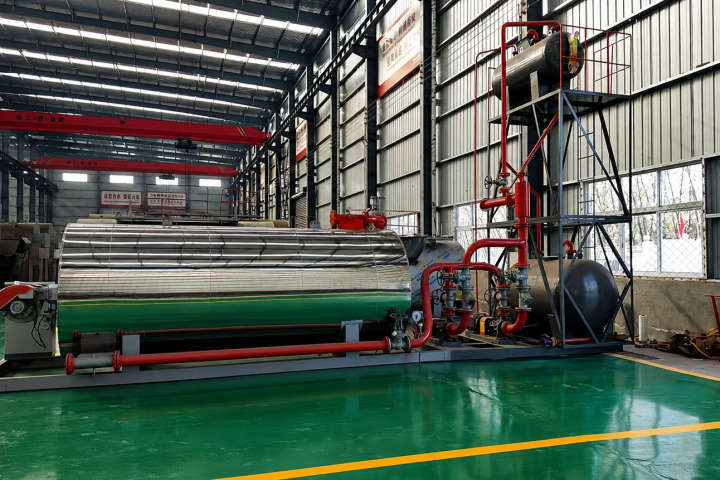
2024
Casablanca, Casablanca-Settat, Morocco
An oil-fired gas-conducting oil furnace was supplied for adhesive production in Casablanca, Morocco. The unit provides indirect hi...
View projectWe appoint one or two partners per country to quote, deliver and service our boilers locally. Territory protection, factory pricing and commissioning support are part of the agreement.